

Almost everything written about AI in 2027 is a guess. A notable amount of it is not: specific obligations with specific dates already exist in European law, they apply to anyone selling into that market, and they have been quietly rescheduled once already. Here is the difference between what is fixed and what is merely plausible.
The dates that are actually fixed
These are obligations in the EU AI Act. They are not projections, and they reach any company selling into the European market regardless of where it is based.
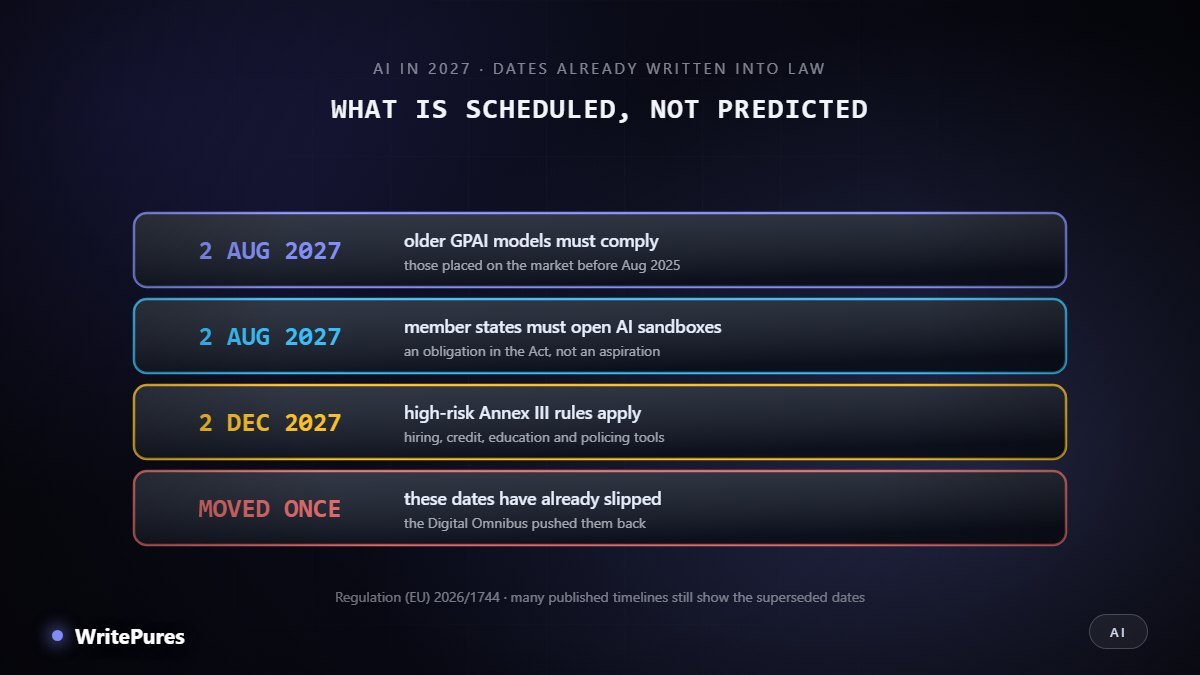
- 2 August 2027 — providers of general-purpose AI models placed on the market before 2 August 2025 must have brought them into compliance. Legacy models stop being grandfathered.
- 2 August 2027 — member states must have established AI regulatory sandboxes. An obligation on governments, not on companies, and worth watching because it determines where supervised deployment is practical.
- 2 December 2027 — obligations apply for standalone high-risk systems under Annex III: recruitment, credit scoring, education, law enforcement, border control.
That Annex III list is the one to read carefully. If you build hiring software, lending tools or anything that scores students, that date is a product deadline, not a legal footnote.
The detail most compliance guides get wrong
High-risk obligations used to fall in August 2027. The Digital Omnibus amendments — Regulation (EU) 2026/1744 — moved standalone Annex III systems to December 2027, and AI embedded in regulated products under Annex I all the way to August 2028.
A large number of published timelines still show the old dates. If you are working from a compliance guide written before mid-2026, check it against the Official Journal text before you build a plan on it.
What is a forecast, and should be labelled as one
Prices keep falling. Not guaranteed, but the evidence is strong: within one week of November 2026, OpenAI cut Astra's API price about 20%, Microsoft launched a model family positioned on cost, and Google launched Neon below its own flagship. Three labs competing on price in the same week is what a market looks like when capability differences at the top have stopped being decisive.
Capability timelines. Anthropic co-founder Jared Kaplan has estimated the risk of recursively self-improving AI arising between 2027 and 2030. That is an informed view from someone with deep knowledge and an obvious commercial interest in the field's importance. Treat it as neither prophecy nor marketing — just an opinion with a date attached.
The money. The Economist's World Ahead 2027 identifies AI-sector debt and the AI construction boom as pressures on government borrowing costs. That is a macro argument rather than a technology one, and it is a useful corrective: the most consequential AI story of 2027 may be financial rather than technical. Anthropic's record listing already carries about $900bn of committed compute spending, roughly $70bn of it inside twelve months. Those commitments are contractual. Whether the revenue arrives to meet them is the open question.
How to use this
Build your plan on the regulatory dates, because they are enforceable and they will not care whether you were ready. Treat everything about capability as a scenario, and prefer architectures that let you switch models cheaply — routing by task rather than committing to a provider — because the one thing the last month demonstrated conclusively is that the cheapest capable model changes faster than any procurement cycle.
And whenever you read a 2027 AI prediction, including this one, check whether the author is describing something that already has a date on it.
Written by the WritePures newsroom. Spotted something that needs updating? Tell our editors.
0 Comments
Join the conversation
Replying toNo comments yet. Be the first to share your thoughts.