

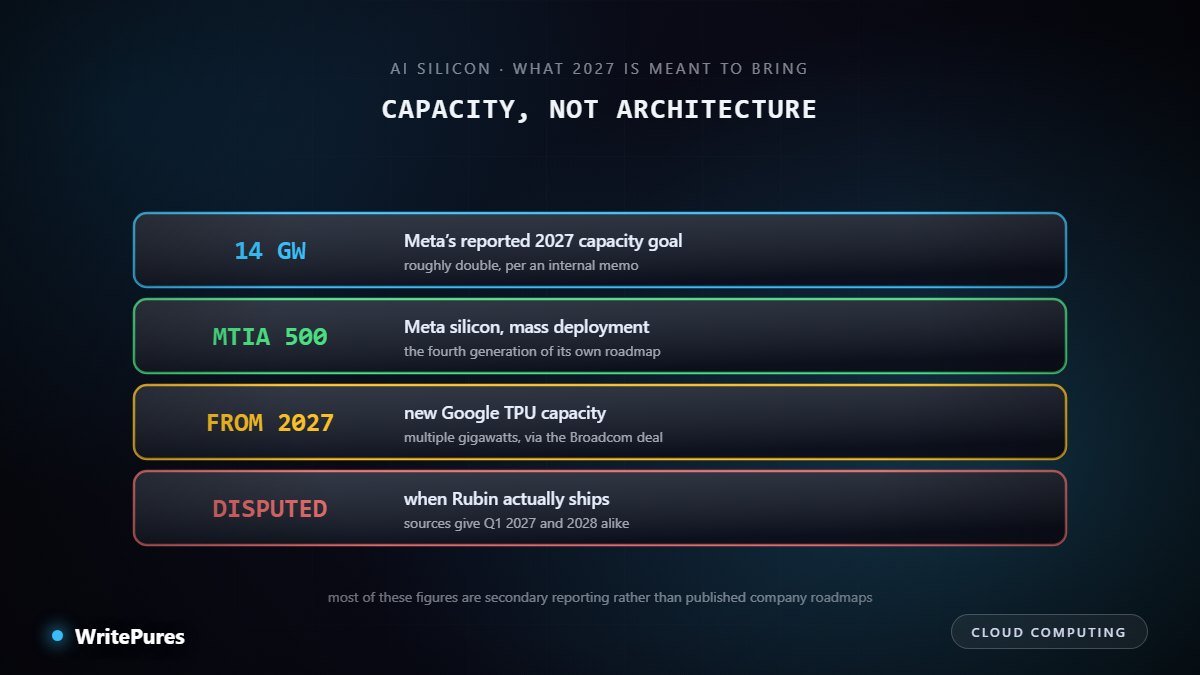
The interesting question about AI hardware in 2027 is not whose chip is fastest. It is how many gigawatts anyone can actually get built, powered and running — and on that question the published roadmaps disagree with each other about even the most basic dates.
What is reportedly committed
- Meta: about 14 gigawatts of AI data centre capacity by 2027, roughly double, per a reported internal memo — using both its own and purchased silicon.
- Meta MTIA 500 scheduled for mass deployment in 2027, the fourth generation of an in-house roadmap announced through the 300, 400 and 450 parts.
- Google TPU: an April 2026 agreement with Broadcom added multiple gigawatts of next-generation TPU capacity starting in 2027. Meta is reported as possibly buying TPU v7 outright from 2027 after leasing v6e.
- AMD: the Instinct MI500 series is placed in 2027, with the OpenAI agreement covering 6GW and the first gigawatt of MI450 from the second half of 2026.
A necessary caveat on all of it: most of these figures come from secondary reporting and analyst notes rather than published company roadmaps. Gigawatt targets in particular are the easiest number in this industry to announce and the hardest to verify.
The disagreement worth noticing
Nvidia's own timeline is reported inconsistently. One account has Vera Rubin shipping from August 2026 with Vera Rubin Ultra in 2027. Another puts Rubin general availability in Q1 2027 with the volume ramp later that year. Rubin HPC, announced at SC26, is separately stated as 2028 — as we covered in our comparison of that announcement against Google's TPUs.
These cannot all be right, and the discrepancy is not pedantry. If you are planning capacity around a part arriving in Q1 2027, a 2028 reality is a different budget year and possibly a different vendor.
Why gigawatts replaced FLOPS
The shift in how this race is measured tells you where the constraint moved. Nobody serious is short of chip designs. What they are short of is advanced packaging, high-bandwidth memory, grid connections and the physical ability to energise a building — the argument we set out in our piece on where the real bottleneck sits.
A target expressed in gigawatts is a statement about electricity and construction, not about silicon. That is why a company can announce a doubling of capacity and still be unable to buy what it wants: the chips are the easy part now.
What it means if you are buying
- Expect diversification to continue, driven by supply constraints rather than disappointment with Nvidia. Nvidia is projected to keep the majority of new training capacity through 2027 while losing share of net-new deployments.
- The real switching cost is software, not price per hour. Porting to a different stack is where the money goes, and a cheaper accelerator with a thin ecosystem is often more expensive overall.
- Capacity is contracted before it exists. Google has said available TPU capacity is already spoken for. Planning to rent frontier compute in 2027 on short notice is planning to be disappointed.
- Geopolitics is now a supply variable, not background noise — as the H200 halt and the wider semiconductor map both show.
Written by the WritePures newsroom. Spotted something that needs updating? Tell our editors.


0 Comments
Join the conversation
Replying toNo comments yet. Be the first to share your thoughts.