
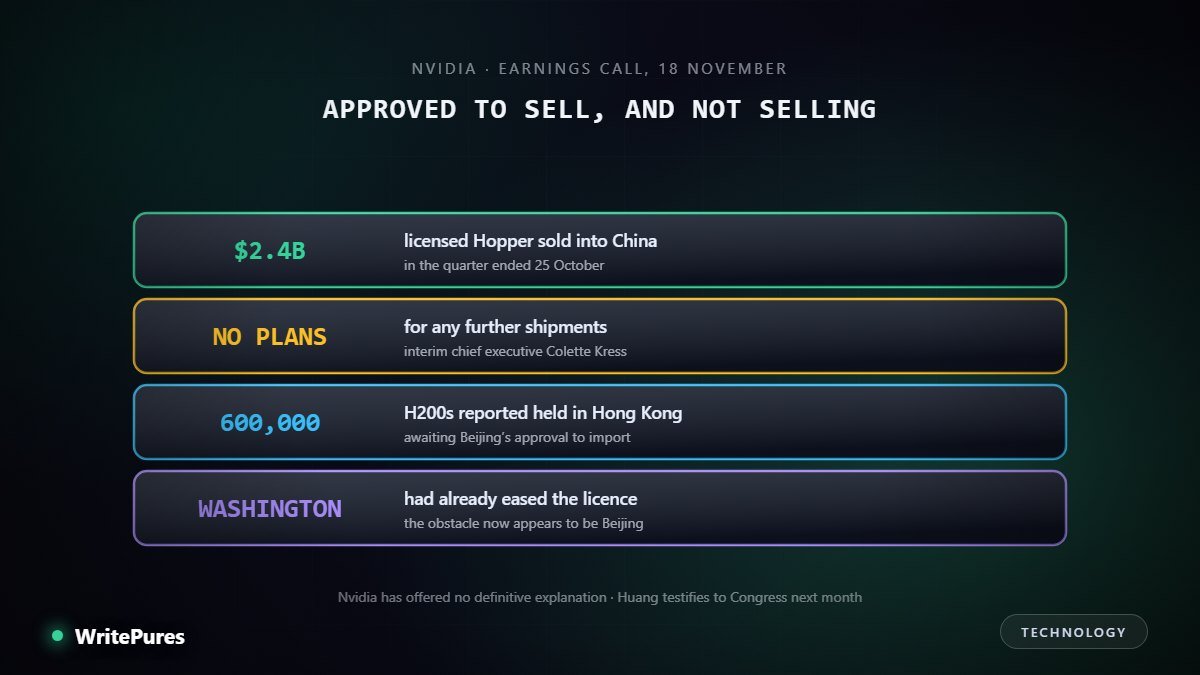
Nvidia has stopped shipping H200 and other licensed Hopper-generation chips to China — not because Washington blocked it, but apparently because Beijing has not let them in. Roughly 600,000 of the chips are reported to be sitting in Hong Kong, waiting.
What was said, and by whom
On the earnings call, interim chief executive Colette Kress said Nvidia sold $2.4 billion of licensed Hopper data centre products into China in the quarter ended 25 October, and that there are no current plans for further shipments.
That is a notable sentence to deliver about a market the company spent two years lobbying to keep access to.
The inversion worth understanding
For most of this decade the story of Nvidia and China has been the US government restricting what could be sold. In January, Washington eased its licensing policy for the H200, allowing export applications to be reviewed individually under security conditions. The constraint was lifted.
And the chips still are not moving. Reuters reported roughly 600,000 H200 units held in Hong Kong awaiting shipment to the mainland after Beijing withheld approval for large-scale imports.
So the blockage appears to have changed ends. Nvidia has offered no definitive explanation, and that absence is itself informative: a company does not usually decline to explain why it is not selling $2.4 billion a quarter of anything, unless the explanation is diplomatically awkward.
Why Beijing might not want them
The plausible readings are not mutually exclusive.
Industrial policy. China has invested heavily in domestic AI silicon. Allowing large-scale H200 imports would undercut exactly the domestic demand those programmes depend on.
Security. The US approval came with security conditions. Conditions acceptable to Washington are not automatically acceptable to Beijing, particularly for infrastructure intended for state-adjacent work.
Leverage. Export controls have been a negotiating lever for years. Declining to accept chips you were previously refused is a way of demonstrating that the lever no longer works.
All three point the same way: the assumption that Chinese demand for Nvidia silicon is a constant, and only US policy is variable, no longer holds.
What it means for the AI hardware market
If China's market closes from the inside rather than the outside, two things follow.
Nvidia loses a large addressable market permanently rather than temporarily, which is a materially different proposition for a company valued on growth. And Chinese domestic accelerators gain a protected home market — the single most effective subsidy available, and how several national semiconductor industries were built.
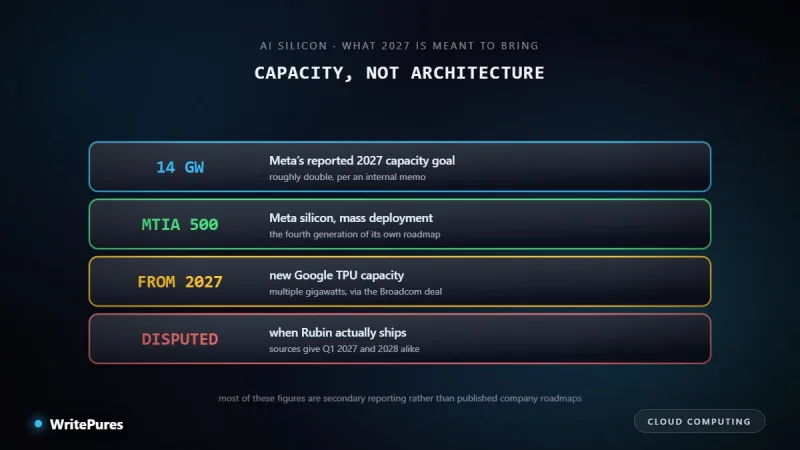
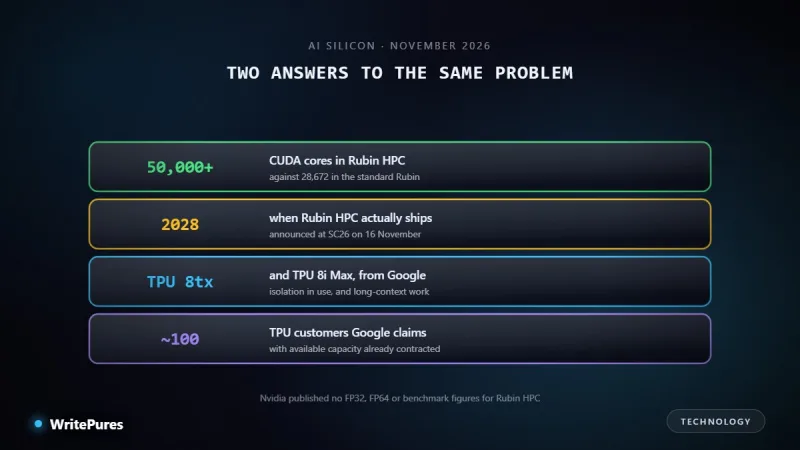
Set against the rest of the month, the picture is of a market reorganising rather than simply expanding: a science GPU announced for 2028 while Google ships TPUs now, hyperscalers building their own silicon, and the wider geopolitics of chip supply tightening on both sides.
The governance overhang
This lands with Nvidia already unsettled. Jensen Huang resigned on 12 November with no reason given, Colette Kress is running the company on an interim basis while remaining CFO, and lawmakers from both parties are pressing for more oversight of the China business. Huang is expected to testify to Congress next month.
An interim chief executive announcing the suspension of a market her predecessor fought to open, weeks before he testifies about it, is a lot of unresolved threads in one quarter. The China question will not be settled by the earnings call.
Written by the WritePures newsroom. Spotted something that needs updating? Tell our editors.
Related reading
- California Subpoenas Nvidia Over Chips Reaching China — the investigation that followed, one day later

0 Comments
Join the conversation
Replying toNo comments yet. Be the first to share your thoughts.