

Generative AI is the technology behind ChatGPT, Claude, Gemini, image generators and the coding assistants that now write a visible share of the world's software. Underneath all of it is a single mechanism that is far simpler than the output suggests — and understanding it tells you, more reliably than any feature list, where the technology will work and where it will let you down.
The one-sentence version
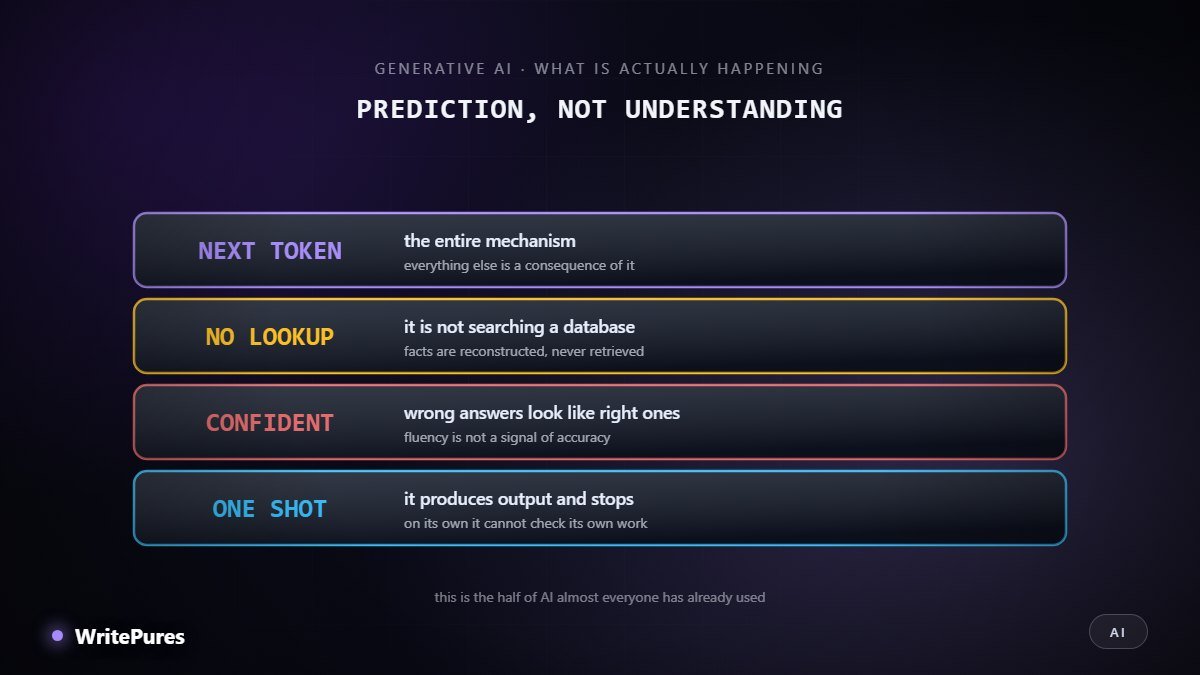
A generative model predicts what comes next.
Given some text, it produces the most likely next fragment. Then it looks at everything including that fragment, and produces the next one. Then again. That loop, run thousands of times, is how an essay, a function or a legal summary gets written.
Everything people find remarkable or alarming about these systems follows from that mechanism.
What a token is
Models do not work in words. They work in tokens — chunks that are often a word, sometimes part of one, sometimes punctuation. "Understanding" might be two tokens; "the" is one.
This is worth knowing because it explains odd behaviour. Models are historically poor at counting letters in a word or doing arithmetic character-by-character, and that is not stupidity — they genuinely do not see individual letters. They see tokens.
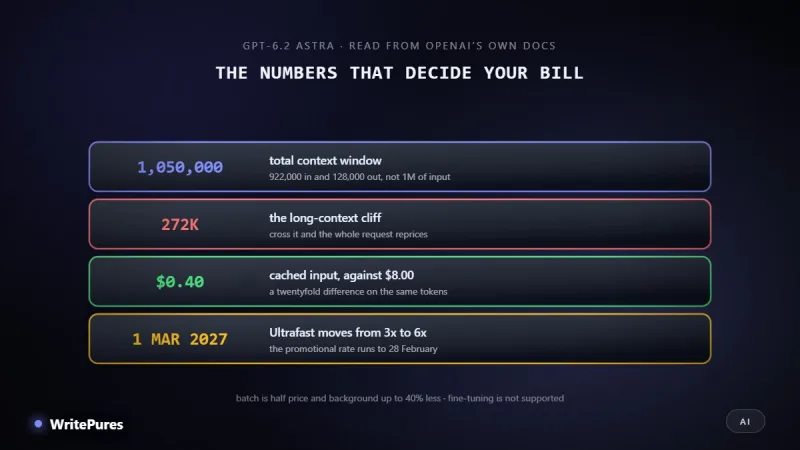
It is also how you are billed. API pricing is per million tokens, which is why the economics of a model's context window and caching matter as much as its intelligence.
Where the knowledge comes from
Training is the process of adjusting billions of internal numbers so that the model's predictions match real text. Show it enough of the internet, books and code, and to predict well it has to encode an enormous amount about grammar, facts, reasoning patterns and style.
Two consequences that matter in practice.
There is a cutoff. The model knows nothing after its training data ends. GPT-6.2 Astra, for instance, has a stated knowledge cutoff of 18 May 2026. Ask about anything later and it either says so or guesses.
There is no database. This is the part that surprises people most. The model is not storing documents and looking things up. Facts are reconstructed from statistical patterns, which is why it can state a real fact perfectly and then produce a citation that does not exist — both were generated the same way.
Why it invents things, stated properly
"Hallucination" makes it sound like a malfunction. It is the mechanism working exactly as designed.
The model's job is to produce a plausible continuation. When it knows the answer, the plausible continuation is the true one. When it does not, there is no internal signal saying "I lack this" — it produces the most plausible text anyway.
From the outside, those two cases look identical. Same confidence, same fluency, same tone. That is the genuinely dangerous property, and it is why "it sounded certain" is worth nothing as evidence.
Mitigations exist — giving the model your actual documents to work from, as in our tutorial on retrieval over your own files, is the most effective — but nothing removes it entirely.
Context: the model's short-term memory
Everything the model can consider is in its context window: your prompt, the conversation so far, any documents you pasted. Outside that window, it has no awareness at all.
Two implications people get wrong. A new conversation starts from nothing — the model does not remember you. And a long document pasted into the window is not "learned", it is simply visible for that request.
What it is good at, and what it is not
Reliably good: rewriting and summarising, translation, extracting structure from messy text, classification, drafting, explaining code, and generating the obvious parts of anything.
Unreliable: precise facts and figures, citations, arithmetic, anything after the cutoff, long chains of dependent reasoning, and knowing what it does not know.
A useful rule: it is strong where plausible and correct coincide, and weak where they can diverge without the text looking any different.
The limitation that leads to part two
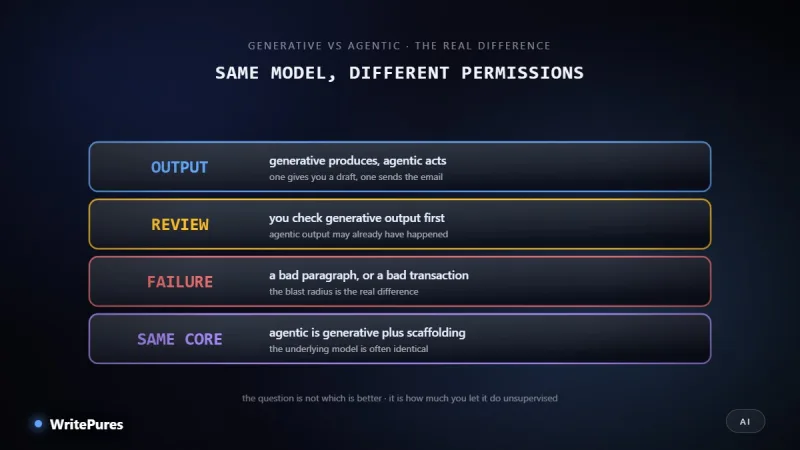
A generative model produces output and stops.
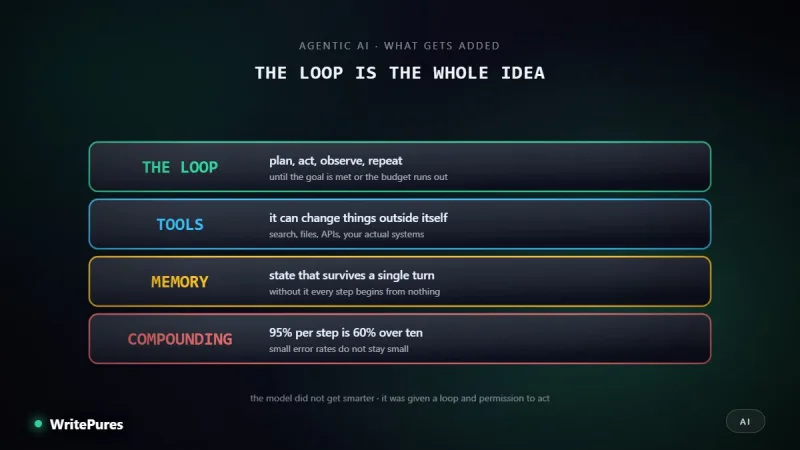
It cannot run the code it wrote to see whether it works. It cannot check a fact it was unsure about. It cannot do step one, look at the result, and adapt step two. Each response is a single shot, from a fixed context, with no way to act on the world and observe what happened.
Giving it that ability is what turns generative AI into agentic AI — and that is both the whole advance and the whole risk.
Written by the WritePures newsroom. Spotted something that needs updating? Tell our editors.
0 Comments
Join the conversation
Replying toNo comments yet. Be the first to share your thoughts.