

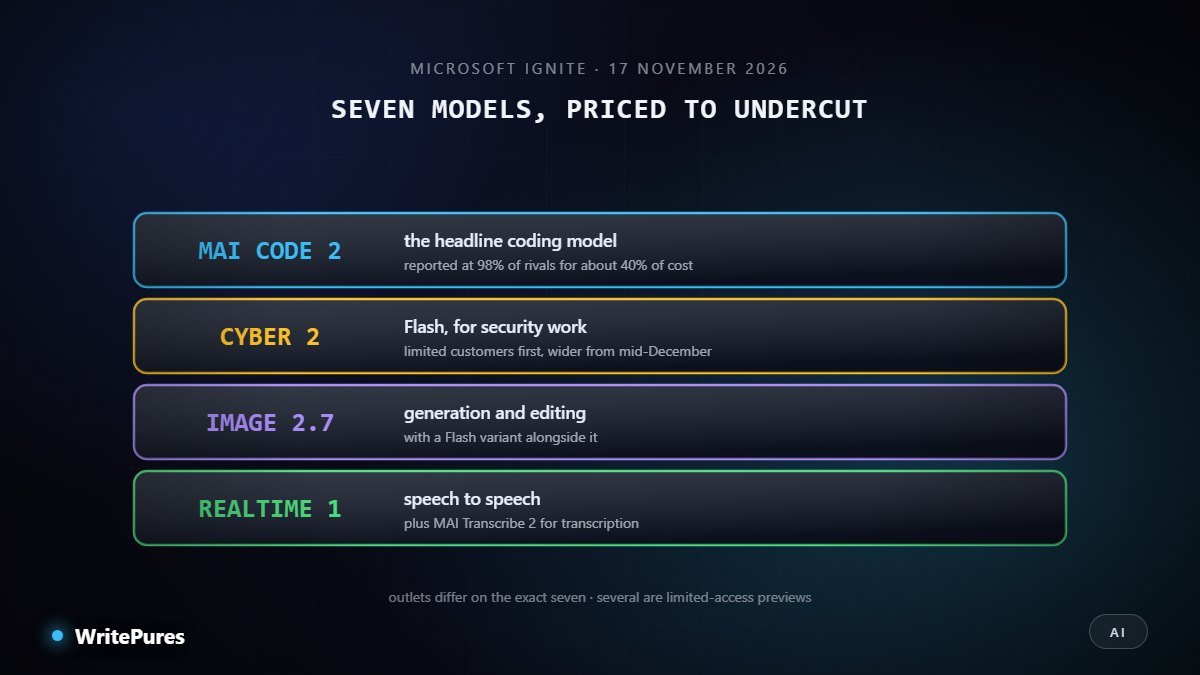
Microsoft announced seven of its own MAI models at Ignite on 17 November, covering coding, cybersecurity, image generation and speech. The pitch is not that they beat the frontier labs. It is that they cost a fraction as much — which, in a week when OpenAI and Google both cut prices, is the clearest signal yet of where this market has moved.
What was announced
- MAI Code 2 — the headline model, for everyday enterprise coding. Microsoft reports it at about 98% of competing models' performance for roughly 40% of the cost.
- MAI Code 2 Flash — lighter and faster, for high-volume work. Limited-access preview in Microsoft Foundry.
- MAI Cyber 2 Flash — security work, going to a limited group of customers first.
- MAI Image 2.7 and a Flash variant — generation and editing.
- MAI Realtime 1 — speech to speech, via MAI Labs.
- MAI Transcribe 2 — transcription.
A caution on that list: outlets disagree on which seven models count. Some include Microsoft's Maia 200 accelerator, and names vary between reports. Treat the lineup as reported rather than settled, and check Microsoft's own release before writing anything into a procurement document.
The strategy, which is the actual story
Microsoft is OpenAI's largest commercial partner and resells its models throughout Azure. Shipping an in-house family that competes on cost with those same models is not a small decision.
The logic is straightforward once you look at where enterprise AI spend goes. Most of it is not hard reasoning — it is bulk work: code completion, log triage, transcription, summarisation. Paying frontier prices for that is waste, and whoever supplies the cheap tier captures enormous volume. MAI Code 2 at roughly 40% of the cost is aimed precisely there.
It also reduces Microsoft's dependence on a single supplier, which has obvious appeal for a company whose AI strategy is otherwise built on one partnership.
The week in context
Three price-led launches in five days:
- 17 Nov — GPT-6.2, with Astra's API price cut about 20%.
- 17 Nov — Microsoft's MAI family, explicitly positioned on cost.
- 18 Nov — Gemini 4 Neon, launched below Carbon with an introductory rate.
None of them led on capability. That is what a market looks like when the gap at the top has narrowed enough that buyers will switch over price — and it is good news for anyone building, provided you architect for it. The sensible pattern is routing by task rather than committing to one provider: cheap models for volume, expensive ones only where being wrong is costly.
What to be careful about
Every performance and cost figure above is Microsoft's own, unreproduced by anyone independent — the same caveat that applies to OpenAI's and Google's launches this week. "98% of performance" is also doing a lot of work as a phrase: on which tasks, measured how, and is the missing 2% concentrated in exactly the hard cases you were hoping to automate?
And several of these are not generally available. A limited-access preview is not a product you can plan a quarter around.
Written by the WritePures newsroom. Spotted something that needs updating? Tell our editors.
0 Comments
Join the conversation
Replying toNo comments yet. Be the first to share your thoughts.