
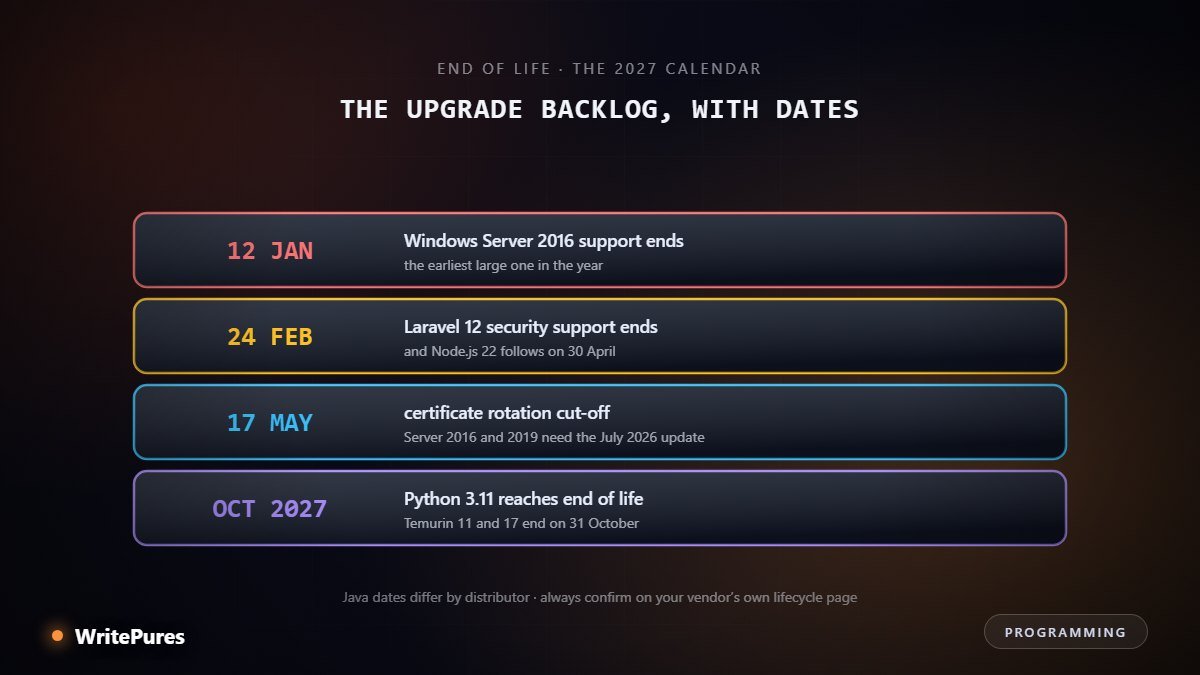
Year-ahead pieces usually deal in trends. This one deals in dates you can put in a sprint planning document. Four widely-used platforms reach end of life during 2027, the first one lands twelve days into January, and one of the deadlines is not an end-of-life date at all — which is why it is the one most likely to hurt.
The 2027 calendar
- 12 January — Windows Server 2016 end of support.
- 24 February — Laravel 12 security support ends.
- 30 April — Node.js 22 end of life.
- 17 May — certificate-rotation cut-off for Windows Server 2016, Server 2019 and Windows 10 Enterprise 2019 LTSC.
- September — earliest end of support for Microsoft's builds of OpenJDK 11 and 17.
- October — Python 3.11 end of life.
- 31 October — Eclipse Temurin 11 and 17.
For context on what is already gone: Python 3.10 ended on 1 October 2026 with no further security releases, and .NET 8 and 9 are reported as ending 10 November 2026. If you are on any of those, the deadline is behind you.
The one that will catch people out
17 May.
It is not an end-of-support date, which is precisely the problem — it will not show up on an EOL tracker or in a lifecycle dashboard. Reporting indicates Windows Server 2016, Server 2019 and Windows 10 Enterprise 2019 LTSC need the July 2026 update installed before that date, as part of a certificate rotation.
A machine that misses a certificate rotation is not in the same position as a machine that missed a patch. Install the update now, on everything in scope, and verify it rather than assuming your patch management caught it.
Why Java has no single answer
There is no one Java end-of-life date and anyone who gives you one is guessing. Oracle sells support in tiers; every OpenJDK distributor publishes its own calendar. Eclipse Temurin 11 and 17 are listed at 31 October 2027. Microsoft's builds of OpenJDK 11 and 17 have an earliest end of support in September 2027. Oracle JDK 17 premier support ended in September 2026 with extended support to 2029.
So the question is not "when does Java 17 die" but "whose JDK is in our container image". Teams frequently cannot answer that quickly, which is the real finding — and the same gap that made this month's Java4Shell flaw hard to scope. The organisations that handled that well were the ones who could list what they run, where, and on what, in minutes.
How to approach this
- Inventory first. Runtimes, framework versions, base images, server builds. You cannot plan migrations you cannot enumerate.
- Book the January work in 2026. Windows Server 2016 ends twelve days into the year. Starting in January is starting late.
- Do the 17 May update now. It is the cheapest item on this list and the most expensive to miss.
- Confirm every date with the vendor. The dates here come from lifecycle trackers, which are aggregators and are not always consistent. Microsoft Learn, devguide.python.org and your JDK distributor's roadmap are the authorities.
- Treat unsupported as exploitable. An end-of-support date is the day your platform stops getting security fixes, and attackers read these calendars too. Patch strategy only works on software that still receives patches.
Written by the WritePures newsroom. Spotted something that needs updating? Tell our editors.
0 Comments
Join the conversation
Replying toNo comments yet. Be the first to share your thoughts.