
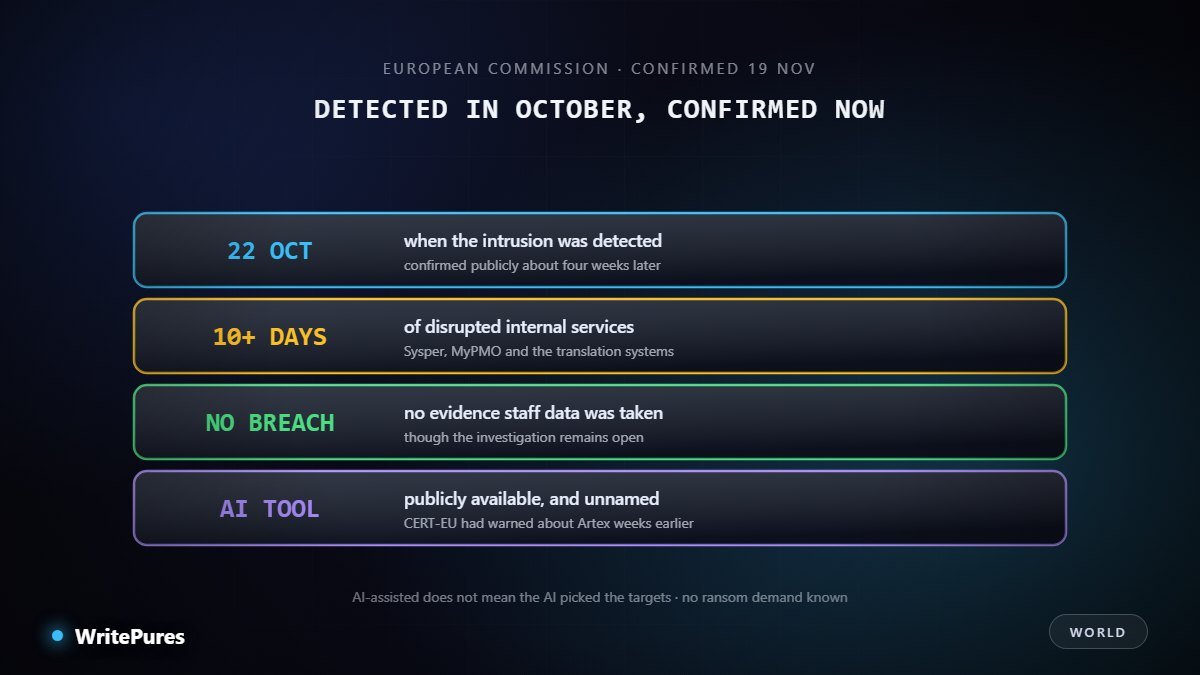
The European Commission has confirmed that it was the target of an AI-assisted cyberattack which disrupted internal systems for more than ten days. The intrusion was detected on 22 October. The confirmation came on 19 November — a gap of nearly four weeks between discovery and public acknowledgement.
What is confirmed
- Detected 22 October. An investigation was opened immediately.
- Services disrupted for over ten days, including Sysper (the HR platform), MyPMO (medical reimbursement) and the Commission's translation systems. External services such as Outlook reportedly continued working.
- A publicly available AI tool was used, according to spokesperson Thomas Regnier, who did not name it.
- No evidence of a staff data breach has been detected, and the Commission says it is not aware of a ransom demand. The European Data Protection Supervisor has been notified.
- No attribution to any known group.
Most affected services have since been restored. The investigation remains open and the full extent of the damage is still unclear.
Two things being reported as more certain than they are
The tool. Several outlets name Artex. The Commission did not. What is true is that CERT-EU warned about the Artex penetration-testing framework roughly two weeks before this confirmation, and that the FBI issued its own advisory about Artex intrusions on 16 November, which we covered in our report on that advisory. That is a plausible adjacency, and it is not the same as the Commission saying so.
The meaning of "AI-assisted". The phrase is doing a lot of unexamined work. It could describe an AI tool automating reconnaissance and exploitation under human direction, which is what the FBI described for Artex, or something closer to autonomous target selection. The Commission has not specified the tool's role, so the honest reading is narrow: AI tooling was used somewhere in the chain.
There is also tension on the data question. The Commission says it has found no evidence of a staff data breach; some reporting suggests large amounts of data may have been compromised. Those are not necessarily contradictory — "no evidence found so far" and "data was taken" can both be true during an open investigation — but the Commission's wording is a status report, not a conclusion.
The four-week gap
The interval between detection on 22 October and confirmation on 19 November is the detail most worth sitting with. A ten-day disruption to HR and medical reimbursement systems was visible to thousands of staff throughout. The institution did not publicly characterise it until a month later, and the reporting appears to have arrived first.
This is not unusual in incident response, where organisations prefer to understand an intrusion before describing it. It is still a reminder that public confirmation tends to lag reality by weeks, and that an institution saying nothing is not evidence that nothing happened.
Why this one matters beyond Brussels
The European Commission is a well-resourced institution with a dedicated CERT that had already circulated a warning about the class of tooling involved. It was disrupted for over ten days anyway.
That tracks with what the FBI described: these intrusions are not especially stealthy, they are fast, and defences built around human-paced triage arrive after the fact. It is the third story this month, alongside the Optimizely compromise and the poisoned Microsoft package on PyPI, where the defining feature is speed and trusted access rather than any novel exploit.
Written by the WritePures newsroom. Spotted something that needs updating? Tell our editors.
0 Comments
Join the conversation
Replying toNo comments yet. Be the first to share your thoughts.