

GPT-6.2 Astra is OpenAI's heavyweight model, released on 17 November 2026 for demanding work in science, law and finance. Most coverage of it reported the price cut and the benchmark claims. Almost none of it covered what the model actually supports, where its limits sit, or the three pricing rules that decide whether it is affordable — so this is that article, read from OpenAI's own documentation rather than from the coverage.
The specification
| Model ID | gpt-6.2-astra |
|---|---|
| Context window | 1,050,000 tokens |
| Maximum input | 922,000 tokens |
| Maximum output | 128,000 tokens |
| Knowledge cutoff | 18 May 2026 |
| Input | Text and images |
| Output | Text only |
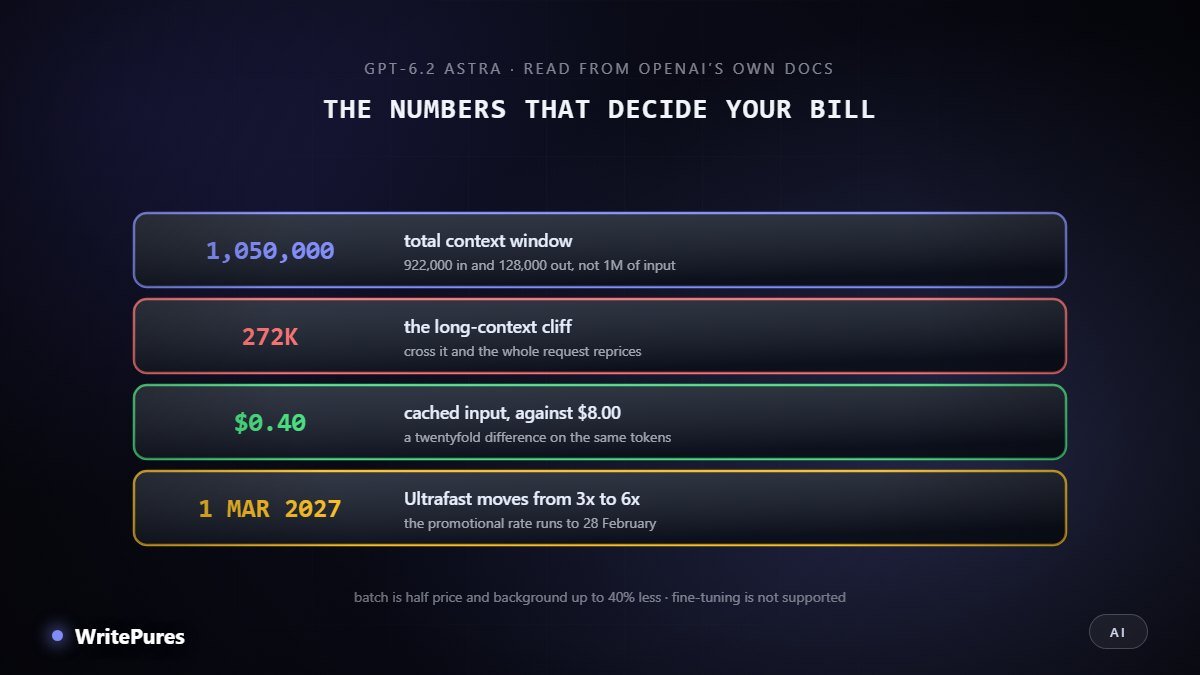
The first thing worth noticing is that the context window is not a million tokens of input. It is 1,050,000 total, split into 922,000 in and 128,000 out. Plenty of write-ups round this to "1M context" and leave readers to discover the difference when a large document set is rejected.
Audio and video are not supported on either side.
What it can do
Supported: streaming, structured outputs, function calling, file search, image input, web search, prompt caching.
Not supported: fine-tuning, predicted outputs. If your plan depended on fine-tuning Astra, it does not exist.
Through the Responses API it supports a wider tool set: web search, file search, image generation, code interpreter, hosted shell, apply patch, skills, computer use, MCP and tool search. There is also a multi-agent beta in the Responses API for delegating to subagents, and discounted background completion windows in public beta.
Endpoints: Chat Completions, Responses and Batch. Not Realtime, not Assistants, not fine-tuning, and none of the image, video or audio endpoints.
On reasoning: the model supports reasoning tokens, and the API rejects
requests that set reasoning effort to none. Artificial Analysis
publishes separate scores by effort level, putting Astra at 62 on its index at
maximum effort and 57 at medium — a reminder that "Astra" is not one
performance point but a dial you are paying for.
The three rules that decide your bill
1. Cached input is twenty times cheaper
Standard rates per million tokens: $8.00 input, $0.40 cached input, $40.00 output.
That is a twentyfold difference on the same tokens. Cache writes cost $10.00 for 30-minute retention and $20.00 for 12-hour retention, so caching pays for itself quickly on any workload that re-sends the same system prompt, document or schema. If you send a large fixed context repeatedly and are not caching, that is the single largest saving available to you.
2. The 272K cliff reprices the whole request
Short context means 272,000 input tokens or fewer. Above that:
- Input and cache rates double — $16.00 and $0.80.
- Output is charged at 1.5× — $60.00.
The important detail: the higher rates apply to the entire request, not just the tokens above the line. A request at 280,000 input tokens is not slightly more expensive than one at 270,000 — every token in it reprices.
So the 922,000-token ceiling is real but expensive. If you can keep a job under 272K by chunking or retrieval rather than stuffing the window, that is usually the cheaper architecture by a wide margin.
3. Speed tiers multiply, and one changes on a fixed date
- Batch — half the standard rate. $4.00 / $0.20 / $20.00.
- Background — eligible requests are 30% below standard on a two-hour completion window, 40% below on an eight-hour window.
- Fast (renamed from Priority processing in July 2026) — double. $16.00 / $0.80 / $80.00.
- Ultrafast — three times the standard rate through 28 February 2027, then six times from 1 March 2027.
Put a note in your calendar for that last one. Anything built on Ultrafast pricing doubles in cost on 1 March 2027, and a promotional rate expiring is the kind of change that shows up on an invoice rather than in a release note.
One more: regional processing for data residency carries a 10% uplift for models released on or after 5 March 2026, which includes this one.
Using it well
- Cache the fixed part of every prompt. Twenty times cheaper is not an optimisation, it is the difference between viable and not.
- Stay under 272K unless you genuinely cannot. Retrieval beats window-stuffing on cost, and usually on quality too.
- Batch anything that is not interactive. Half price for work nobody is waiting on.
- Use the reasoning dial deliberately. Maximum effort costs more and is not always better; measure on your own task rather than on a public index.
- Route, do not commit. Reserve Astra for work where being wrong is expensive and send the volume elsewhere — the point we made in our report on the launch and again when Microsoft and Google both launched on price in the same week.
About access in the ChatGPT app
This is the one thing worth being honest about rather than confident. Reports of where Astra appears disagree with each other — some describe it in ChatGPT Work and Codex for paid tiers, others describe different behaviour in ordinary chats on different plans. Roll-outs also change week to week.
Everything else in this article comes from OpenAI's own model and pricing pages and should hold. For app access on your specific plan, check OpenAI's help pages rather than any third-party summary, this one included.
Written by the WritePures newsroom. Spotted something that needs updating? Tell our editors.
0 Comments
Join the conversation
Replying toNo comments yet. Be the first to share your thoughts.