
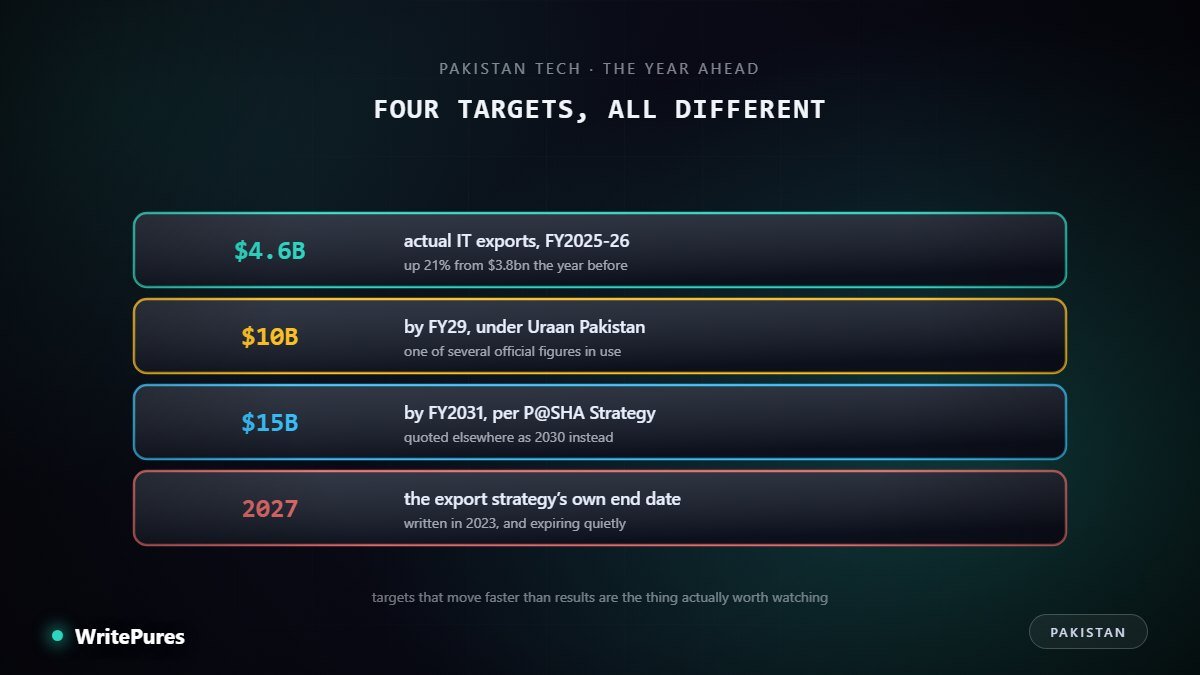
Pakistan's IT exports reached a record $4.6 billion in FY2025-26, up about 21%. That is genuinely good. It is also the only number in this article that everyone agrees on — because the official targets for where the sector is heading contradict each other by years and billions.
The number everyone agrees on
- $4.6 billion in IT and IT-enabled services exports for FY2025-26, a record.
- Up about 21% from $3.8 billion in FY2024-25.
- $417 million in July 2026 alone, up 18% year on year.
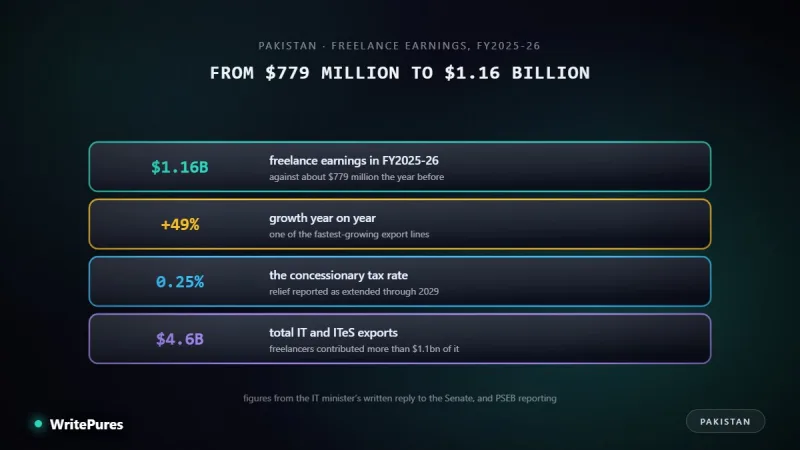
- More than $1.1 billion of the total from freelancers, whose own earnings we covered in this week's report on the FY26 figures.
Growth of a fifth, in a sector needing no imported raw materials and no reliable grid beyond laptops and connectivity, is the most encouraging economic line Pakistan has.
The targets, which do not agree
Depending on which official source you read, Pakistan is aiming for:
- $10 billion by FY29, under the Uraan Pakistan framework.
- $15 billion by FY2031, under P@SHA's Strategy 2031.
- $15 billion by 2030, in other government statements.
- $10-18 billion by 2028, under an older PSEB roadmap.
- $30 billion, as a broader ICT ambition.
These are not variations on one plan. $10bn by FY29 and $15bn by FY2031 imply very different growth rates, and $10-18bn by 2028 is arithmetically difficult from $4.6bn today — it would require roughly tripling in two years.
Why it matters practically: a company deciding whether to build an export business here, or an investor deciding whether to fund one, reads targets as a signal of what the state will actually support. Five numbers signal that nobody is being held to any of them.
What expires in 2027
The Software Development Export Strategy 2023-2027, prepared with P@SHA and the Ministry of Commerce, reaches the end of its window next year.
That is the most useful date in this article. A strategy reaching its end date is the natural moment to publish what it set out to do and what happened — and it is exactly the moment such documents usually pass without comment, while a new one is launched with fresh numbers. Whether anyone audits the 2023-2027 strategy before announcing its successor is a reasonable test of whether the targets mean anything.
The regulation that starts to bite
Several frameworks finalised or drafted in late 2026 become practical questions during 2027:
- The satellite in-flight connectivity licensing framework, finalised this month, which still has no named licensee, timeline or price.
- The draft IoT-LPWAN licensing regulations, where the routing requirement matters far more to architecture than the Rs 2,000 fee.
Both follow the same pattern: permit the technology, require it to terminate through licensed local infrastructure. And both face the precedent of satellite internet, where six firms have registered and still cannot sell. In Pakistan the gap between a framework existing and a service being purchasable has repeatedly been measured in years, so "the rules exist" is not the same as "the service arrives in 2027".
The question underneath all of it
Export growth of 21% is real, and most of it is still services — selling hours, whether through firms or freelancers. That scales linearly: double the revenue, roughly double the people.
No official target distinguishes between $15 billion of billed hours and $15 billion that includes products earning while their creators sleep. Those are completely different economies with completely different durability, which is the case we made in our argument for moving from gigs to products and IP.
The number to watch in 2027 is not the export total. It is whether any meaningful share of it starts coming from products.
Written by the WritePures newsroom. Spotted something that needs updating? Tell our editors.
0 Comments
Join the conversation
Replying toNo comments yet. Be the first to share your thoughts.