
A number of large US banks have quietly rewritten their customer agreements so that if a third-party AI agent moves money out of your account, the loss is yours. Citi, PNC and Citizens are the most recent, following earlier changes elsewhere. The clauses are short, the implications are not, and the legal position is untested.
What is reported to have changed
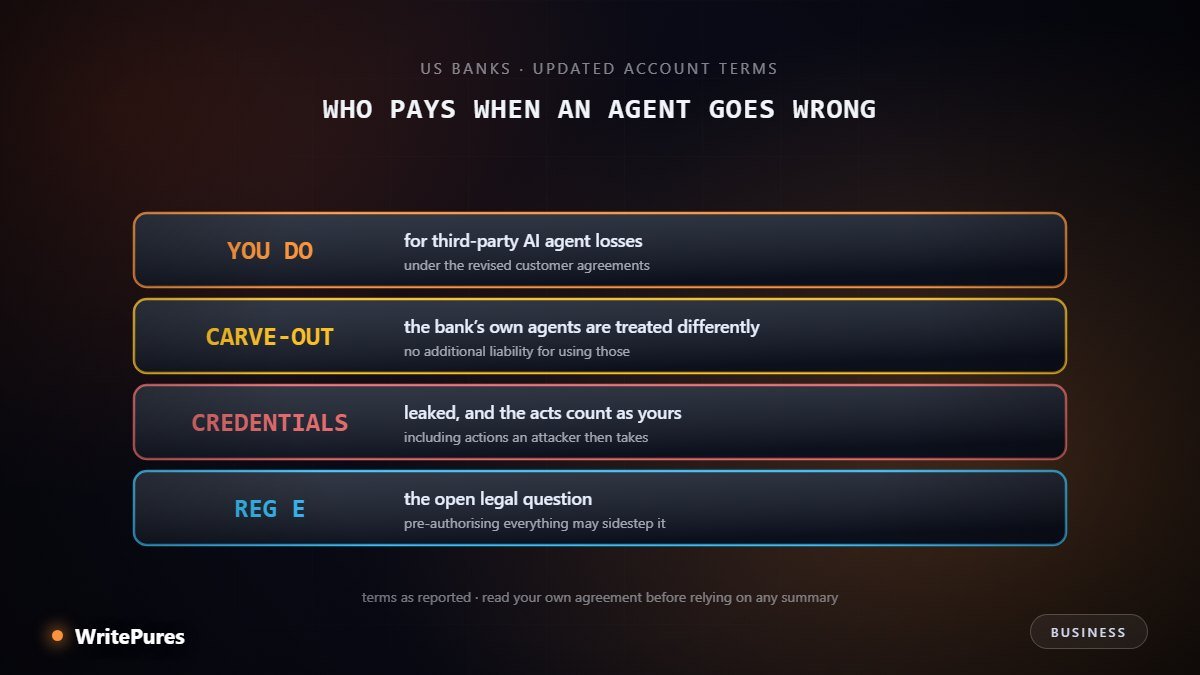
The common shape: activity performed by a third-party AI agent on your account is treated as authorised by you. If that agent moves money, makes a payment, or is manipulated into doing so, the resulting loss sits with you rather than the bank.
Two details sharpen it considerably.
The bank's own agents are carved out. Citi's terms are described as creating no additional liability for customers using Citi's own AI agents. The shift targets external tools.
Leaked credentials may count as your authorisation. Reporting describes customers being answerable for actions taken through their accounts if credentials are compromised — including actions taken by an attacker. If that is what the language says, it is the most consequential part by a wide margin, because it reaches well beyond anyone who deliberately connected an AI tool.
Why banks are doing this
The position is not unreasonable from their side. An AI agent acting on your behalf presents valid credentials and makes requests that look legitimate. The bank cannot readily distinguish an agent you authorised from an agent that was manipulated, or from an attacker using the same credentials.
Agents are also newly vulnerable in ways the industry has not solved. Prompt injection — hostile instructions hidden in content the agent reads — can make an agent take actions its user never intended. Nobody has a reliable defence. Faced with that, banks are allocating the risk to the party who chose to connect the tool.
The difficulty is that the clause as described does not stay neatly inside that rationale. It reaches customers who never connected anything.
The Regulation E question
Regulation E governs electronic fund transfers in the US and limits consumer liability for unauthorised transactions. The argument commentators have raised is structural: if a contract defines everything an agent does as authorised by you, the transaction is no longer unauthorised, and the protection never engages. The dispute is settled before it starts, by definition rather than by evidence.
Whether that holds is genuinely unknown. Consumer protection regulations are not usually waivable by contract, and a clause attempting it may not survive scrutiny. But no regulator has ruled and no court has tested it, so the honest answer is that nobody knows — and in the meantime the terms are what your bank will point to.
What to do
- Read the emails you have been ignoring. These changes arrive as routine terms-update notices. Citizens reportedly notified customers by email.
- Do not give banking credentials to third-party AI tools — including browser agents and assistants that offer to manage your finances. Under these terms, whatever follows is yours.
- Protect the credentials themselves. If leaked credentials really do transfer liability, then credential security stops being hygiene and becomes financial exposure. Phishing-resistant authentication matters more than it did last month — which is why banks have been moving off OTPs is worth reading alongside this.
- Prefer official integrations where you want automation. The carve-out for banks' own agents is not generosity; it reflects where they are willing to carry risk.
The wider point
This is the first large-scale instance of an industry allocating the cost of AI agent failure to consumers, and it has happened through terms-of-service updates rather than legislation or public debate.
The sector best placed to assess the risk of autonomous agents has looked at it and declined to carry it. That judgement is worth noting on its own, quite apart from whether the clauses hold up. It is also a reasonable prompt to ask the same question of every AI tool you have granted access to something that matters, as the week's Muse permissions story illustrates from the other direction.
Written by the WritePures newsroom. Spotted something that needs updating? Tell our editors.
0 Comments
Join the conversation
Replying toNo comments yet. Be the first to share your thoughts.