
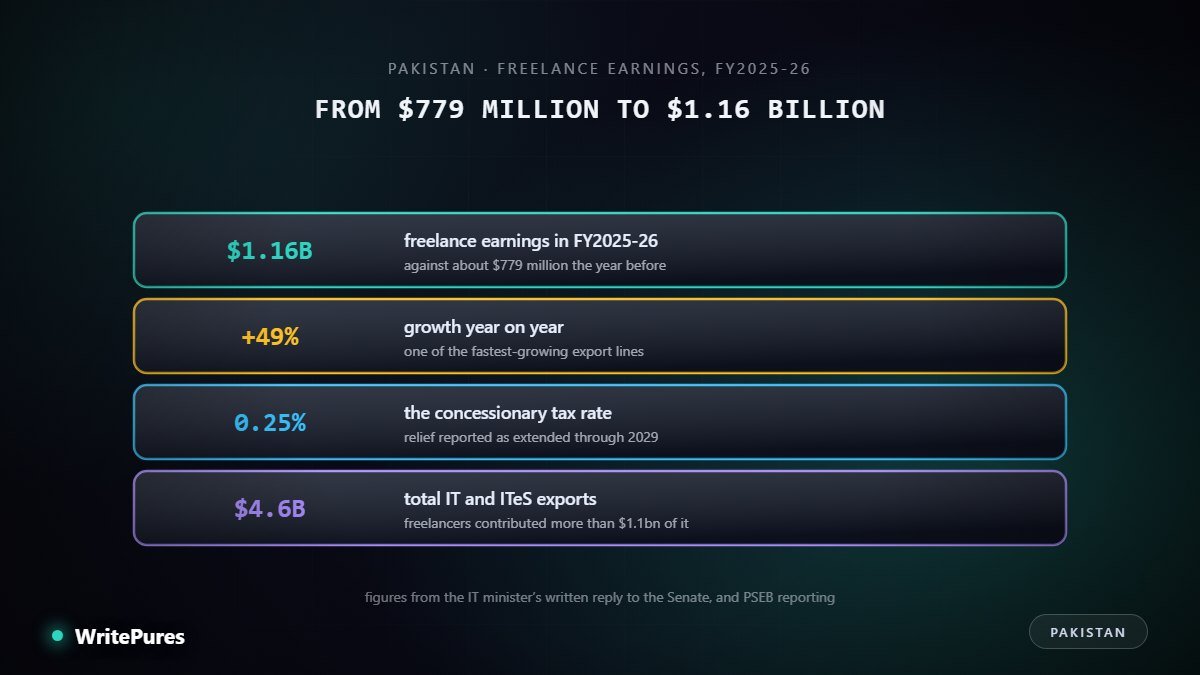
Pakistani freelancers earned about $1.16 billion in the 2025-26 fiscal year, up from roughly $779 million the year before. That is growth of close to 50% in a single year, in a category that needs no factories, no imports and no electricity beyond a laptop and a connection.
The numbers
- $1.16 billion in freelance earnings for FY2025-26, per the IT minister's written reply to the Senate.
- About $779 million the previous year — growth of roughly 49%.
- More than $1.1 billion of a record $4.6 billion in total IT and IT-enabled services exports, per PSEB.
- A concessionary 0.25% tax rate on foreign exchange earnings, reported as extended through 2029.
PSEB has also introduced a Top Freelancer Award within its IT Export Awards for 2026 — a small thing, but a signal about who the state now considers worth celebrating.
What the growth actually represents
Two things are happening at once and it is worth separating them.
Some of it is genuine new work: more people freelancing, better-paid contracts, and a shift up the value chain from basic tasks towards development, design and specialist services.
Some of it is better documentation. A concessionary rate on money that arrives through banking channels gives people a reason to use those channels instead of informal routes. When earnings move from invisible to counted, the official figure rises without anyone doing more work.
Both are good. But they mean different things for policy, and treating a documentation gain as pure growth would lead to the wrong conclusions about how much headroom is left.
The part worth arguing about
PAFLA has asked for the 0.25% rate to be guaranteed for ten years rather than extended in increments, and that request is more serious than it sounds.
Consider the decision an individual freelancer is making. Registering, formalising, routing earnings through documented channels and building a tax history is a multi-year commitment with real friction. A low rate that might lapse in three years is a weaker reason to take it than a slightly higher rate guaranteed for ten. Short renewal cycles do not just create uncertainty — they actively reward staying informal, which is the opposite of what the policy is for.
If you are weighing your own position, our guide to the current FBR slabs and rebates sets out what applies now, and the beginner's guide covers getting set up properly from the start.
The ceiling nobody has addressed
$1.16 billion is a real achievement and it is still selling hours.
Freelance income scales linearly with people and time. Double the earnings and you need roughly double the working hours. A product business does not work that way, which is the argument we made in our case for moving from gigs to products and IP.
Nothing in these figures suggests that transition is happening at scale. PAFLA's chairman has urged the government to help successful freelancers become startups, which is the right instinct and is a far harder policy problem than a tax rate — it needs access to capital, to international payment rails, and to customers who will buy from a Pakistani company rather than hire a Pakistani contractor.
The earnings growth is worth celebrating. The thing to watch over the next few years is whether any meaningful share of it converts into businesses that keep earning when their founders stop working.
Written by the WritePures newsroom. Spotted something that needs updating? Tell our editors.
Related reading
- Freelancing From Pakistan: The Money and the Paperwork — the practical guide to payment channels, PSEB and filing
- Pakistan Tech in 2027: The Targets and the Reality — where the sector is supposed to be heading, and by when
0 Comments
Join the conversation
Replying toNo comments yet. Be the first to share your thoughts.