
Most of what gets written about cybersecurity in a year ahead is mood. For 2027 there is something firmer: a compliance deadline on the first day of January that has been fixed for years, and which will quietly reshape what vendors ship to everyone else.
1 January 2027: the post-quantum gate
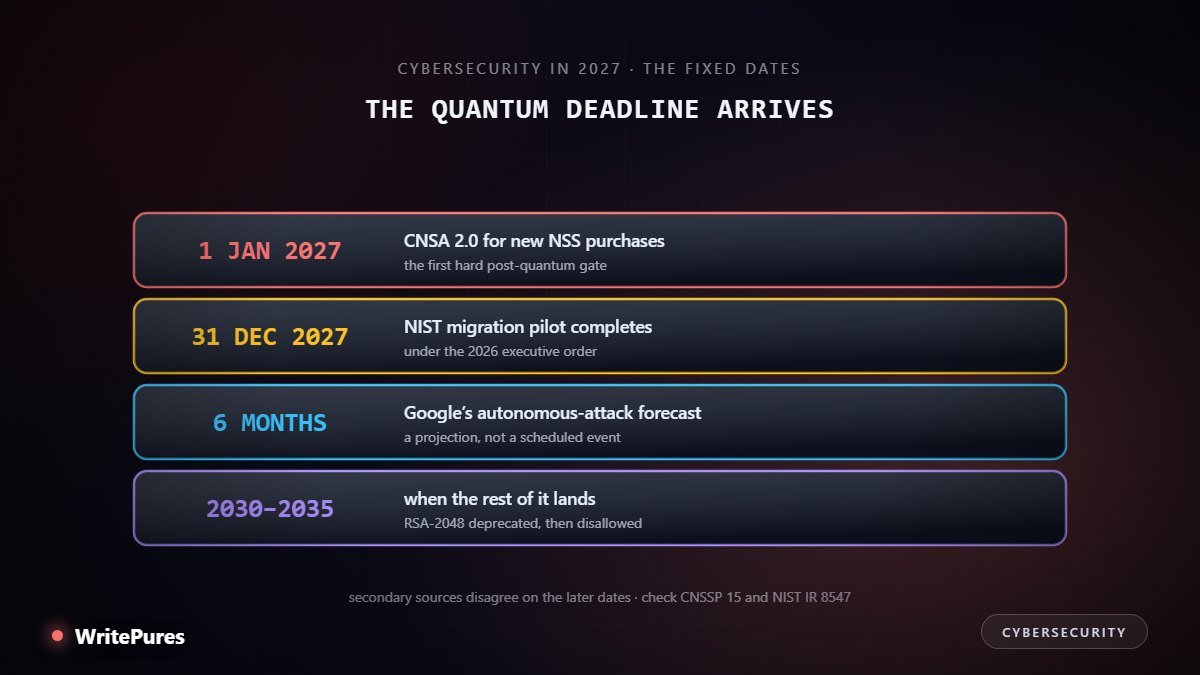
From that date, new acquisitions for US national security systems must be CNSA 2.0 compliant — built on the post-quantum algorithms the NSA has specified — unless a documented exception applies.
It is a procurement gate, not a shutdown. Nothing stops working on 1 January. But it is the first hard date in a migration that runs for another decade, and its effect reaches far beyond government: a vendor that wants to sell into those systems has to ship post-quantum support, which drags the capability into commercial products that everyone else buys.
The later milestones are where published sources stop agreeing. The range reported runs roughly from 2030 for networking equipment, through 2031 and 2033 for other categories, to 2035 for full coverage, with NIST's draft IR 8547 deprecating RSA-2048 and ECC-256 by 2030 and disallowing them after 2035. A 2026 executive order is reported to require covered contractors to follow NIST post-quantum standards by the end of 2030, with a NIST migration pilot completing by 31 December 2027.
Treat those later dates as indicative and check CNSSP 15 and NIST IR 8547 directly. The 2027 date is the one that is solid.
Why bother before quantum computers exist
Because of harvest now, decrypt later. An adversary can capture encrypted traffic today and store it until a machine exists that can break it. Anything that must remain confidential for ten years — medical records, legal files, state secrets, long-lived credentials — is already exposed by that logic. The deadline is set years early precisely because the data being protected outlives the protection.
The forecast half of 2027
Google Threat Intelligence's recent assessment, which we covered in our report on that warning, projects unsophisticated autonomous attacks within about three months and sophisticated fully agentic ones within six. Both windows land inside 2027.
Worth repeating what Google itself said alongside that: the intrusions are noisy and leave recognisable traces, and some AI-generated exploits simply failed. The attacker advantage is speed, not invisibility.
What 2026 suggests will still be true
The year just gone is a better guide than any forecast. Its significant incidents had almost nothing to do with novel techniques:
- A compromised third-party script served malware from 178 major websites.
- A poisoned package shipped under an official vendor's name.
- A supplier breach exposed about 150,000 people's identity documents.
- A pre-auth bypass with no workaround, reportedly exploited for two months before the patch.
- An AI tool that got in through missing MFA and an unrevoked vendor credential.
Four of those five are supply chain. None required a new category of defence. The planning conclusion for 2027 is unglamorous: know which suppliers hold your data and your credentials, revoke access when relationships end, make authentication phishing-resistant, and automate the first response — because an intrusion that completes in under three hours does not wait for a human to read an alert.
The quantum deadline is the thing that is genuinely new. Everything else is the same work, with less time to do it.
Written by the WritePures newsroom. Spotted something that needs updating? Tell our editors.
0 Comments
Join the conversation
Replying toNo comments yet. Be the first to share your thoughts.