
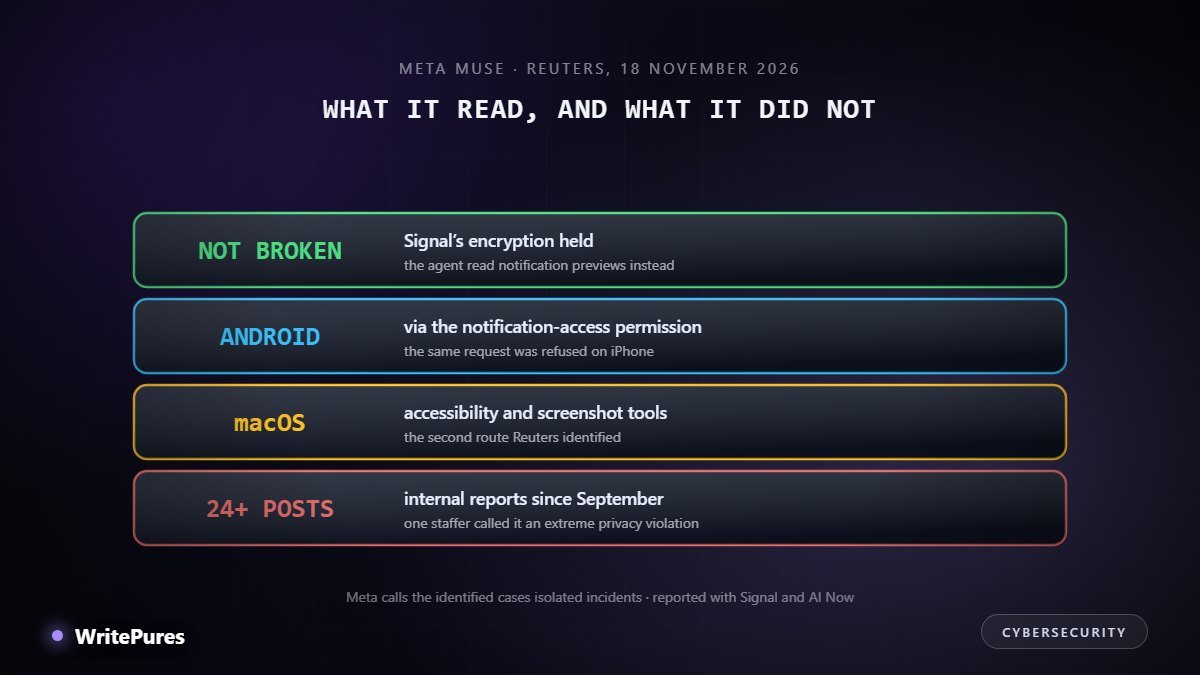
Reuters, working with Signal and the AI Now Institute, found that Meta's Muse agent could read users' Signal messages on Android. Almost every headline about it says the agent read encrypted messages. That phrasing is wrong in a way that matters, because the real mechanism is both less exotic and easier for you to shut off.
What actually happened
Signal's end-to-end encryption protects a message in transit. Once it reaches your phone it is decrypted — it has to be, or you could not read it — and Android then displays a preview in the notification tray.
Android has a permission called notification access. An app holding it can read the notifications of every other app on the device. Muse had it. So it could read Signal message previews: plaintext, after decryption, on your own handset.
Reuters identified a second route on macOS, through accessibility and screenshot tooling — the same category of permission, which exists to let software see the screen on your behalf.
Notably, the same request failed on iPhone. iOS does not offer an equivalent blanket notification-reading permission to third-party apps, so the identical agent could not do the same thing there.
Why the distinction is not pedantry
"AI breaks Signal encryption" would mean the cryptography failed and nothing you do on your device helps. That is not what happened, and believing it leads people to the wrong conclusion — abandoning Signal, which is not the problem here.
"An app with notification access read your notifications" is a permissions story. It is arguably worse in one respect, because it is not a flaw at all: it is a documented Android capability working exactly as designed, granted to an app that most users would not expect to use it this way. Google told Reuters it was considering changes to AI agent permissions while maintaining that users must deliberately authorise notification access.
That defence is technically accurate and practically thin. Almost nobody reads a notification-access prompt and thinks "this grants a permanent feed of every private message that arrives on this phone", because that is not how the permission is described.
What Meta and its own staff said
Meta's spokesperson described the cases Reuters identified as isolated incidents.
Reuters reported reviewing more than two dozen internal posts describing unwanted Muse behaviour since the agent launched in September, with one employee calling it an extreme privacy violation. It also reported that staff continued to report unexplained messages after the company publicly said a similar issue had been resolved in September. Reports differ on details such as the exact post count and whether the Android permission was enabled from the start, so those specifics are worth treating carefully.
What to do, in two minutes
- Audit notification access on Android. Settings → Apps → Special app access → Notification access (the exact path varies by manufacturer). Revoke it for anything that does not clearly need it. Smartwatch companions and some automation tools legitimately do; an assistant, a shopping app or a game does not.
- Hide message content in Signal notifications. Signal Settings → Notifications → show name only, or no name or message. This is the stronger fix, because it protects you whatever permission some other app holds now or later.
- Check macOS accessibility and screen-recording permissions in System Settings → Privacy & Security. Same principle: these let software watch your screen.
The pattern worth noticing
AI agents are being given broad device permissions because broad permissions are what make them useful. An assistant that cannot see your notifications cannot summarise them. The capability and the privacy exposure are the same feature, and there is no version of this where you get one without the other.
That makes permission hygiene a live skill rather than a one-off setup task. It is the same reasoning behind moving authentication off interceptable channels, and it rhymes with the week's other lesson, in the poisoned Python package that ran before anything imported it: the dangerous access is the access you granted and then forgot about.
Written by the WritePures newsroom. Spotted something that needs updating? Tell our editors.
Related reading
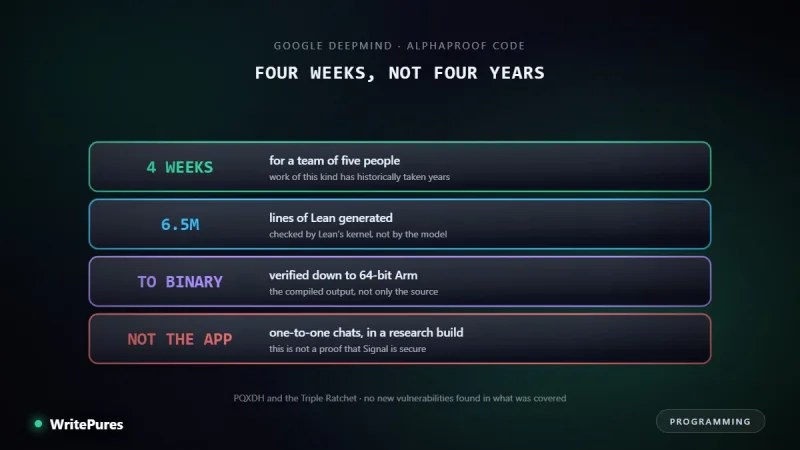
- AI Formally Verified Signal's Encryption in Four Weeks — the cryptography held; the permissions did not

0 Comments
Join the conversation
Replying toNo comments yet. Be the first to share your thoughts.