

The two terms are used as though they describe different technologies. In most cases they describe the same model in two different arrangements. Understanding where the line actually falls is useful, because it tells you which one a given job needs — and how much supervision it deserves.
The difference in one line
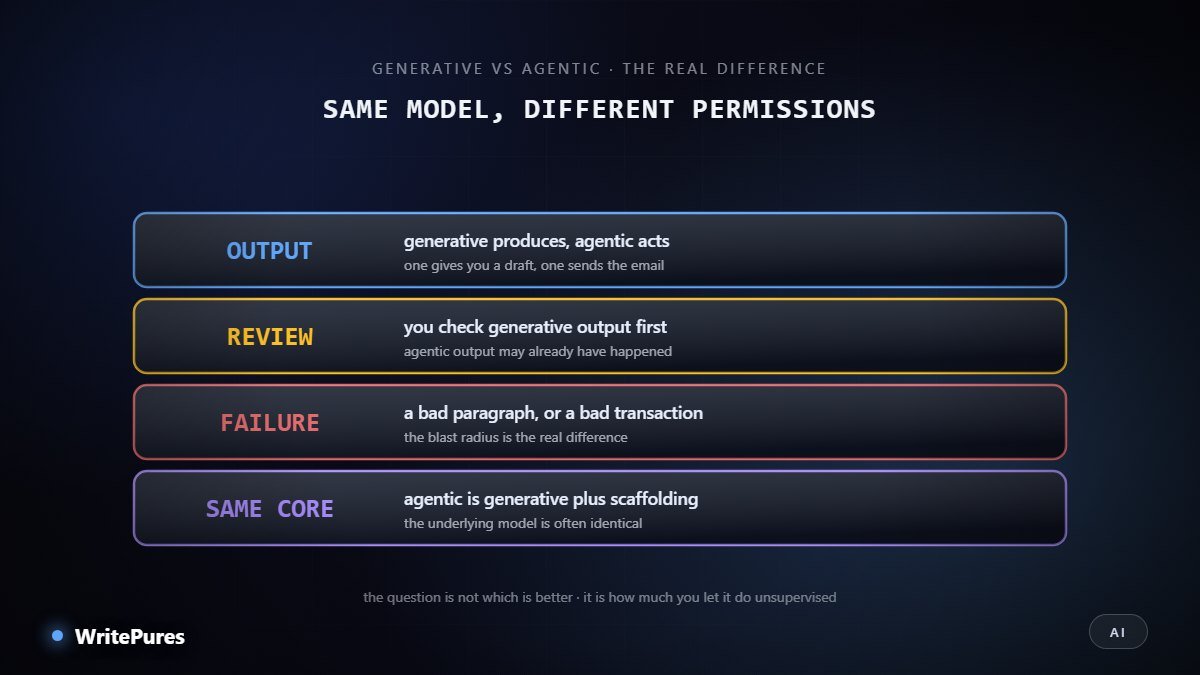
Generative AI produces. Agentic AI acts.
One gives you a draft email. The other sends it.
Side by side
| Generative | Agentic | |
|---|---|---|
| Output | Text, code, images | Actions, and their results |
| Steps | One | Many, until done |
| Tools | None | Search, files, APIs, systems |
| Memory | The context window | State carried across steps |
| You review | Before anything happens | Often after it has |
| Cost | One call | Many calls, unpredictable |
| Latency | Seconds | Minutes to hours |
| Failure | A bad draft | A bad action, already taken |
The row that matters is the last one.
The boundary is blurrier than the table suggests
Honesty requires noting that this is a spectrum, not a binary. A chat model that can search the web is already taking an action and observing a result — it is faintly agentic. A coding assistant that proposes a change you approve sits in between.
A workable test: can it do something you would not be able to undo, without asking first? If yes, treat it as an agent regardless of the label on the box.
Why the same model appears in both
The models behind both are usually the same. What changes is the scaffolding: a loop, tool definitions, memory, and a decision about what it may do unsupervised.
Which is why "agentic" in a product description tells you almost nothing about quality. It describes an architecture, not a capability level — and a poorly built agent on a frontier model will underperform a well-designed single prompt.
Choosing between them
Generative is right when: the task is one step; you want to review before anything happens; speed matters; the output is a document, some code or an explanation; or being wrong is cheap.
Agentic is right when: the task genuinely spans several systems; later steps depend on earlier results; it needs information nobody has supplied; or it has to run unattended.
The most common mistake is reaching for an agent when a prompt would do. It costs more, takes longer, fails in more ways and is harder to debug. If a single well-written prompt produces the answer, that is the better engineering.
Cost, which behaves differently
A generative call has a predictable price: your input, its output.
An agent's cost depends on how many steps it takes, and it does not know that in advance. A task that usually resolves in four steps occasionally takes thirty, and a loop that fails to notice it is stuck can run until something stops it.
Anyone deploying agents needs a hard step budget and a spend cap. That is not pessimism; it is the same discipline as a timeout on a network call.
The risk difference, stated plainly
This is the heart of it, and it is not about accuracy.
Assume both are wrong at the same rate. The generative model's error is a paragraph you delete. The agent's error is an email already sent, a file already overwritten, a payment already made.
Two things from this month make it concrete. Several large US banks have rewritten their terms so that losses caused by third-party AI agents sit with the customer, as we covered in our report on those changes — an industry whose business is pricing risk looked at this one and declined it. And Google's threat team reports AI agents running multiple stages of real intrusions, in its autonomous attacks assessment.
Neither is an argument against agents. Both are arguments for deciding deliberately what an agent may do without asking.
How to deploy an agent sensibly
- Make reversible actions automatic, irreversible ones approved. Drafting an email, automatic. Sending it to a customer, approved. Moving money, always a human.
- Cap the steps. An agent that cannot finish in twenty steps should stop and report, not keep going.
- Log every action, not just the final answer. When something goes wrong, the only useful question is what it actually did.
- Scope the tools narrowly. An agent with database write access has database write access on its worst day too.
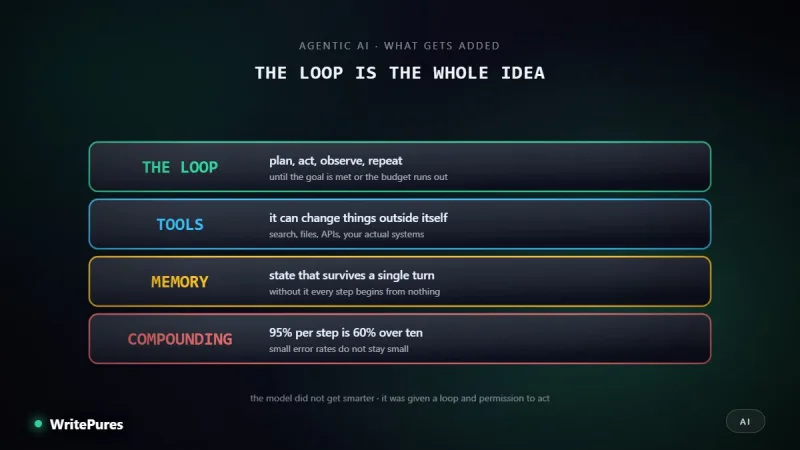
- Keep tasks short. The compounding arithmetic in the agentic explainer is the reason: 95% per step is about 60% over ten.
The summary worth keeping
Generative AI changed what software can produce. Agentic AI changes what software can do without being asked twice.
The useful question is not which is more advanced. It is how much you are willing to let run unsupervised — and whether you would notice, and could undo it, if it were wrong.
Written by the WritePures newsroom. Spotted something that needs updating? Tell our editors.
0 Comments
Join the conversation
Replying toNo comments yet. Be the first to share your thoughts.