

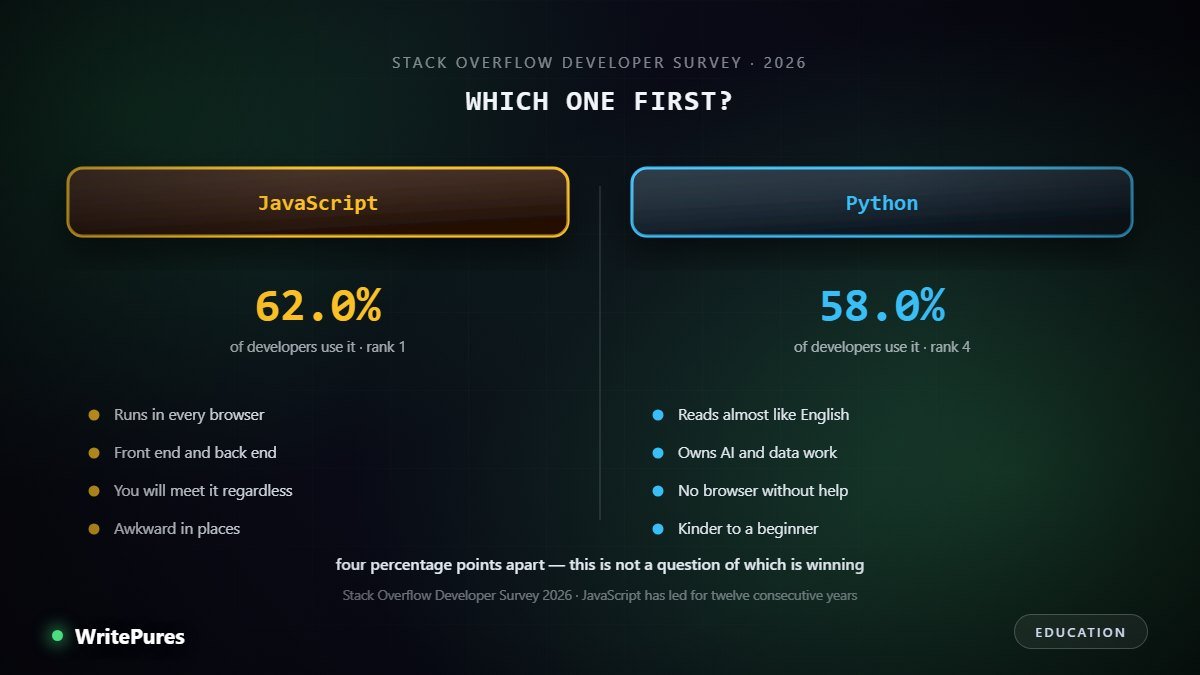
This question gets answered with league tables, which is why it keeps getting answered badly. The latest Stack Overflow survey separates these two languages by four percentage points — a gap with no practical meaning for someone choosing what to learn. What should decide it is what you want to have built in a year.
What the Data Actually Says
From the official Stack Overflow Developer Survey 2026 results, the most-used languages among professional developers:
| # | Language | Used by |
|---|---|---|
| 1 | JavaScript | 62.0% |
| 2 | SQL | 58.4% |
| 3 | HTML/CSS | 58.2% |
| 4 | Python | 58.0% |
| 5 | Bash/Shell | 51.3% |
| 6 | TypeScript | 43.8% |
| 7 | Java | 27.6% |
JavaScript has topped this ranking for twelve consecutive years. But note how tight positions two to four are: SQL, HTML/CSS and Python sit within half a percentage point of each other.
Two things worth taking from that table rather than the headline. SQL is second — whichever language you choose, you will need it, and it is far smaller to learn than either. And TypeScript at 43.8% means a large share of professional JavaScript is now written with types, so learning JavaScript realistically means learning TypeScript shortly afterwards.
What Each Is Actually For
JavaScript runs in the browser. It is the only language that does, which is the whole reason it is unavoidable. If what you want to build has a web interface, you will write JavaScript, whatever else you also use. With Node.js it runs on the server too, so an entire application can be one language.
Python runs everywhere except the browser. It dominates data analysis, machine learning, automation, scripting and scientific computing, and it is perfectly capable for web back ends. If what you want to build processes data, automates a task, or touches AI, Python is where the libraries and the examples are.
That split is the actual decision. It is not about which language is better designed — it is about which rooms each one lets you into.
Side by Side
| Python | JavaScript | |
|---|---|---|
| Hardest part early on | Little — syntax is forgiving | Async code and the browser |
| Runs in a browser | No, not without extra tooling | Yes, natively |
| Runs on a server | Yes | Yes, via Node.js |
| AI and data work | Dominant | Limited |
| Websites and apps | Back end only | Front and back |
| Automation and scripting | Excellent | Workable |
| Mobile apps | Rare | Yes, via React Native |
| Entry-level freelance work | Less, better paid | More, more crowded |
The Same Task in Both
Read a list of prices and print the total. This is roughly where a beginner is in week two.
Python:
prices = [250, 1800, 99, 450]

total = sum(prices)
print(f"Total: Rs {total}")

for price in prices:
    if price > 300:
        print(f"{price} is above budget")
JavaScript:
const prices = [250, 1800, 99, 450];

const total = prices.reduce((sum, p) => sum + p, 0);
console.log(`Total: Rs ${total}`);

prices.forEach((price) => {
  if (price > 300) {
    console.log(`${price} is above budget`);
  }
});
The logic is identical. The differences are real but small: Python uses indentation where JavaScript uses braces, Python has a built-in sum() where JavaScript composes one from reduce, and JavaScript asks for semicolons and more punctuation generally.
This is why "which is easier" has a defensible answer and a narrow one. Python is a little less to type and a little less to get wrong at this stage. Neither of those differences is what will decide whether you are still learning in six months.
How to Choose, in One Question
What do you want to be able to show someone in six months?
- A website or web app people can visit → JavaScript.
- Something that analyses data or automates a chore → Python.
- Anything involving AI models → Python.
- A mobile app → JavaScript, via React Native, unless you go native.
- Genuinely do not know → Python first. It is the gentler introduction to programming as a subject, and the concepts carry over cleanly when you add JavaScript later.
That last point deserves emphasis because it contradicts the usual advice. If you are unsure, the easier language is the better first one — not because the second is hard, but because the most common reason beginners stop is losing momentum, and momentum comes from finishing things.
A Realistic Timeline
Assuming consistent study alongside other commitments, not full-time:
- Months 1–2: Syntax, control flow, functions, data structures. You can solve exercises.
- Months 3–4: Your first complete small project. This is where most people quit, and where the actual learning happens.
- Months 5–8: Three or four real projects, version control, reading other people's code. Employable at junior level in a good market.
- Months 9–12: First paid work, usually freelance and underpriced. Normal.
Anyone promising a job in thirty days is selling a course. Our beginner's guide to freelancing in Pakistan covers turning that into income, and free courses with certificates lists places to start without paying anyone.
One Thing That Has Changed
AI assistants have made the first few months noticeably easier and the middle months slightly harder. Getting working code for a small task is now trivial. The skill that pays — reading code, knowing why it is wrong, and fixing it when the assistant is confidently incorrect — is unchanged, and you only build it by writing code yourself before reaching for help.
The practical advice is narrow: use the assistant to explain things, not to produce code you then paste without understanding. Our guide to writing better prompts is useful once you are past the basics, and the AI coding tools round-up covers what is available.
Key Takeaways
- JavaScript 62.0%, Python 58.0% in the Stack Overflow 2026 survey — four points apart.
- JavaScript is the only language that runs in a browser; that is why it is unavoidable.
- Python owns data, automation and AI work.
- Choose by what you want to build, not by the rankings.
- Unsure? Python first — momentum matters more than the language.
- Learn SQL too. It is second on that list and far smaller than either.
Written by the WritePures newsroom. Spotted something that needs updating? Tell our editors.


0 Comments
Join the conversation
Replying toNo comments yet. Be the first to share your thoughts.