
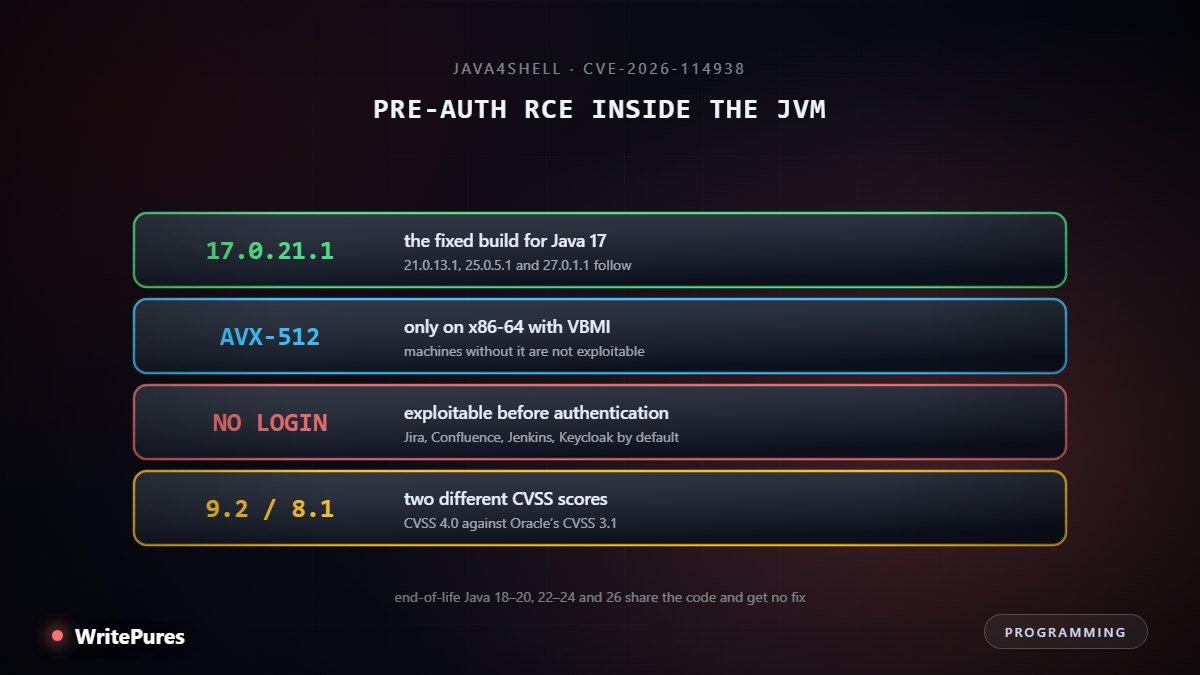
A vulnerability in OpenJDK's HotSpot Base64 decoder allows remote code execution without any authentication, in default configurations of Jira, Confluence, Jenkins, Keycloak, JFrog Artifactory and PingFederate. Researchers are calling it Java4Shell. The comparison to Log4Shell is doing some work, though — this one has a hardware precondition that genuinely limits who is exposed.
What it is
CVE-2026-114938 is a flaw in the Base64 decoder inside HotSpot, the JVM itself. Because the bug is in the runtime rather than a library, it reaches any application that decodes attacker-supplied Base64 — which, in practice, is most web-facing Java software handling tokens, headers or payloads.
The consequence is unauthenticated remote code execution. No credentials, no prior foothold. Reporting identifies default configurations of Keycloak, Jira, Confluence, JFrog Artifactory, Jenkins and PingFederate as exploitable.
The precondition that decides whether this is your emergency
Here is the detail that much of the coverage buries: the flaw is only exploitable on x86-64 CPUs with AVX-512 VBMI. The vulnerable code path is a hardware-accelerated intrinsic that only runs on those processors.
If your Java workloads run on ARM — Apple Silicon, AWS Graviton, Ampere — or on x86 parts without AVX-512 VBMI, you are not exploitable through this path. That is not a reason to skip patching, because fleets are mixed and change. It is a reason to triage rather than declare a company-wide incident.
So the first task is not patching. It is working out which of your hosts have the instruction set.
Two CVSS scores, and why they differ
You will see this rated 9.2 and you will see it rated 8.1. Both are correct. The 9.2 is CVSS 4.0, cited by Snyk and others; the 8.1 is Oracle's score under CVSS 3.1. They are different scales and are not interchangeable, so quoting one against the other proves nothing. Treat the technical facts — pre-auth, RCE, hardware-gated — as the real severity input.
What to do, in order
- Inventory. Find Java-running hosts exposed to untrusted input, and check which are x86-64 with AVX-512 VBMI. That intersection is your actual exposure.
- Patch those first: 17.0.21.1, 21.0.13.1, 25.0.5.1, 27.0.1.1. Verify your distribution has shipped it — Corretto and Zulu were out first, while Temurin, Red Hat and Ubuntu were still pending on 18 November.
- If you cannot patch today, disable the intrinsic:
-XX:+UnlockDiagnosticVMOptions -XX:-UseBASE64Intrinsics. Expect a performance cost on Base64-heavy workloads, and treat it as temporary. - Deal with end-of-life branches. Java 18–20, 22–24 and 26 share the vulnerable code and get no fix. Those need to move to a supported branch; there is no patch coming.
- Hunt before you assume you were not hit. A pre-auth RCE with public analysis will be exploited. Review logs for the affected services rather than patching and closing the ticket.
Why the Log4Shell comparison only half works
Log4Shell was catastrophic because it was trivially exploitable everywhere Log4j ran, which was effectively everywhere, with no precondition. Java4Shell is in a more fundamental component — the JVM — but gated behind a CPU feature. Broader in principle, narrower in practice.
The operational lesson is the same one in our guide to patch strategy for zero-days and in October's critical PHP RCE: the organisations that handle these well are the ones that can answer "what do we run, where, on what hardware" in minutes rather than days. The patch is the easy part. Knowing where to apply it is what separates a Thursday from a fortnight.
Written by the WritePures newsroom. Spotted something that needs updating? Tell our editors.


0 Comments
Join the conversation
Replying toNo comments yet. Be the first to share your thoughts.