
The usual version of this comparison treats Docker Swarm as a toy and moves on. That is unfair — Swarm genuinely does the main job with a fraction of the complexity, and for a small deployment it is still the fastest route from a Compose file to three machines running your containers. The real question in 2026 is not whether it works. It is who is looking after it.
The Short Version
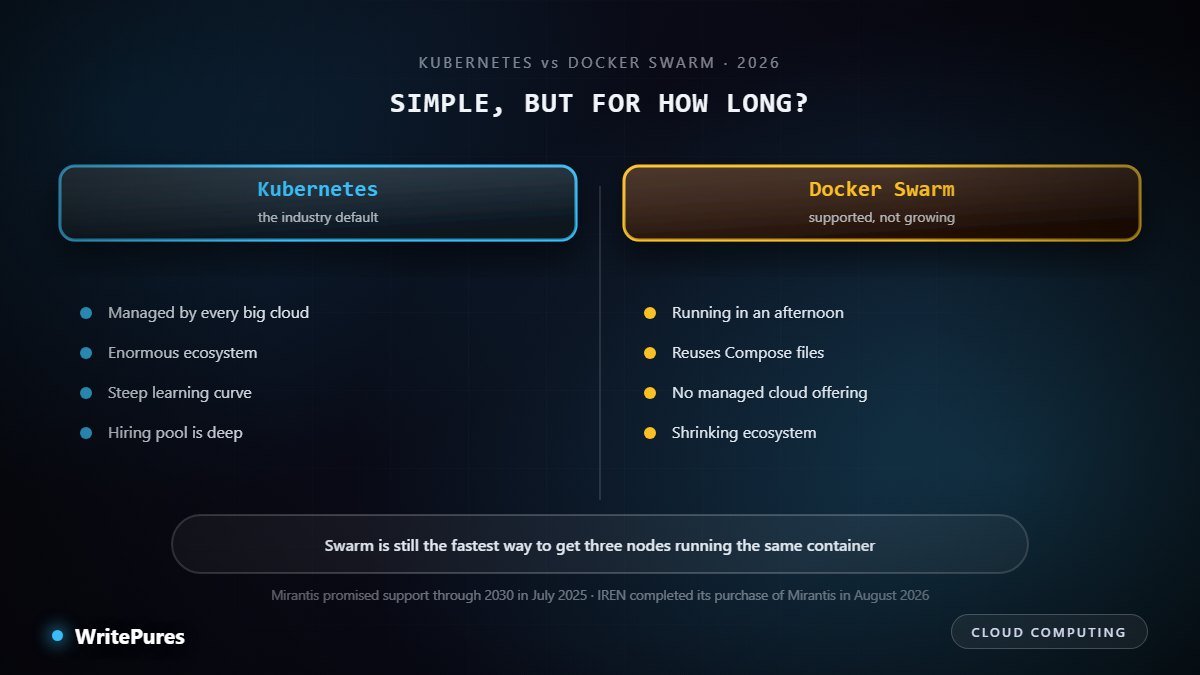
Kubernetes is the industry default and will stay so. Swarm is simpler, still supported, and no longer growing.
If you want the one-line answer: choose Kubernetes unless you have a specific reason not to, and "it looks complicated" is a reasonable specific reason for a small team with no platform engineer.
Side by Side
| Kubernetes | Docker Swarm | |
|---|---|---|
| Setup | Hours to days, or minutes managed | Minutes |
| Configuration | Extensive YAML | Compose files you already have |
| Learning curve | Steep | Gentle |
| Managed hosting | Every major cloud | None |
| Ecosystem | Vast | Small and shrinking |
| Autoscaling | Built in, mature | Manual |
| Hiring | Deep pool | Shallow |
| Future | Not in question | Supported, see below |
The Support Question, Honestly
This is the part most comparisons either skip or get wrong, so here is the sequence with dates.
In July 2025, Mirantis — which bought Docker Enterprise — published a commitment that "Swarm will be fully supported through at least 2030 as part of Mirantis Kubernetes Engine 3". That is an explicit, dated promise, and Docker's own documentation carries no deprecation notice, no end-of-life date and no maintenance-mode banner. Swarm fixes have continued to ship in Docker Engine releases.
In May 2026, IREN announced it was acquiring Mirantis, and it completed that acquisition in August 2026. IREN said Mirantis would operate as a standalone subsidiary serving its existing customers.
We could not find any public restatement of the 2030 Swarm commitment from the new owner. That is not evidence of a change — companies rarely reissue every prior commitment after an acquisition — but it does mean the strongest assurance available is one made by a company under different ownership, fifteen months ago.
Separately, the next generation of Mirantis's platform has been reported as Kubernetes-only, which would leave Swarm supported on the older product line rather than carried forward. That reporting comes from a competing vendor, so weigh it accordingly.
What to do with that: if you are running Swarm today, nothing urgent. If you are choosing for something that must still be running in 2030, the uncertainty is a real cost even if the support holds.
What Swarm Is Genuinely Good At
It deserves credit on its merits.
- It reuses what you have. A Compose file becomes a Swarm stack with little change. There is no second configuration language to learn.
- It is running in an afternoon.
docker swarm init, join your other machines, deploy. That is the entire process. - It does the core job. Multiple machines, service replicas, rolling updates, overlay networking, secrets, health checks and restarts.
- It is small. Nothing extra to run and far less to monitor than a cluster.
For a team of three running an internal application across a few servers, this is a sensible engineering choice, not a compromise.
What You Give Up
No managed option. This is the decisive one. Every major cloud sells managed Kubernetes; none sells managed Swarm. So Swarm means operating it yourself, while Kubernetes can mean someone else operating it — which inverts the usual "Swarm is simpler" argument once a managed service is on the table.
The ecosystem. Helm charts, operators, service meshes, dashboards, and a decade of written answers all target Kubernetes. On Swarm you will find fewer, older answers.
Hiring and careers. Job listings ask for Kubernetes. For an employee, Swarm experience transfers less well.
Autoscaling. Kubernetes scales on load out of the box; on Swarm you script it.
What Each Looks Like in Practice
The complexity gap is easiest to see in what you type.
Swarm, from nothing to a three-node cluster running a service:
docker swarm init
# then on each other machine, using the token it prints:
docker swarm join --token <token> <manager-ip>:2377

docker stack deploy -c docker-compose.yml myapp
docker service scale myapp_web=5
That is the whole thing, and the Compose file is one you may already have.
Kubernetes needs the same intent expressed as objects — a Deployment describing the pods, and a Service exposing them:
apiVersion: apps/v1
kind: Deployment
metadata:
  name: web
spec:
  replicas: 5
  selector:
    matchLabels: { app: web }
  template:
    metadata:
      labels: { app: web }
    spec:
      containers:
        - name: web
          image: myapp:1.0
          ports:
            - containerPort: 8080
Then a Service, and for outside traffic an Ingress, and for configuration a ConfigMap, and so on. Every one of those objects exists for a reason, and each is a concept to learn before the cluster does anything useful.
This is the honest case for Swarm and the honest case against it in the same breath: the Kubernetes verbosity buys you precision and an ecosystem that assumes those objects exist. Tools like kompose will translate a Compose file into Kubernetes manifests to get you started, though the output usually needs editing.
Choosing
- One machine is enough? Neither. Use Docker Compose. Most small projects stop here and should.
- A few machines, small team, no platform engineer? Swarm is defensible today, with the ownership caveat above.
- Already on a cloud? Managed Kubernetes. The cloud absorbs the hard part, and you get the ecosystem.
- Need autoscaling, or a service mesh, or anything from the CNCF landscape? Kubernetes, with no real argument.
- Building a career? Kubernetes. The market is unambiguous.
For the layer below this decision, see Docker versus Kubernetes, which covers what each tool actually is; serverless containers versus Kubernetes for the option that skips orchestration entirely; and Docker versus Podman for the runtime underneath.
Key Takeaways
- Kubernetes is the default and the safe career choice.
- Swarm genuinely works and is far simpler to stand up.
- Mirantis committed in July 2025 to supporting Swarm through at least 2030.
- IREN completed its acquisition of Mirantis in August 2026; that commitment has not been publicly restated since.
- No cloud sells managed Swarm, which undercuts its simplicity advantage.
- If one machine suffices, use Compose and skip this decision.
Written by the WritePures newsroom. Spotted something that needs updating? Tell our editors.


0 Comments
Join the conversation
Replying toNo comments yet. Be the first to share your thoughts.