

Comparisons of the big three usually end in a scoreboard, which is the least useful possible outcome. All three run enormous production workloads reliably. The interesting question is not which is better in the abstract, but which is better given what your organisation already owns, who you can realistically hire, and where your particular architecture will leak money.
Where They Stand
Published market-share estimates disagree enough that it is worth stating the spread rather than a number. Across analyst figures for the first half of 2026, AWS lands somewhere between 28% and 31%, Azure between 20% and 25%, and Google Cloud between 11% and 15%. The gaps come from methodology — what counts as cloud infrastructure, whether software-as-a-service revenue is included, and which quarter is being measured.
What the figures agree on is the shape: AWS leads, Azure is a strong second growing faster, and Google Cloud is a distant but fast-growing third. For a buying decision, the ordering matters far less than the fact that all three are at a scale where neither availability nor service breadth is a reason to rule any of them out.
Where Each One Genuinely Wins
AWS
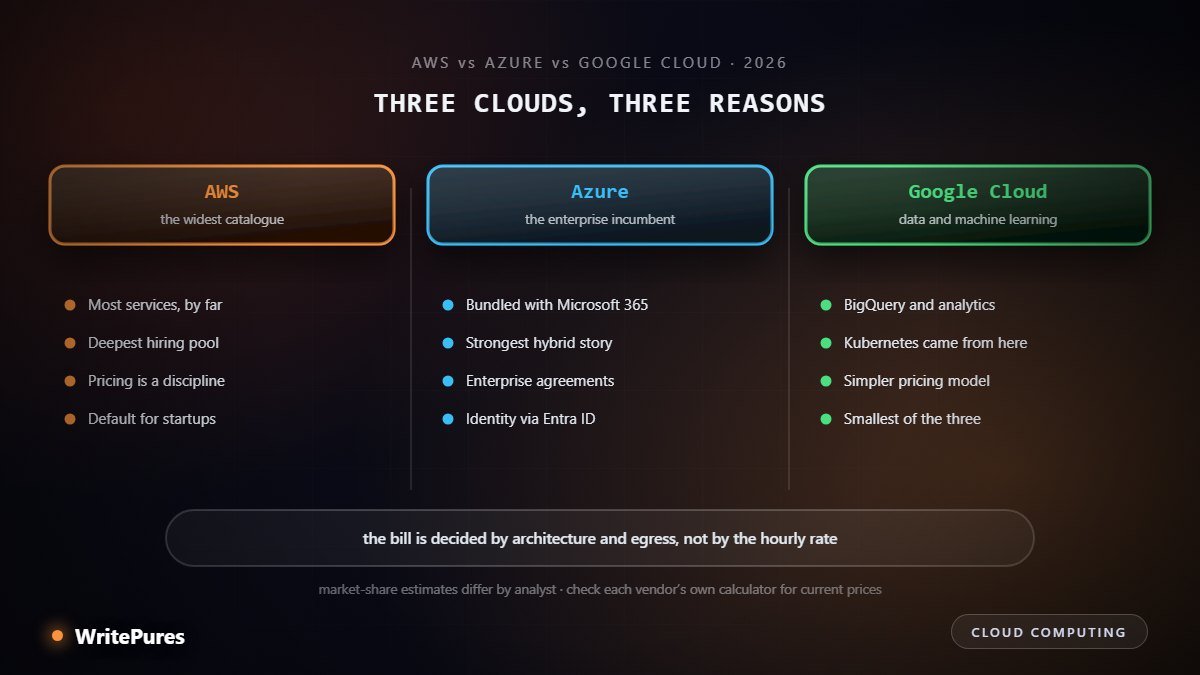
Breadth and hiring. It has the largest catalogue of services by a wide margin, which means the answer to "does it do X" is almost always yes. It also has the deepest pool of engineers who have used it in anger, and the largest body of written answers when something breaks at 2am.
The cost of that breadth is complexity. AWS pricing is genuinely difficult, with instance families, reserved instances, savings plans and per-service billing dimensions that reward attention and punish inattention. Treat cost management as an ongoing discipline rather than a setup task — the approach in our piece on FinOps and cloud repatriation applies directly.
Azure
Enterprise gravity. If an organisation already runs Microsoft 365, Windows Server and Entra ID for identity, Azure is not a new vendor — it is an extension of a relationship that already has a contract, a support channel and an identity system attached. That is an enormous practical advantage that has nothing to do with technical quality.
Azure also has the most credible hybrid story for organisations that must keep some workloads on their own hardware, which matters for regulated sectors and for anyone with data-residency obligations.
Google Cloud
Data and machine learning. BigQuery remains a genuinely differentiated analytics product, and the broader data tooling is widely considered the strongest of the three. Kubernetes originated at Google, and its managed Kubernetes offering reflects that.
Its pricing model is the simplest of the three, with sustained-use discounts applied automatically rather than requiring you to buy commitments in advance — which is worth real money to teams without a dedicated cloud cost function.
The trade-off is the smallest ecosystem and the shallowest hiring pool of the three.
What Actually Drives Your Bill
This is the part that comparison tables of hourly rates miss entirely. In practice, four things dominate:
- Egress. Moving data out to the internet, or between regions, is charged at rates that quietly dwarf compute on data-heavy workloads. This is also the single biggest practical lock-in mechanism, because leaving means paying to extract everything you have stored.
- Managed versus self-run. A managed database costs several times a virtual machine running the same engine. Frequently worth it; rarely modelled honestly.
- Commitment discounts. Reserved capacity and savings plans routinely cut compute costs substantially, and are left unused by teams who have not got round to it.
- Idle resources. Non-production environments left running overnight and at weekends are the most common avoidable line on any cloud bill.
None of those four is a reason to pick one provider over another. All four are reasons your bill is what it is.
A Way to Decide
- Already a Microsoft shop? Azure, unless you have a specific reason not to. The identity and licensing integration is worth more than any feature comparison.
- Data and analytics at the centre of the product? Google Cloud deserves a serious look.
- Need an obscure managed service, or hiring at speed? AWS, on catalogue breadth and market depth.
- Team already fluent in one? That one. Operational familiarity beats a marginal feature advantage every time.
- Regulated data that cannot leave the country? Start from the region map, not the feature list. This rules providers in or out faster than anything else.
- Small and cost-sensitive? Look beyond the big three. Smaller providers are materially cheaper for straightforward virtual machines, and serverless containers may remove the question entirely.
For Teams in Pakistan
Two practical considerations that rarely appear in global comparisons.
Region and latency. None of the three operates a region inside Pakistan. Traffic is typically served from the Gulf, Singapore or Mumbai, and the choice between them has a measurable effect on latency for local users. Test from where your users actually are rather than trusting a map.
Billing and currency. All three bill in US dollars by card or invoice, which makes cost exposure a currency question as well as a technical one. Startup credit programmes are worth pursuing — all three operate them, and the amounts are meaningful at early stage. The incubation and export programmes covered in PSEB's national incubation centres have included cloud credits.
For the architecture layer above this choice, see Kubernetes versus Docker Swarm and Docker versus Kubernetes.
Key Takeaways
- Published shares put AWS around 28–31%, Azure 20–25%, Google Cloud 11–15%, depending on the analyst.
- AWS wins on catalogue breadth and hiring; Azure on Microsoft integration and hybrid; Google Cloud on data and ML.
- Egress, managed services, unused commitments and idle resources drive the bill — not hourly rates.
- Lock-in is mild for VMs and storage, serious for proprietary managed services.
- Existing skills and existing vendor relationships should usually decide it.
- None of the three has a region in Pakistan; test latency from where your users are.
Written by the WritePures newsroom. Spotted something that needs updating? Tell our editors.



0 Comments
Join the conversation
Replying toNo comments yet. Be the first to share your thoughts.