
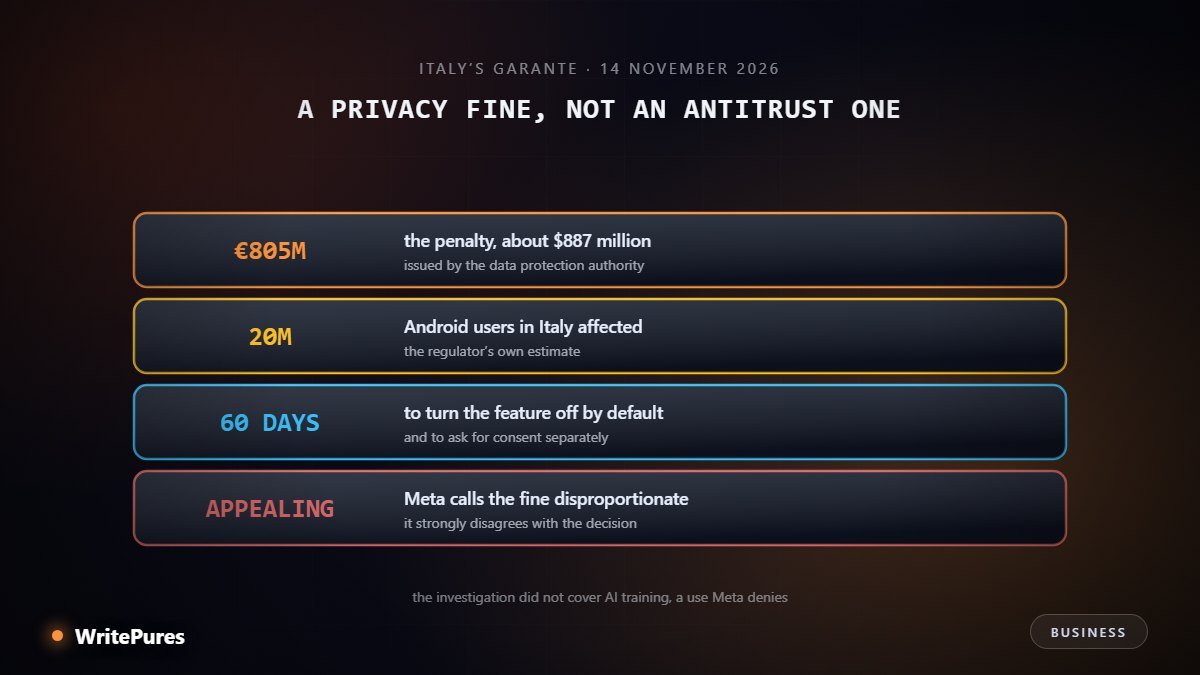
Italy's data protection authority has fined Meta €805 million — about $887 million — over a Facebook feature that reached into the photo galleries of around 20 million Android users in the country. It is one of the largest privacy penalties ever issued by a single European member state, and Meta is appealing it.
Get the two basic facts right first
A lot of the coverage of this fine has garbled it in two ways, so it is worth being precise before anything else.
It is €805 million, not €887 million. The $887m figure is the dollar conversion, and several outlets printed the dollar number with a euro sign in front of it.
And it is a privacy fine, not an antitrust one. It was issued on 14 November by the Garante, Italy's data protection authority, under a European privacy directive written into Italian law. Meta was separately fined about €798 million by the European Commission in 2024 over Facebook Marketplace — that was antitrust, it was a different regulator, and it has nothing to do with this.
What the regulator found
The feature in question suggested content for people to post on Facebook by drawing on the photos and videos already sitting in their Android phone gallery. The Garante found that this amounted to accessing users' personal gallery content in breach of privacy law, and estimated that around 20 million Android users in Italy were affected.
In setting the size of the penalty, the regulator cited three things: how long the infringement ran, what it described as Meta's lack of cooperation during the investigation, and an earlier regulatory measure against the company in 2019. The investigation itself began in 2025.
Meta now has 60 days to switch the feature off by default and to ask for consent for it separately rather than bundling it in.
Two things the ruling pointedly did not settle
The Garante was explicit that its investigation did not cover whether any of this content was used to train artificial intelligence models — a use Meta denies. It also reserved the right to assess separately a newer feature, launched in 2026, that allows gallery content to be processed in the cloud.
Both of those are larger questions than the one just answered, and both remain open. The fine closes a 2025 investigation; it does not clear Meta on the AI training question, because that question was never in scope.
Meta's response
Meta says it strongly disagrees with the decision, calls the fine disproportionate, and will appeal. That is worth taking seriously as a practical matter rather than dismissing as boilerplate: large European privacy penalties are frequently reduced on appeal, and the headline number is better understood as an opening position than a settled transfer.
Why this matters outside Italy
The pattern here is becoming the normal shape of European tech enforcement: a national regulator, acting on privacy rather than competition grounds, issuing a penalty large enough to matter and an order to change a default. The order is usually the more consequential half. A fine is absorbed; a forced change to a default setting alters what the product does for everyone.
We saw the same structure in the EU's case against TikTok's recommendation feed, and the direction of travel is consistent — regulators are increasingly targeting the defaults rather than the disclosures, on the reasonable view that almost nobody changes a default and almost nobody reads a disclosure.
Written by the WritePures newsroom. Spotted something that needs updating? Tell our editors.

0 Comments
Join the conversation
Replying toNo comments yet. Be the first to share your thoughts.