

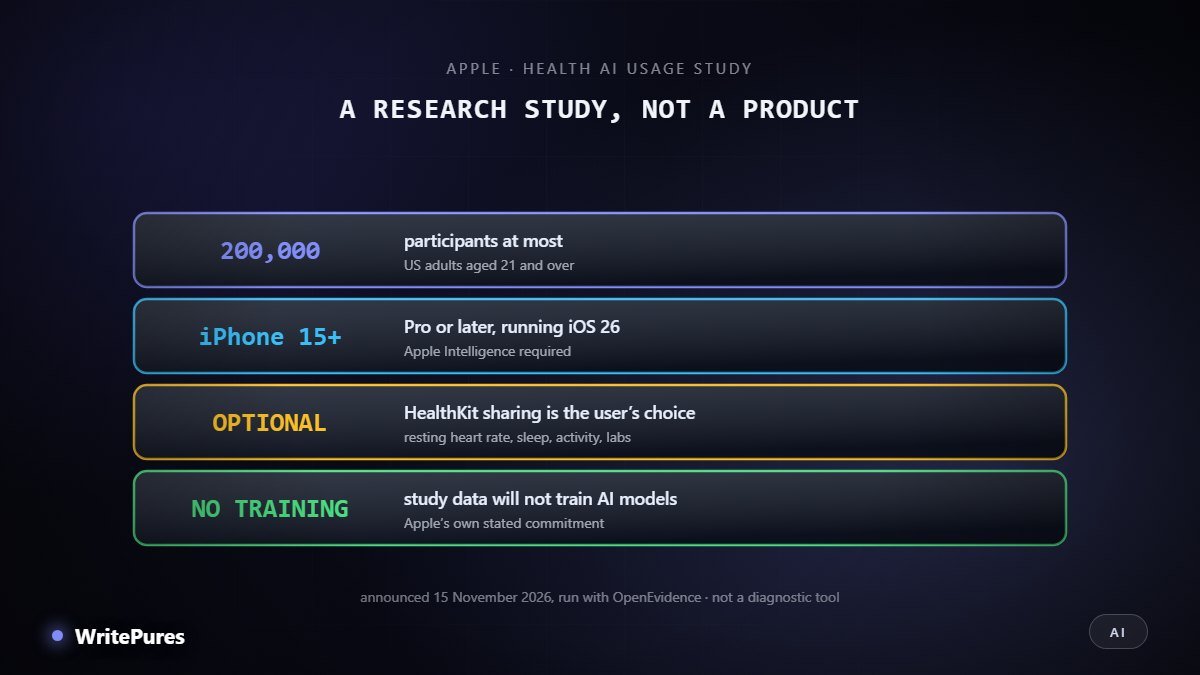
Almost every large technology company has responded to health AI by shipping something. Apple has responded by running a study. On 15 November it opened the Apple Health AI Usage Study to as many as 200,000 adults in the United States — not to sell them a medical assistant, but to find out what happens when ordinary people ask software about their health.
What the study actually does
Participants use a study app to ask the kind of health questions people normally type into a search engine at midnight. The app answers, and — importantly — shows peer-reviewed citations alongside the answer. Participants then rate the response: was it useful, was it comprehensible, did it change what they did next.
Apple is running it with OpenEvidence, a clinical AI platform that supplies the underlying technology. Apple's vice president of Health and Fitness, Sumbul Desai, M.D., framed the approach in the announcement by saying that responsible innovation starts with scientific rigour and clinical grounding.
The questions it is built to answer are behavioural rather than technical. Do people trust these answers? Should they? Does a citation change whether someone believes what they are told? Does any of it lead to a better decision, such as actually seeing a doctor?
What it collects, and what it does not
- Always: the questions asked in the app, and survey responses including quality ratings.
- Only if you choose: HealthKit data such as resting heart rate, activity, sleep or lab results.
- Never, per Apple: study data is not used to train AI models.
Apple describes the study as designed with privacy protections, transparency and clinical guardrails from the start, and says participants retain control over whether to share any HealthKit metrics or survey responses at all.
Two caveats worth keeping in view. First, these are Apple's own commitments about Apple's own study — they are credible, and they are also not independently audited. Second, the hardware requirement is a real limit on what the study can tell anyone: it needs an iPhone 15 Pro or later on iOS 26, which selects for people who bought a recent premium phone. Whatever the results say about trust in health AI, they will say it about that group.
Why running a study is the interesting choice
The obvious move for Apple was a health chatbot in the Health app. It has the devices, the sensor data and the distribution. Instead it has committed to a long research exercise whose most likely outcome is a set of findings about how badly people misread confident-sounding answers.
That is a slower path, and a defensible one. Health is the category where the gap between a fluent answer and a correct answer does the most damage, and where the usual AI product cycle — ship, observe, patch — is least appropriate. It is also, in commercial terms, a way to build the evidence base you would want before putting a medical assistant in front of a billion people.
If you want the wider picture of how these tools are being adopted in practice rather than in press releases, we covered that in our look at how AI is changing everyday work.
The honest summary
This is not a product launch, and reporting it as one gets it wrong. It is Apple saying, in effect, that nobody actually knows whether consumer health AI helps people or quietly misleads them — and then spending a year and 200,000 participants trying to find out. The finding will matter more than the app.
Written by the WritePures newsroom. Spotted something that needs updating? Tell our editors.


0 Comments
Join the conversation
Replying toNo comments yet. Be the first to share your thoughts.