
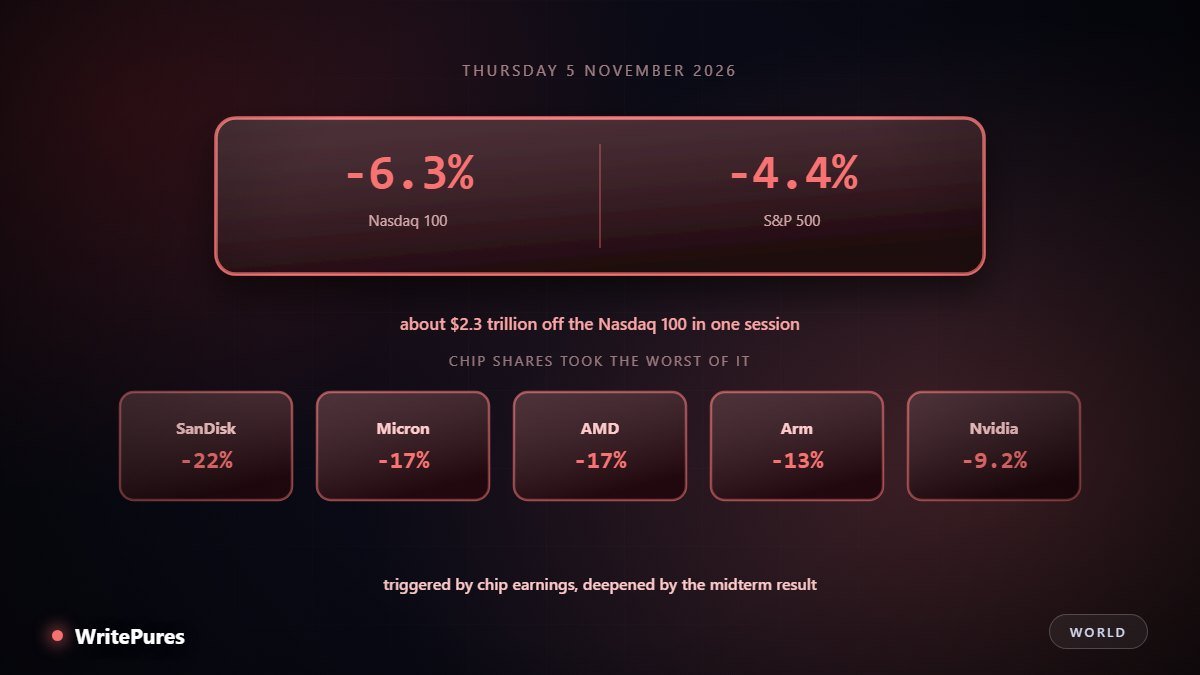
Chip shares have had bad days before. What made Thursday different is why it happened: for the first time, an American election result was priced straight into the value of AI infrastructure.
The Damage
Figures for Thursday 5 November 2026, as reported by NBC News:
| Index | Move | Value erased |
|---|---|---|
| Nasdaq 100 | −6.3% | ~$2.3 trillion |
| S&P 500 | −4.4% | ~$2.8 trillion |
| Nasdaq Composite | −5.5%+ | into correction territory |
| Dow Jones Industrial Average | −3.4% (1,833 pts) | — |
| Philadelphia semiconductor index | −12.3% | worst day since March 2020 |
Asia followed. South Korea's Kospi opened down 8 per cent, Japan's Nikkei 225 fell 6 per cent, and Taiwan's TAIEX closed 4.5 per cent lower.
Reported percentages differ between outlets — some put the Nasdaq 100 drop closer to 4.5 per cent — which is a reminder to check which index and which source a headline figure refers to before repeating it.
Where it hit hardest
- SanDisk −22%
- Micron, Western Digital, AMD −17% each
- Seagate −16%
- Arm Holdings −13%
- Qualcomm −9.5%
- Nvidia −9.2%, the largest single drag on the Dow
- SK Hynix −10%+ and Samsung −6.3% in Korea
The pattern is not random. Memory and storage took the worst of it because their demand is driven by how much data centre capacity is physically built, not by multi-year software contracts. Any hint that build-out might slow feeds straight into those forecasts. Our map of the semiconductor industry sets out who sits where in that chain.
Three Things Compounding
- The immediate trigger: chip earnings. Qualcomm and Arm Holdings both reported on Wednesday night and investors read the results as mixed at best. Qualcomm's smartphone chip sales missed estimates.
- The policy shock: the midterms. Tuesday's results returned a number of candidates who had campaigned on slowing or halting AI data centre construction — notably in Texas, Ohio, Michigan and Georgia, four of the largest data centre markets in the country. Separately, 40 of 41 local data-centre ballot measures went against development, which we covered in the data centre ballot results.
- The underlying anxiety: returns. Neither of the above would move markets this far on its own. They landed on a market already asking whether the capital committed to AI will earn a return, and how long investors are willing to wait.
Why Earnings From Two Mid-Sized Firms Moved Trillions
Qualcomm and Arm are not the largest companies in the sector, and on an ordinary day a mixed quarter from either would be a sector story rather than a market one. The reaction was disproportionate because of what investors were looking for rather than what was reported.
Valuations across AI infrastructure embed an assumption of sustained, rapid demand growth. When a valuation rests on a growth assumption rather than on current earnings, any data point that questions the assumption is worth far more than its own weight. Qualcomm's miss on smartphone chip sales said little about AI directly — but it arrived at a moment when the market was actively hunting for evidence either way.
This is also why the damage spread so unevenly. Firms whose revenue depends on how much capacity gets physically built fell hardest; those with diversified or contracted revenue fell far less. The selloff was not a verdict on AI as a technology. It was a repricing of the assumption that build-out continues at the pace already in the numbers.
What Is Genuinely New Here
Sharp AI-linked drops are not new; several have happened in the past two years and most recovered. The novel element is the transmission mechanism.
Until now, the risks priced into AI infrastructure were technical and commercial — chip supply, power availability, competition, model performance. Thursday added a political one. A local planning decision in Ohio and a governor's race in Texas are now inputs to a semiconductor valuation in a way they were not twelve months ago.
That matters because political risk behaves differently. It is not solved by spending more, it does not follow a roadmap, and it can reverse. It also means the industry's expansion plans now depend partly on persuading people who live near the sites, which is a capability most of these companies have never needed to build.
What to watch rather than predict
- Capital expenditure guidance from the large cloud providers at the next results. That is the real signal — if build-out plans are unchanged, the selloff was sentiment.
- Whether the anticipated regulation materialises. Campaign pledges and enacted rules are different things.
- Memory pricing. It leads the cycle, and it will show a genuine slowdown before earnings do.
- Whether the recovery holds. Reports of the following session were mixed, with some recovery in futures and continued weakness in Asia.
One session is not a verdict. But the market has now established that it treats AI infrastructure as politically exposed, and that assumption is unlikely to be unlearned.
Key Takeaways
- Nasdaq 100 −6.3% on 5 November 2026, about $2.3 trillion erased.
- The Philadelphia semiconductor index fell 12.3%, its worst day since March 2020.
- Memory and storage fell hardest because they track build-out volume directly.
- Triggered by Qualcomm and Arm earnings, amplified by the midterm result.
- The new element is political risk being priced into AI infrastructure.
Written by the WritePures newsroom. Spotted something that needs updating? Tell our editors.


0 Comments
Join the conversation
Replying toNo comments yet. Be the first to share your thoughts.