
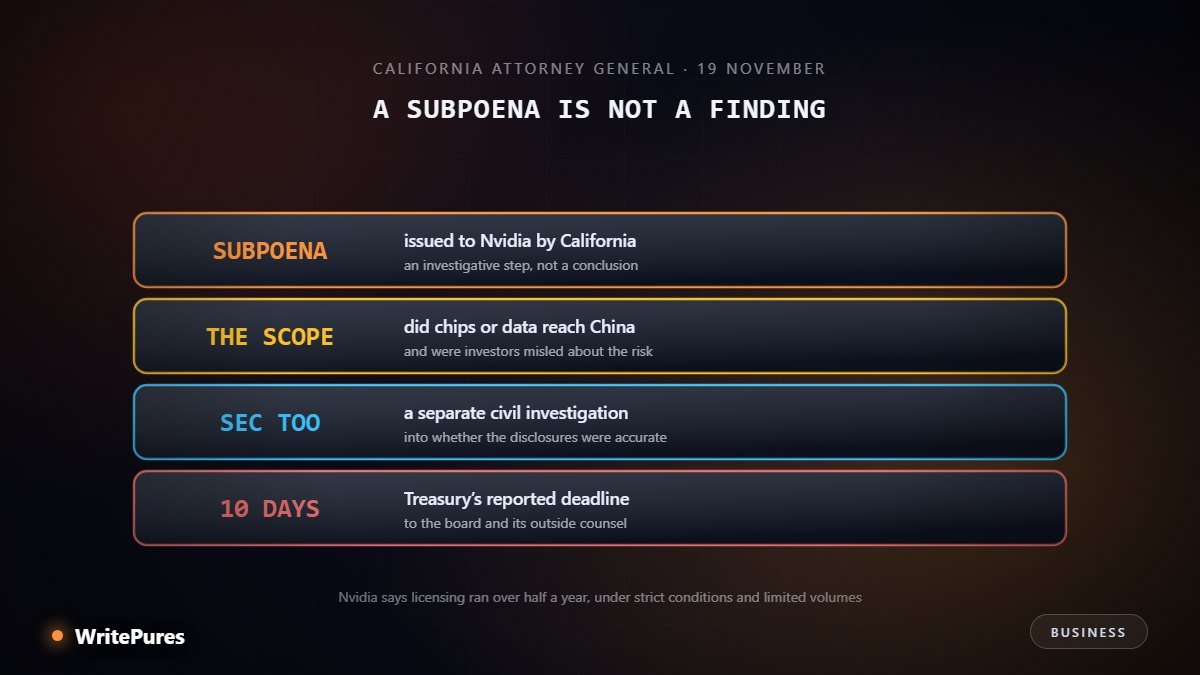
California's attorney general has issued an investigative subpoena to Nvidia, seeking information on whether its advanced chips or confidential data reached China and whether investors were misled about the risk. It arrives alongside an SEC inquiry, a Treasury deadline and three congressional reviews — and none of it, yet, amounts to a finding that Nvidia did anything wrong.
What a subpoena is, and is not
Worth settling first, because the coverage blurs it. An investigative subpoena compels a company to produce documents and information. It means a regulator wants to look. It is not a charge, a lawsuit, a settlement or a conclusion, and plenty of investigations opened this way end without any action at all.
It is still significant. A state attorney general does not subpoena one of the world's largest companies casually, and the scope tells you what is being asked.
The scope
Two questions, issued 19 November:
- Whether Nvidia's advanced chips or confidential information reached China.
- Whether the company misled investors about the risks of that.
The second is the one with teeth. Export-control questions are largely federal; securities disclosure is where a state attorney general and the SEC both have reach, and where the consequences land on the company rather than on a shipping licence.
And it is not the only inquiry
- The SEC has reportedly opened a civil investigation into whether Nvidia's disclosures gave investors an accurate picture of the business.
- Treasury Secretary Scott Bessent is reported to have given the board and its outside counsel ten days to answer whether questionable sales were used to inflate earnings.
- Three House committees are examining whether sensitive US technology reached China.
On the context around the timing
The subpoena came roughly a week after Jensen Huang resigned with no reason given by the company. Reporting connects the timing to allegations about his personal conduct and a Singapore-based firm said to be under investigation for diverting restricted chips.
We said when he resigned that we would not repeat unproven personal allegations as fact, and that has not changed because an investigation opened. What is reportable is the official action: a state subpoena, an SEC inquiry and a congressional review all exist, and the allegations are the context others have given for why. Whether any of it is substantiated is precisely what the investigations are for.
What Nvidia says
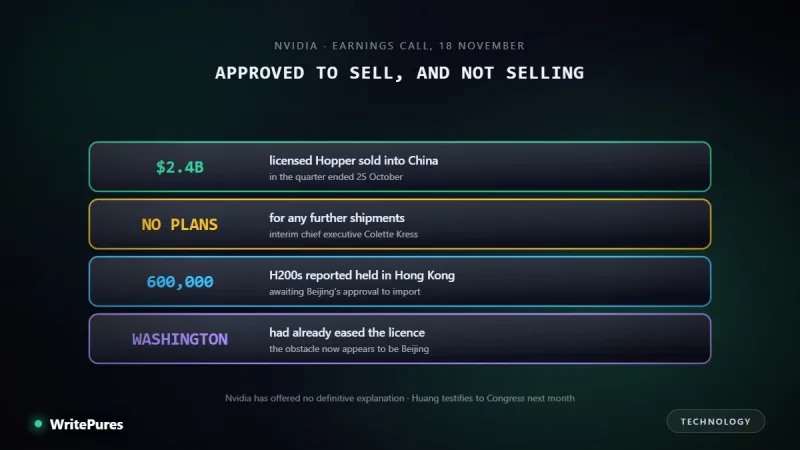
A spokesperson said the review and licensing process ran for more than half a year, with approvals subject to strict conditions and limited volumes. The company has also stopped shipping H200s to China entirely — announced on the earnings call the day before the subpoena.
Those two facts sit together awkwardly. Halting shipments is consistent with a company tidying up before scrutiny, and equally consistent with a company that simply cannot get the chips into China because Beijing will not approve imports. Both explanations fit the available evidence, and the honest position is that it is not yet possible to tell which is right.
Why it matters beyond Nvidia
The export-control regime on advanced chips depends on companies policing their own distribution chains. If a sanctioned destination can be reached through intermediaries in third countries, the regime is weaker than it looks on paper — and the policy response to that tends to be blunter rules that affect everyone selling into Asia, not just the company under investigation.
For investors, the live question is narrower and older than AI: not whether the chips are good, but whether the disclosures were complete.
Written by the WritePures newsroom. Spotted something that needs updating? Tell our editors.
0 Comments
Join the conversation
Replying toNo comments yet. Be the first to share your thoughts.