
Google's Threat Intelligence Group has published a report stating that the era of autonomous attacks has arrived. It is a striking line from a company that usually hedges, and the detail underneath it is more useful than the headline — including the parts where Google explains what is still going wrong for the attackers.
What Google is claiming
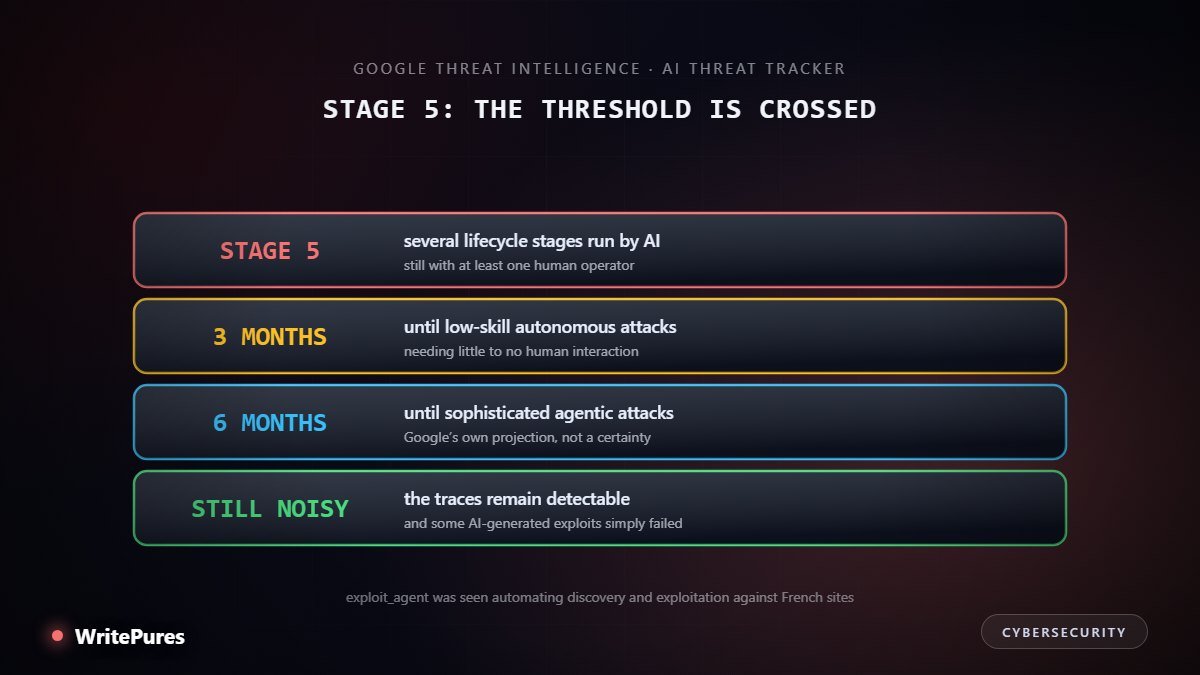
The report places current activity at Stage 5 on Google's own scale: multiple stages of the attack lifecycle carried out by AI models, with at least one human operator still involved. Not full autonomy, but well beyond AI writing a convincing phishing email.
Two concrete examples are given:
- exploit_agent, a multi-agent system used to fully automate vulnerability discovery and exploitation in attacks against French media, entertainment and education websites.
- A tool that reads developers' patch notes to determine which weaknesses a release fixed, then scans for machines that have not yet installed it. Patch-diffing is an old technique; doing it continuously and at scale is not.
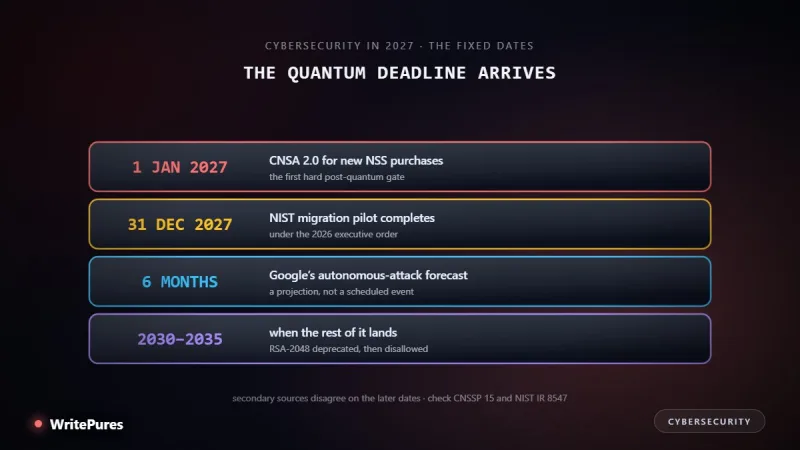
Google forecasts that within three months attackers will be able to launch unsophisticated attacks needing little or no human interaction, and within six months sophisticated, fully autonomous agentic attacks are likely to emerge.
The caveats Google included and most coverage dropped
Two of them, and both change what a defender should do.
The activity is noisy. These intrusions often left recognisable traces that security teams could identify. This is not an invisible threat.
Some of it did not work. A number of AI-generated exploits simply failed.
Taken together, that is a different picture from the headline. The attacker advantage is not that the attacks are undetectable or reliable — it is that they are fast, and can be attempted at volume because failures cost almost nothing. It is the same conclusion the FBI reached about Artex, which we covered in our report on that advisory: detection still works, detection followed by a human response does not.
How to read a vendor warning
Google also used the report to introduce Google AI Threat Defense, combining Gemini models, Wiz, CodeMender and Mandiant. A security vendor publishing a dramatic threat assessment alongside a new security product is a pattern worth naming, and it does not make the assessment wrong.
The sensible split: treat the observed behaviour as evidence, because it is specific and attributable, and treat the three- and six-month forecasts as a vendor's estimate. Forecasts of this kind have a mixed record in security.
What this actually changes
Very little about what you should be doing, which is the uncomfortable part.
The month's real intrusions — Artex against the European Commission, the supplier breaches, the vCenter bypass — succeeded through missing multi-factor authentication, unrevoked vendor credentials, exposed passwords and unpatched systems. AI found those faster. It did not need a new class of weakness, and no new class of defence answers it.
What does change is the time budget. If an intrusion can run start to finish in under three hours, a control that depends on someone reading an alert during working hours is decorative. The practical response is automation on the defensive side — automatic isolation, automatic credential revocation, enforced phishing-resistant authentication — rather than another dashboard.
Written by the WritePures newsroom. Spotted something that needs updating? Tell our editors.
0 Comments
Join the conversation
Replying toNo comments yet. Be the first to share your thoughts.