

Broadcom has disclosed a critical authentication bypass in VMware vCenter that gives an unauthenticated attacker with network access Administrator-level control. There is no workaround, and the fix cannot be applied through Quick Patch. If you run vCenter, this is a this-week problem.
The essentials
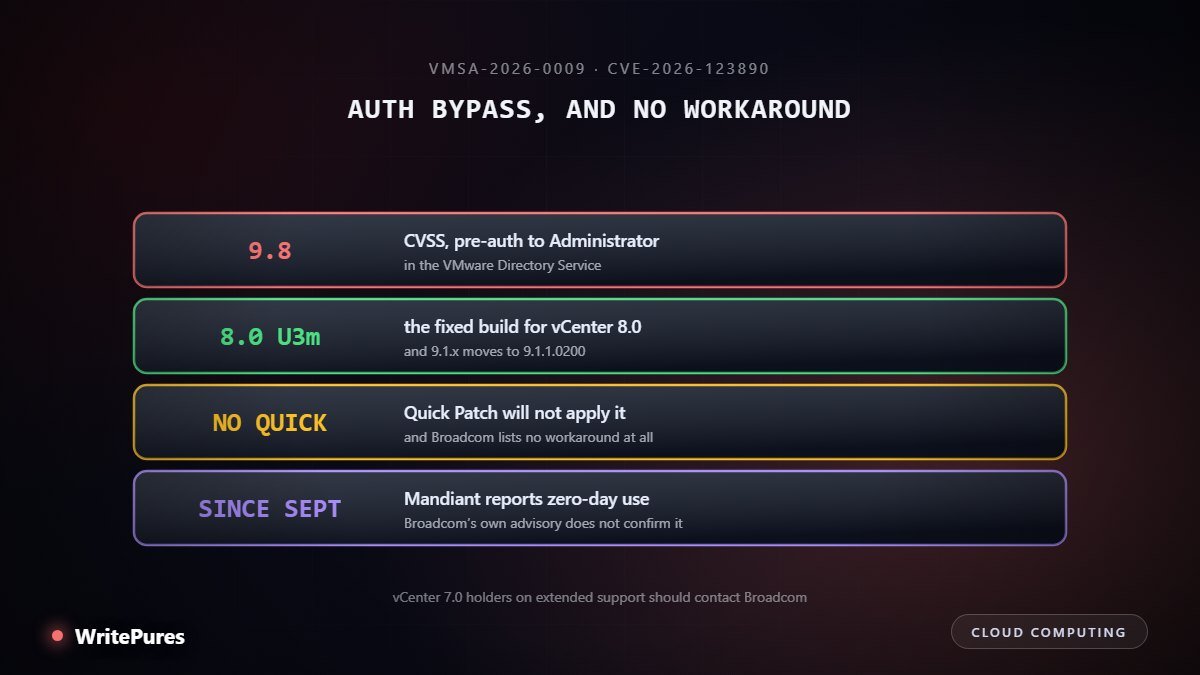
- CVE-2026-123890, in advisory VMSA-2026-0009, published 19 November 2026.
- CVSS 9.8. Authentication bypass in the VMware Directory Service component.
- Pre-authentication. Network access is the only prerequisite. The result is Administrator-level access.
- Affected: vCenter 8.0, 9.0 and 9.1, including the builds shipped inside VMware Cloud Foundation and vSphere Foundation.
- Fixed builds: 8.0 U3m for the 8.0 line, 9.1.1.0200 for 9.1.x. vCenter 7.0 with extended support: contact Broadcom.
- No workaround. And Quick Patch will not apply it.
The advisory covers five issues in total — CVE-2026-123890 through 123894 — with the other four in SDDC Manager and VMware Tools for Windows. This is also a distinct flaw from CVE-2026-59309, the earlier 2026 vCenter authentication bypass, so patching that one does not cover you.
Why this is worse than a typical critical
Three things compound here.
vCenter is the keys to the estate. Administrator access to vCenter is not access to one server; it is control of the virtualisation layer beneath many of them. Snapshots, console access, the ability to deploy. There are few targets in an enterprise network with a better effort-to-reward ratio.
There is nothing to do except patch. With most criticals you can buy time — disable a feature, add a WAF rule, restrict a port. Broadcom lists no workaround. The only mitigation available is the ordinary one of restricting network reachability to vCenter, which you should already be doing and which is not a substitute.
Quick Patch does not apply. That turns a fast, low-ceremony update into a full patching cycle with a maintenance window — exactly the kind of friction that pushes work into next month. Given the first two points, that is the wrong instinct here.
The exploitation question, stated carefully
Mandiant, which reported the bug, says a suspected China-linked group has exploited it as a zero-day since September 2026. Broadcom's advisory does not confirm exploitation.
Both of those can be true: vendors routinely decline to characterise exploitation in an advisory. For planning purposes the sensible position is to treat the Mandiant reporting as operative — assume a capable actor has had a pre-auth path into vCenter for roughly two months — while being precise, when you brief anyone, that the vendor has not corroborated it.
The practical consequence of a two-month window is that patching alone is not a complete response.
What to do, in order
- Inventory vCenter instances, including those embedded in Cloud Foundation and vSphere Foundation deployments, which teams routinely forget are separate installations.
- Schedule the maintenance window now. Quick Patch is not an option, so this needs planning rather than a drive-by update.
- Restrict network reachability to vCenter management interfaces in the meantime. Not a fix, but it reduces who can reach the bypass.
- Hunt retrospectively. If the September date holds, look for unexpected administrative logins, new accounts, unusual snapshot or export activity, and changes to SSO configuration across that window.
- Patch the other four in the advisory as part of the same cycle.
The organisations that come out of this well will be the ones who can answer "where is every vCenter we run" quickly — the same capability that decides how any zero-day response actually goes, and the same lesson as this week's Java4Shell flaw, where the hard part was scoping rather than patching.
Written by the WritePures newsroom. Spotted something that needs updating? Tell our editors.
0 Comments
Join the conversation
Replying toNo comments yet. Be the first to share your thoughts.