

The honest answer to "is local cheaper?" is usually no, and the people for whom it is cheapest are rarely buying it for the money. Here is the arithmetic that settles it either way.
The Two Shapes
These are different kinds of cost, not different amounts of it.
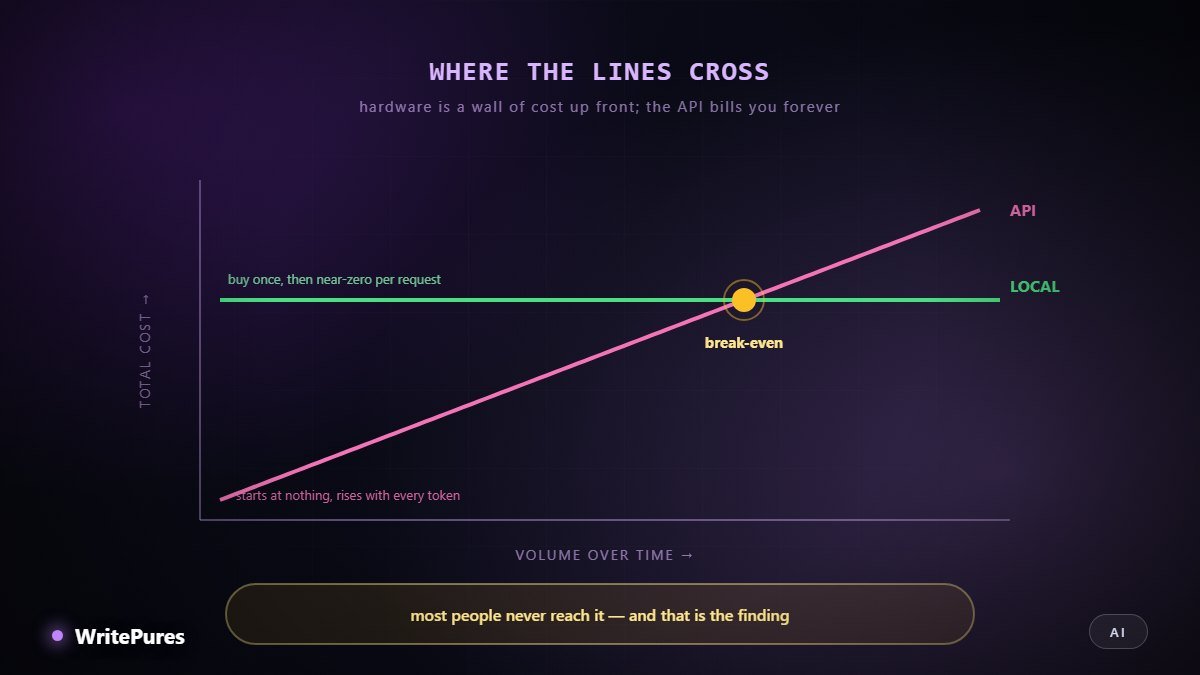
An API is a variable cost. Nothing upfront, then a charge per token in and out. Use it twice a month and it is nearly free; use it continuously and the bill scales without limit.
Local is a fixed cost. A large payment upfront for hardware, then near-zero per request beyond electricity. Use it twice a month and you have wasted the money; use it constantly and it becomes very cheap per query.
Plotted together, the local line is flat and the API line rises. Where they cross is your break-even. Everything else in this article is about finding that point honestly.
The Calculation
- Measure your actual monthly tokens. Not estimated — measured, over at least two weeks against a metered API.
- Multiply by the current rate for the model you would actually use. Check it today; these move.
- That is your monthly API cost.
- Total the hardware you would need — card, and any power supply or memory upgrade it forces.
- Divide hardware by monthly API cost. The result is months to break even.
If that number is under about eighteen months, local is worth serious consideration. If it is over three years, you are buying something other than savings — which is fine, but name it.
The number everyone gets wrong
Token volume. A million tokens sounds trivial and is roughly 750,000 words — something like ten novels. A developer leaning on a model hard all day will struggle to spend that in a month.
This single misjudgement drives most unnecessary hardware purchases. People imagine an enormous bill, buy a card to avoid it, and discover afterwards that their real usage would have cost a modest amount per month. Measure before you buy. Two weeks of metered usage costs very little and answers the question properly.
What Gets Left Off Each Side
Missing from the local column:
- Electricity. A card pulling several hundred watts under sustained load is a real line item, and a much bigger one where power is expensive or supply is unreliable.
- Your time. Setup, updates, debugging, and the afternoon lost to a driver problem.
- Depreciation. The hardware ages and the models grow. A card that comfortably runs today's best open weights may not run what arrives in eighteen months — our VRAM guide shows how quickly requirements scale with model size.
- Capital tied up that could have gone somewhere else.
Missing from the API column:
- Retries and failed calls. You pay for output you discard.
- Prompt overhead. System prompts and retrieved context are billed on every single call, and they are often larger than the user's actual question.
- Growth. If the thing you are building works, volume rises — and the bill rises with it.
Where Each One Clearly Wins
| Situation | Usually better |
|---|---|
| Occasional personal use | API — you will never reach break-even |
| Learning and experimenting | API first; buy hardware once you know your usage |
| Heavy continuous use, stable volume | Local |
| Confidential or client data | Local, regardless of cost |
| Unpredictable or spiky demand | API — you cannot buy elasticity |
| Frontier-quality output required | API — the best hosted models still lead |
| Unreliable internet or power | Depends which fails more where you are |
The Reason That Is Not Money
For a large share of people running models locally, cost is the justification and control is the motive.
Data never leaves the machine — which for client work, health or financial data, or anything under an NDA is not a preference but a requirement, and intersects directly with obligations like those in Pakistan's data protection bill. There is no rate limit, no outage, no model deprecated out from under a product you shipped, no terms change.
Those are real benefits and they are worth paying for. They are just not savings, and a decision made on savings that was really about control tends to be defended badly later. This is the same build-versus-buy question that shows up everywhere in software — our guide to deciding between build and buy covers the general form.
A Sensible Default
Start on an API. Measure for a month. Then decide.
You will learn your real volume, which model quality you actually need, and whether the use case survives contact with reality — all before committing capital. If the numbers then justify hardware, buy it knowing why. Our guide to running local LLMs covers what to do next.
Key Takeaways
- API is variable cost, local is fixed — find where the lines cross.
- Hardware total ÷ monthly API bill = months to break even.
- Under 18 months is compelling; over 3 years you are buying something else.
- Almost everyone overestimates token volume — measure for two weeks first.
- Privacy and control are good reasons to go local; call them that, not savings.
Written by the WritePures newsroom. Spotted something that needs updating? Tell our editors.

0 Comments
Join the conversation
Replying toNo comments yet. Be the first to share your thoughts.