
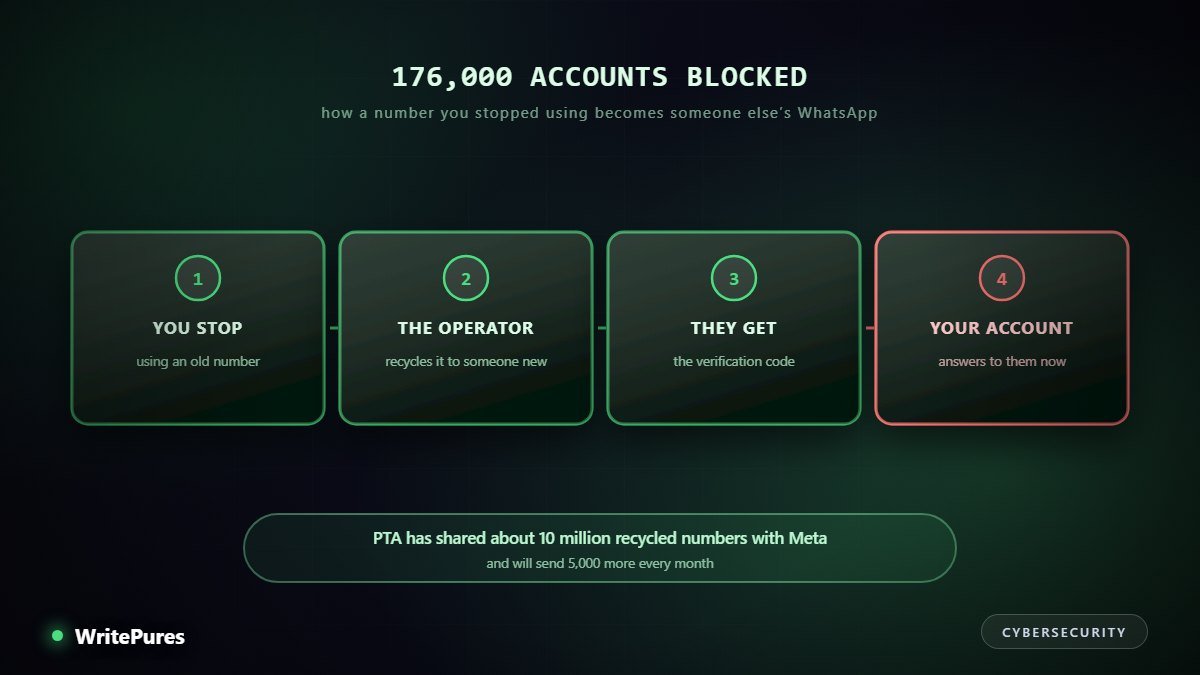
Around 176,000 WhatsApp accounts in Pakistan were switched off this week because they were running on phone numbers that no longer belonged to the people using them. The mechanism behind it is not a hack, and that is precisely why it keeps working.
What Was Announced
According to a Pakistan Telecommunication Authority briefing reported on 6 and 7 November 2026:
- About 176,000 WhatsApp accounts operating on recycled mobile numbers have been blocked, at PTA's request to Meta.
- Around 10 million recycled numbers have been shared with Meta for verification and action, out of roughly 16 million held by operators in total.
- Blocking is being carried out in phases rather than all at once, to limit misuse during the process.
- A standing arrangement will see PTA pass 5,000 recycled numbers to Meta every month.
- PTA also said Meta resolved 82 per cent of complaints the regulator forwarded over the previous year.
One caveat on sourcing: these figures come from a single PTA briefing, repeated across several outlets. The numbers are consistent everywhere because they share one origin, not because they have been independently confirmed.
Why This Works, and Why It Is Not a Hack
Nothing is broken here. Every component behaves as designed.
- You stop using a number. You switch operator, move abroad, or simply let a second SIM lapse.
- The operator reclaims it. Phone numbers are a finite resource, so after a dormancy period the number goes back into the pool and is reissued. In Pakistan that pool reportedly runs to about 16 million numbers.
- Someone new receives it — an ordinary customer buying a SIM, with no idea of its history.
- They register WhatsApp. WhatsApp sends a verification code to the number. It arrives on their handset, because the number is theirs now. The account becomes theirs.
The flaw is conceptual: WhatsApp treats a phone number as a permanent identifier, and phone numbers are not permanent. Anything that uses SMS as proof of identity inherits this weakness, which is the same structural problem behind SIM-swap fraud — covered in our guide to stopping SIM-swap and OTP fraud, and part of why passkeys exist as an alternative to codes sent over the network.
What the new holder actually gets
Not your messages. Chat history lives on your device and in your own backup, and does not travel with the number.
What they get is your identity in other people's phones. Your contacts see your name and your picture. You may still be in groups. Requests for money from a familiar account are far more effective than from a stranger — which is exactly the pattern described in our coverage of hijacked WhatsApp Business accounts in Pakistan. The damage is done to the people who trust you.
What to Do, in Order
- If you still have the old number, use Change Number. WhatsApp's built-in feature migrates your account, groups and settings to the new number and frees the old one properly. This is the clean fix and it takes two minutes.
- If the old number is gone, register on the new number, and delete the account on the old one if you can still reach it at all.
- Turn on two-step verification in WhatsApp. It adds a PIN that a verification code alone cannot bypass — the single most effective protection against this specific takeover.
- Audit everything else tied to that number. Bank, email recovery, government portals, social accounts, delivery services. WhatsApp is the visible case; the recovery contact on your email account is the dangerous one.
- Tell the people who matter if a number has lapsed, so a message from it is treated with suspicion.
If you are switching handsets as well as numbers, the sequencing matters — our guide to moving to a new phone covers doing both without losing access, and the eSIM explainer covers how number transfers work when there is no physical SIM to move.
The Part Worth Noting
This is a regulator and a platform co-operating on a structural weakness rather than chasing individual fraudsters, which is the more useful kind of intervention — and a monthly data-sharing arrangement is a genuine process rather than a one-off announcement.
It does not solve the underlying issue. As long as identity is tied to a recyclable number and proven by a code sent to it, this category of takeover remains available. Blocking accounts after the fact reduces harm; it does not remove the mechanism.
Key Takeaways
- 176,000 WhatsApp accounts blocked for running on recycled numbers.
- PTA has shared about 10 million recycled numbers with Meta, of roughly 16 million.
- No hacking is involved — the number is simply no longer yours.
- Use Change Number before abandoning a number, and enable two-step verification.
- Audit every account using that number for recovery, not just WhatsApp.
Written by the WritePures newsroom. Spotted something that needs updating? Tell our editors.
0 Comments
Join the conversation
Replying toNo comments yet. Be the first to share your thoughts.