
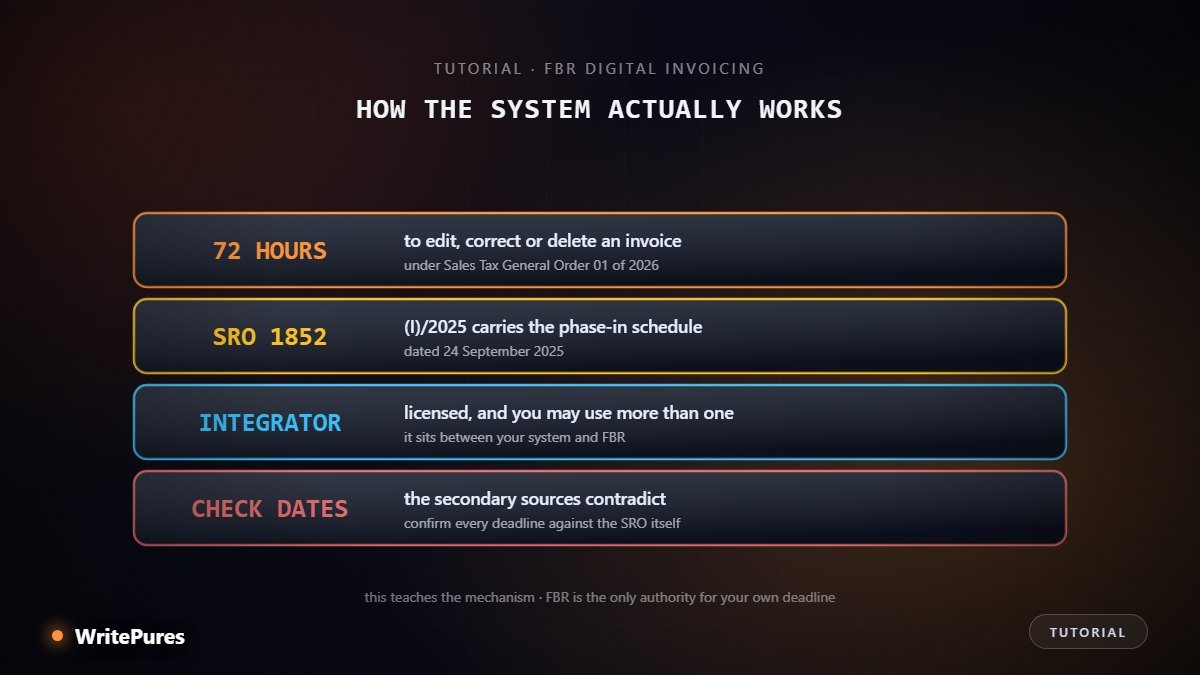
Pakistan has moved sales tax invoicing from monthly summaries to real-time reporting. Instead of filing what you sold after the fact, your system sends each invoice to FBR as it is issued and gets back an identifier that goes on the customer's copy.
For a business, that is not a filing change. It is a change to the software that produces your invoices, and it has to work every time a customer is standing at a counter.
This tutorial covers what that integration actually involves — the architecture, the options for getting there, how to test without affecting live records, what happens when something fails mid-sale, and how corrections work. It is written for the person who has to make it function, whether that is a developer, an IT manager or an owner briefing a vendor.
Why the deadlines are not in here
While preparing this, FBR's own digital-invoicing pages and the PRAL portal returned no readable content to an automated reader, so nothing could be confirmed at source. The secondary guides then disagree with each other: published summaries of the phase-in put the sales-tax dates in late 2025 in one account and in mid-2026 in others, and stated penalties range from figures in the thousands to Rs 500,000 escalating every fifteen days.
They cannot all be right, and the cost of following the wrong one is yours. So this tutorial gives you the parts that are stable and tells you exactly which questions to put to FBR.
What you will understand by the end
- How an invoice travels from your system to FBR and back.
- The realistic integration routes, and which suits your size.
- How to test safely before going live.
- What to do when the connection fails during a sale.
- How corrections work, and the window you have.