

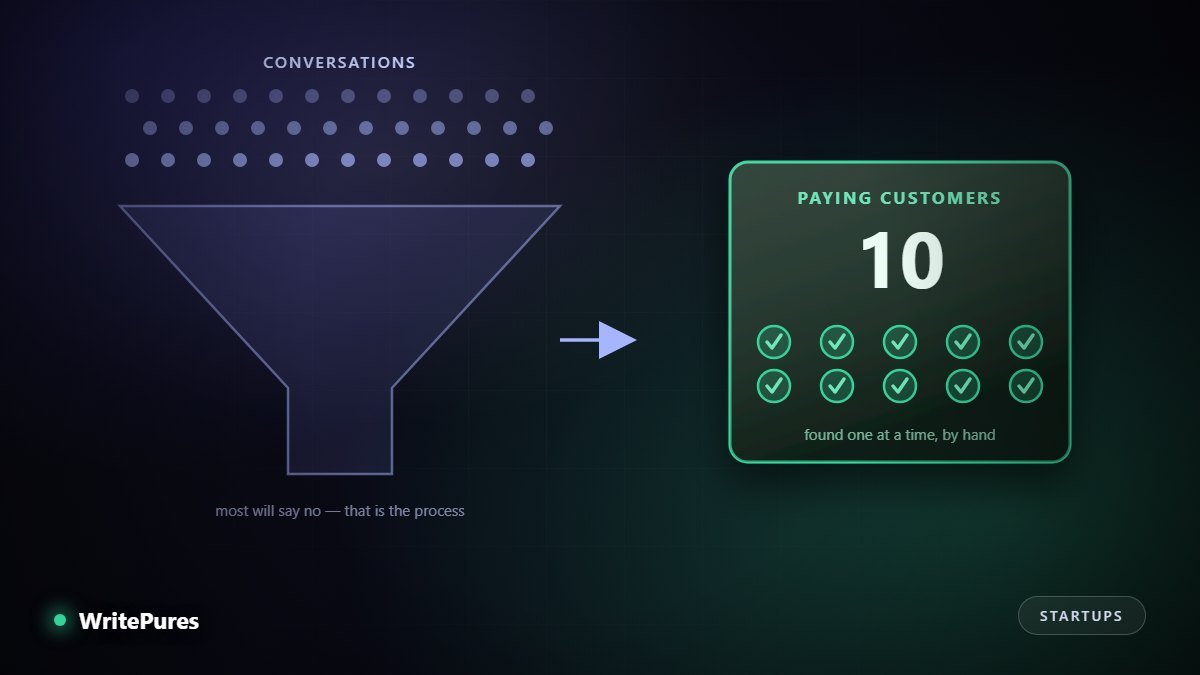
Almost every founder underestimates how manual the beginning is. There is no channel, no funnel and no repeatable motion at the start — there is a list of names, a series of conversations, and ten people eventually persuaded one at a time.
Why the First Ten Are Different
Growth tactics assume something you do not yet have: a message that converts. Advertising amplifies it, content attracts people searching for it, referrals spread it. None of that functions before the message exists.
The first ten customers exist to produce three things:
- Proof that someone will pay, which no amount of encouraging feedback substitutes for.
- The language that works — the specific words that made someone say yes, which are almost never the words you started with.
- A reference, because the eleventh customer will ask who else uses this.
Expect it to be unscalable, and stop treating that as a problem to solve. It is the correct shape of the work at this stage.
Where to Actually Look
In rough order of how well they convert:
- People who already told you about the problem. If you validated properly, you have a list. Those conversations earn the right to return — see our guide to validating a startup idea.
- Your own network, used precisely. Not a broadcast post. Individual messages to people who plausibly have this problem, or who know someone who does.
- Suppliers to your customers. The most underused route: an accountant, a distributor or an agency already serving your target market can introduce you, and will if you are not a competitor.
- Communities where the problem is discussed — trade associations, professional groups, industry forums. Participate usefully for weeks before mentioning what you built.
- Competitors' unhappy customers. They have budget and have already decided the problem is worth paying to solve. Ask what they wish were different.
- Public writing about the problem. Slow to start and compounds, which makes it worth beginning now even though it will not produce the first ten.
What rarely works this early: paid advertising, cold mass email, launch platforms, and announcing to a general audience that cannot distinguish your product from the hundred others announced that day.
What to Say
The opening that works is short, specific and asks for a conversation rather than a sale.
- Name the problem in their words, not your product in yours. "You mentioned reconciling supplier invoices takes two days a month" beats any description of your platform.
- Say why you are contacting them specifically. A message that could have gone to anyone reads as spam, because it is.
- Ask for fifteen minutes, not a purchase. The first meeting is for understanding; selling in the first message mostly ends the conversation.
- Be a person. At this stage being small and direct is an advantage — use it rather than writing as if you were a large company.
In the conversation, listen considerably more than you present. You are still learning which problem you solve.
Closing, and What to Charge
Charge from the first customer. Free users are polite and uninformative; payment is the only reliable signal.
- Discount, do not give away. An early-customer price is honest and keeps the payment signal intact.
- Offer something that costs you time, not margin — hands-on setup, direct access to you, a feature they need. Early customers value attention more than discounts.
- Make the first commitment small. A short pilot with a clear success measure is easier to say yes to than an annual contract.
- Ask directly. "Would you like to start on Monday?" Conversations stall most often because nobody asked.
When you set a standing price, our guide to pricing a SaaS product covers why almost everyone starts too low.
Do Things That Do Not Scale — Deliberately
Onboard each customer personally. Set up their data yourself. Give them your phone number. Fix their problem manually while the software catches up.
This is not a stopgap. It is how you learn what the product must do, and it produces the one thing you cannot buy: customers who feel the company cares, and who will say so when the eleventh prospect asks for a reference.
Key Takeaways
- The first ten come from conversations, not channels; marketing amplifies a message you do not have yet.
- Suppliers to your customers are the most underused introduction route.
- Charge from the first customer — free feedback is polite and worthless.
- Ask for fifteen minutes, then ask directly for the business.
- Unscalable, personal service early is how you learn what to build.
Written by the WritePures newsroom. Spotted something that needs updating? Tell our editors.


0 Comments
Join the conversation
Replying toNo comments yet. Be the first to share your thoughts.