

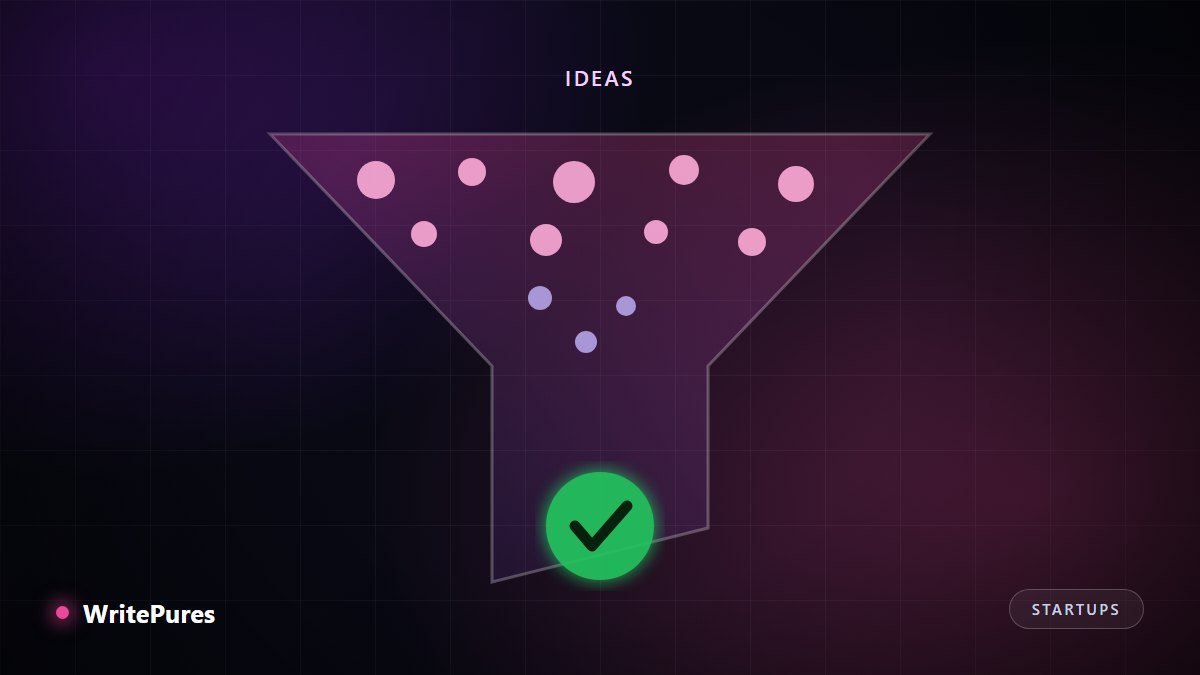
The most common reason startups fail is not running out of money or being outcompeted. It is building something people did not want badly enough to pay for. Validation is the discipline of discovering that cheaply, before it costs you a year.
What Validation Actually Proves
Validation does not prove your idea will work. Nothing does. What it can establish, cheaply, is a much narrower and more useful set of facts:
- A specific group of people has a specific problem.
- That problem costs them something real — money, time, or risk they can name.
- They are already doing something about it, however badly.
- They have the authority and the budget to adopt a different solution.
Notice that none of these are about your product. Validation is about the problem, and the most common failure is skipping straight to testing a solution. If the problem is not real and expensive, no solution will sell — and if it is, you will find out what to build during the process.
The Problem Interview, Done Properly
Most founder interviews are worthless because they ask people to predict their own future behaviour, which humans do badly, and because they telegraph the answer the founder wants to hear. Friends and family are especially unreliable for exactly this reason.
Two rules fix most of it: ask about the past, not the future, and never describe your idea until the end.
Questions that produce signal
- "Walk me through the last time this happened."
- "What did you do about it?"
- "What did that cost you — in money, in hours, in anything else?"
- "What have you already tried? Why did you stop?"
- "Who else is affected when this goes wrong?"
- "If this were fixed tomorrow, what would change for you?"
Questions that produce noise
- "Would you use a product that…?" — invites politeness, not truth.
- "Do you think this is a good idea?" — asks for an opinion they are unqualified to give.
- "How much would you pay for…?" — hypothetical pricing is almost always wrong.
- "Don't you find X frustrating?" — supplies the answer inside the question.
The emotional tell is worth watching for. People describing a genuinely painful problem become animated, specific and occasionally irritated. Polite agreement delivered calmly usually means the problem is real but minor.
Signals That Count — and Vanity Signals
| Strong signal | Weak signal |
|---|---|
| Someone pays before the product exists | Someone says they would definitely buy it |
| They already pay for an inadequate alternative | They agree the problem is annoying |
| They built a spreadsheet or manual workaround | They have never tried to solve it |
| They introduce you to a colleague with the same problem | They compliment the idea |
| They ask when they can have it | They sign up for a waiting list |
The pattern is simple: signals that cost the other person something are real; free signals are not. Money is the strongest, but time, introductions and existing workarounds all count because they represent effort already spent.
Cheap Tests That Produce Honest Evidence
- The concierge test. Deliver the outcome manually for a handful of customers, with no product at all. Slow and unscalable by design — it proves whether the outcome is wanted, and teaches you exactly what to automate.
- The pre-sale. Ask for payment or a signed commitment before building. Uncomfortable, and the single most informative thing you can do.
- The manual-first service. Run the process with spreadsheets and messages. If it does not work manually, software will not rescue it.
- The competitor probe. Find people paying a competitor and ask what they wish were different. They have already proved budget exists.
- The landing page. Useful for testing which message resonates. Treat sign-ups as interest, not demand.
How to Avoid Fooling Yourself
The hardest part of validation is that you want a particular answer. Three habits help:
- Write down what would change your mind before you start. Decide in advance what result would make you abandon the idea. Without this, any outcome can be read as encouraging.
- Separate the interviewer from the advocate. While interviewing, your job is to understand, not to persuade. Pitching contaminates the data.
- Record and review. Memory keeps the encouraging quotes and quietly discards the lukewarm ones.
Be equally willing to find that the problem is real but not expensive enough. That is the most common honest outcome, and recognising it early is a success, not a failure.
When to Stop and Build
You are ready when you can describe the problem using your customers' own vocabulary, name who suffers it most acutely, point to what it costs them, and show at least one person committing something real before the product exists. If you cannot do all four, more building will not help — more listening will.
Key Takeaways
- Validate the problem, not the solution; the product follows from understanding it.
- Ask about past behaviour, never about hypothetical future purchases.
- Signals that cost the other person something are the only reliable ones.
- Concierge tests and pre-sales produce more truth than any survey.
- Decide in advance what evidence would make you walk away.
Once an idea survives validation, the funding question follows. Our B2B SaaS funding playbook covers how that choice shapes what outcomes stay available, and why profitability has been outperforming growth-at-all-costs is worth reading before raising anything. For what a very small team can now sustain alone, see our piece on one-person software businesses.
Written by the WritePures newsroom. Spotted something that needs updating? Tell our editors.







0 Comments
Join the conversation
Replying toNo comments yet. Be the first to share your thoughts.