
A handful of materials most people could not identify determine who is able to manufacture electric motors, batteries, wind turbines and advanced semiconductors. They surface in the news during trade disputes, and the coverage almost always focuses on the wrong part of the chain.
What These Materials Actually Do
"Critical minerals" is a policy term rather than a scientific one: it means materials a country considers essential to its economy and vulnerable to supply disruption. The specific list varies between governments, but the recurring entries do recognisable jobs.
- Lithium, cobalt, nickel, graphite — battery cells. Graphite usually forms the anode; the others are concentrated in the cathode and in battery chemistry.
- Neodymium, praseodymium, dysprosium — permanent magnets. These make compact, powerful electric motors possible, which is why they matter for vehicles, wind turbines, drones and hard drives.
- Gallium, germanium — specialist semiconductors, high-frequency devices, LEDs, infrared optics.
- Copper — unglamorous and enormous in volume. Electrification is, in large part, a copper problem.
The common thread is that substitutes usually exist on paper and are worse in practice — heavier, less efficient, or more expensive — so swapping them out costs performance.
Rare Earths Are Not Rare
Several rare earth elements are more abundant in the crust than metals nobody worries about. The difficulty is threefold: they seldom occur in concentrated deposits, they occur mixed with each other and have very similar chemistry, and separating them requires long chemical processes that generate hazardous and sometimes radioactive waste.
So the scarcity is not geological. It is industrial. The constraint is the capacity and willingness to process, not the availability of ore.
The Chokepoint Is Refining
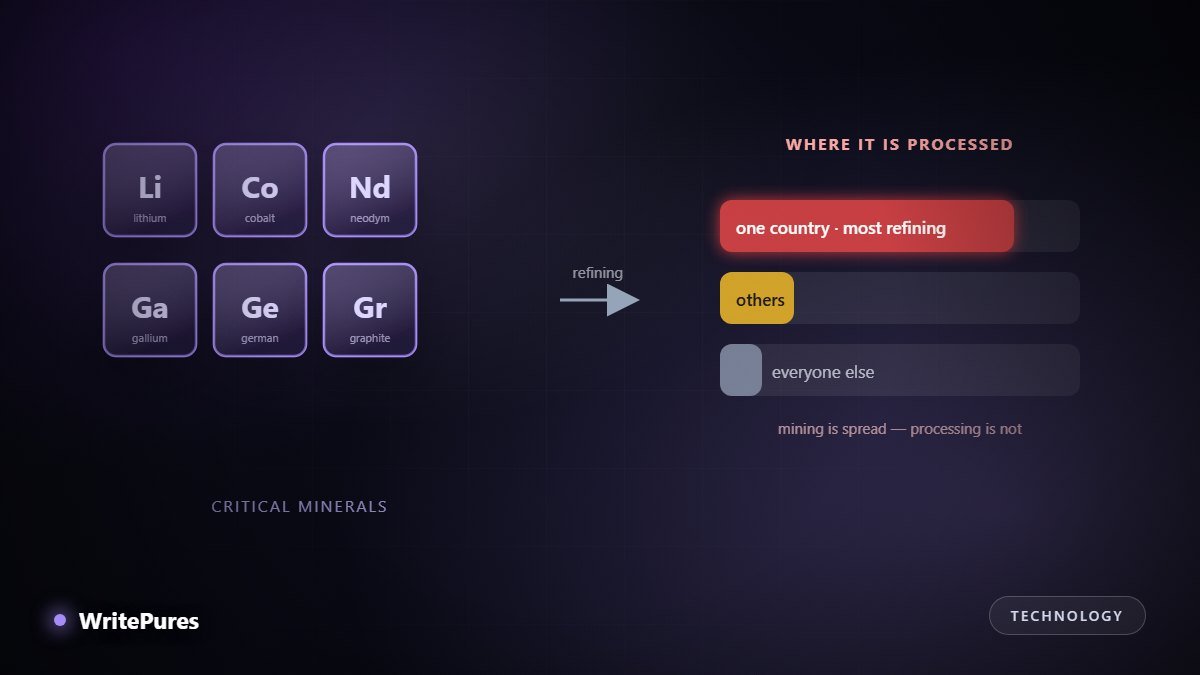
This is the part most coverage misses. Mining is reasonably distributed across many countries. Processing — separation, purification, and conversion into magnets, chemicals and metals to manufacturer specification — is heavily concentrated.
The consequence is stark: a country can hold substantial deposits and still be entirely dependent, because unprocessed ore is not a usable input. It also explains why export controls on processed materials are so much more disruptive than restrictions on raw ore — the processed form is where the bottleneck is.
It is the same pattern we described in how global supply chains work and in the semiconductor supply chain: the fragile link is rarely the one that looks most important.
Why Diversification Is Slow
- Permitting. Separation plants face long environmental review, for sound reasons given the waste they produce.
- Finance. Capital requires long-term purchase commitments, which buyers avoid signing while cheaper supply is available.
- Expertise. The operational know-how sits with those already doing it, and is not quickly replicated.
- Price volatility. An incumbent can increase output and depress prices below a new entrant's costs — a well-understood deterrent to investment.
Which is why announcements of new capacity should be read with attention to processing commitments and timelines, not mining agreements. A mine without a refinery changes very little.
What Would Reduce the Dependence
- Recycling. Recovering magnets and battery materials from end-of-life products. Growing, limited by collection rather than technology.
- Design substitution. Motors engineered to use less of the scarce elements, accepting some performance cost.
- Alternative chemistries. Battery designs that avoid the most constrained inputs, already in commercial use.
- Stockpiling. Buys time during a disruption; does not solve it.
What a Country With Deposits Should Actually Do
Holding reserves is not the same as benefiting from them, and the difference is almost entirely about where in the chain the value is captured.
Exporting unprocessed ore is the fastest route to revenue and the smallest share of it. The value multiplies at each later stage — concentration, separation, refining, component manufacture — and each stage requires capability the previous one does not.
- Negotiate for processing, not just royalties. A contract that includes building separation or refining capacity locally is worth far more over time than a higher royalty on raw ore.
- Be clear-eyed about the environmental cost. Processing generates hazardous waste. A country that wants the industry has to regulate it properly, or it will pay for it later in remediation and public health.
- Build the skills pipeline alongside. Metallurgy and process chemistry expertise is the binding constraint, and it takes a decade to develop.
- Treat one buyer as a risk. A single dominant purchaser sets the price and can simply stop buying.
The pattern holds well beyond minerals: the money and the resilience sit in processing and manufacturing, not in extraction.
Key Takeaways
- Critical minerals is a policy category, not a geological one.
- Rare earths are not scarce in the ground — processing capacity is the constraint.
- Mining is distributed; refining is concentrated, and that is the real chokepoint.
- New capacity takes years because of permitting, finance and expertise.
- Judge announcements on processing commitments, not mining deals.
Written by the WritePures newsroom. Spotted something that needs updating? Tell our editors.



0 Comments
Join the conversation
Replying toNo comments yet. Be the first to share your thoughts.