
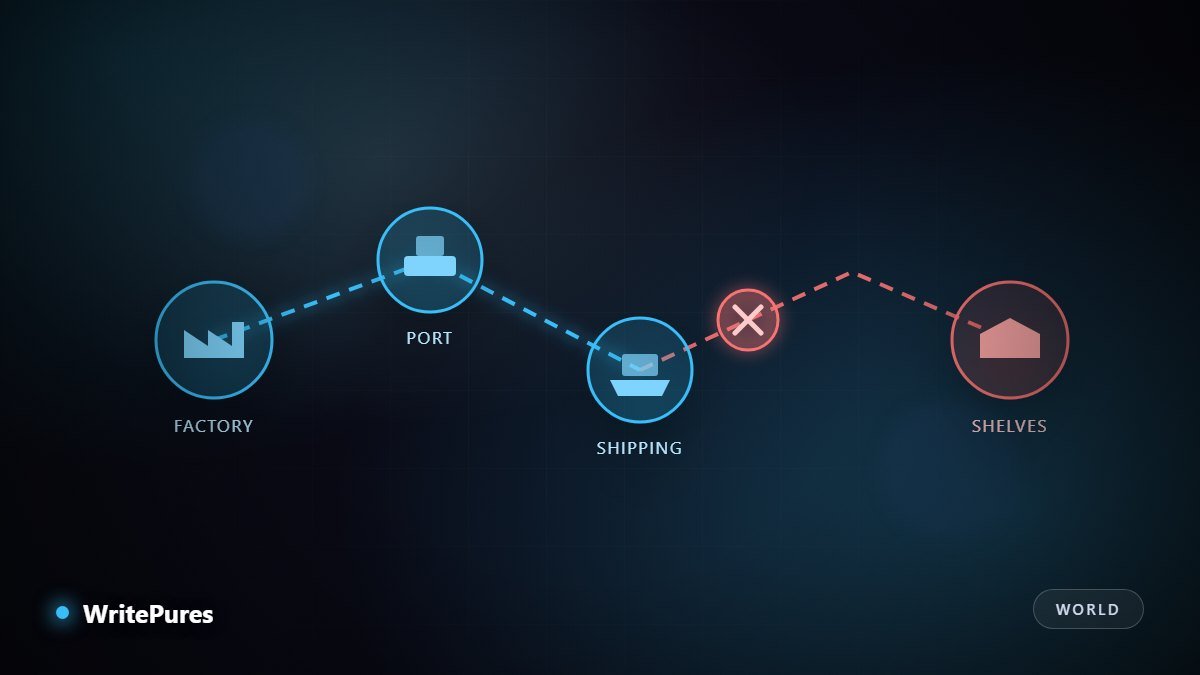
Something on a shelf is the visible end of a chain that may involve dozens of companies across several continents. Understanding its stages explains both why it is so cheap in normal times and why it fails so abruptly when conditions change.
The Stages, in Order
A finished product typically passes through these, each with its own owner, costs and failure modes.
- Raw materials — mined, grown or refined, often in a small number of countries with the right geology or climate.
- Components — materials become parts, frequently in specialised clusters where expertise and suppliers have concentrated.
- Assembly — parts converge. A single factory may draw components from twenty countries, and it cannot ship until the last one arrives.
- Freight — mostly by sea in containers, through a limited number of major ports.
- Customs and clearance — paperwork, duties, inspection. A documentation error here can hold goods longer than the voyage took.
- Distribution — regional warehouses, then onward to retailers.
- Last mile — to the shop or the customer's door. Proportionally the most expensive leg.
Two features matter more than the rest. The chain is only as fast as its slowest stage, and assembly requires everything simultaneously — a car missing one inexpensive component is not a nearly-finished car, it is an unsellable one.
The Buffers That Were Removed
For decades the industry optimised relentlessly for cost, and the main thing it removed was slack.
Inventory is expensive: it ties up money, occupies warehouses, and can expire or become obsolete. Holding less is genuinely more efficient, and just-in-time delivery — parts arriving as they are needed rather than sitting in a store — saves real money every single day that nothing goes wrong.
What inventory also does is absorb shocks. A factory with six weeks of parts can survive a six-week disruption. A factory with two days of parts stops in two days. The same logic applied to spare capacity, alternative suppliers and alternative routes. Each was trimmed because it was idle most of the time — and each was the thing that would have absorbed a disruption.
None of this was irrational. It was a deliberate trade of resilience for cost, made by thousands of firms independently, each of which bore the saving privately while the fragility accumulated across the whole system.
Why Small Disruptions Produce Large Shortages
The amplification has a name: the bullwhip effect.
| Stage | What it sees | What it does |
|---|---|---|
| Customers | Slightly higher need | Buy a little more |
| Retailer | Shelves emptying faster | Orders extra to avoid stocking out |
| Wholesaler | Larger retailer orders | Orders more again, plus a margin |
| Factory | A surge in orders | Expands output and buys more components |
| Component supplier | A very large surge | Cannot meet it; allocates and delays |
A modest change at one end becomes a violent swing at the other, because every stage adds its own safety margin and nobody can see the real end demand. Then it reverses: everyone over-ordered, inventories build, orders stop abruptly, and shortage turns into glut.
Two other features make this worse. Lead times are long, so decisions are made on information that is already weeks old. And allocation behaviour — customers ordering more than they need because they expect to receive only part of it — makes the apparent demand signal even less honest.
What Resilience Actually Costs
There is no version of this where resilience is free. Every measure trades efficiency for it:
- More inventory — money tied up, space, obsolescence risk.
- Second sources — lower volumes with each, so worse prices, plus qualification cost.
- Nearer production — shorter, more controllable chains at higher unit cost.
- Spare capacity — equipment that earns nothing until the day it is needed.
The realistic outcome is not resilient-everywhere but selectively resilient: identify the inputs where failure stops everything, and buy slack only there. For most businesses that is a short list.
Chips are the clearest contemporary example of concentration risk — our piece on the semiconductor supply chain covers why that particular link is so hard to duplicate.
Key Takeaways
- Assembly needs every component at once, so one missing part stops a whole line.
- Efficiency removed the buffers that used to absorb disruption — a deliberate trade, not an error.
- The bullwhip effect turns small demand changes into large swings upstream.
- Long lead times mean decisions are always made on stale information.
- Resilience costs money; buy it only for the inputs that stop everything.
Written by the WritePures newsroom. Spotted something that needs updating? Tell our editors.



0 Comments
Join the conversation
Replying toNo comments yet. Be the first to share your thoughts.