
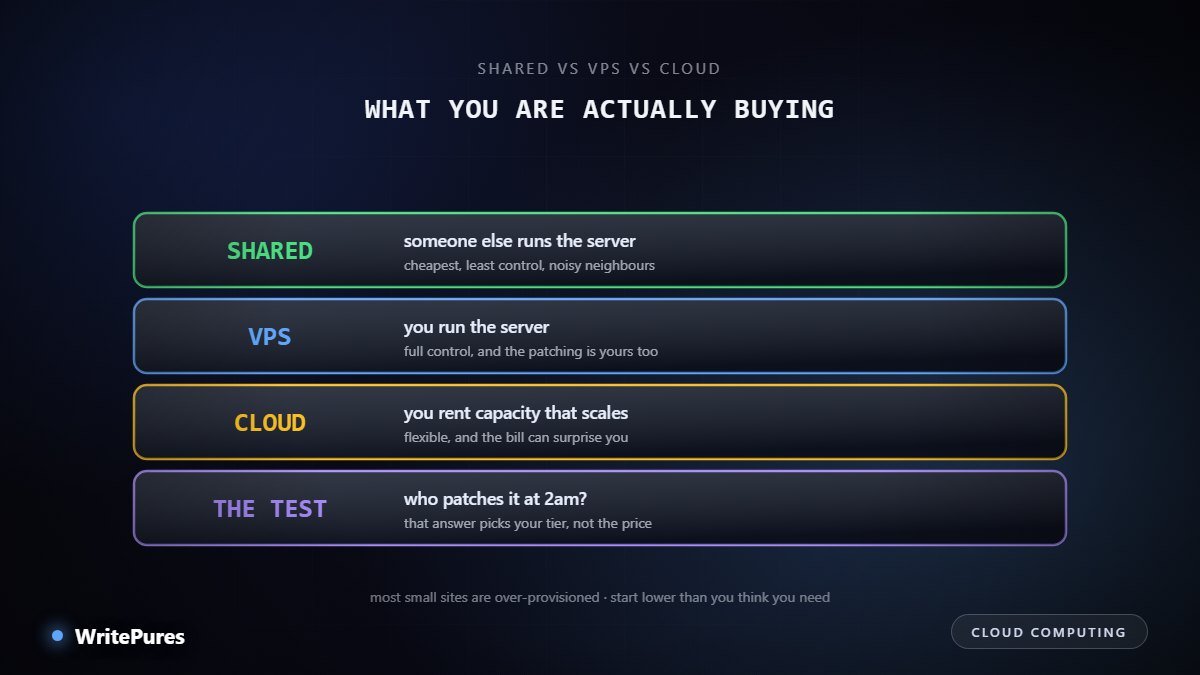
Most hosting comparisons argue about performance figures. For nearly everyone that is the wrong axis — the choice is really about how much of the machine you want to be responsible for, and nobody mentions that until the server stops at an inconvenient hour.
What you are actually buying
Shared hosting. Space on a server that someone else owns, configures, patches and monitors, shared with other customers. You get a control panel and a place to put files.
VPS. Your own virtual machine with root access. You choose the operating system and install anything. You also patch it, firewall it, back it up and fix it.
Cloud. Capacity you rent rather than a machine you keep, able to scale with demand and usually billed by consumption. More moving parts, more flexibility, a less predictable bill.
Side by side
| Shared | VPS | Cloud | |
|---|---|---|---|
| Control | Minimal | Full | Full, plus services |
| Who patches it | The host | You | You, for your layer |
| Cost shape | Low, fixed | Moderate, fixed | Variable |
| Scaling | Change plan | Resize, with downtime | Designed for it |
| Skill needed | Little | Linux basics | More |
| Fails because | You hit a limit | Nobody patched it | The bill |
The question that decides it
Who fixes this at two in the morning?
If the answer is "nobody on my side, and I need it to just work" — shared hosting, and that is a legitimate engineering decision rather than a compromise. An unpatched VPS you own is genuinely worse than a managed platform you do not.
If the answer is "me, and I want the control" — a VPS. Just budget the time, because that is the real price.
If the answer is "a team, and load varies a lot" — cloud.
When to actually move up
Move off shared hosting when you hit a limit, not a traffic number:
- Software you need that the host will not allow.
- A background worker or scheduled job that keeps getting killed.
- Performance that does not improve on a higher plan — a sign of a noisy neighbour rather than your own load.
- A requirement for root, a specific runtime version, or custom networking.
Move to cloud when load genuinely varies — predictable traffic on consumption billing usually costs more than a fixed machine, not less.
What people get wrong
Over-provisioning. A small business site on a four-core VPS that never exceeds 5% CPU is paying for comfort it cannot perceive. Start lower than you think and resize when something actually struggles.
Underestimating maintenance. A VPS is not a one-off setup. It is patching, certificate renewal, backup verification and log management, indefinitely. People who do not budget for it end up running an unpatched server, which is the worst of every option.
Treating cloud as automatically modern. Cloud is a billing and scaling model, not a quality tier. A well-run VPS beats a badly configured cloud setup on every axis including cost.
If you choose a VPS
Do it properly from the first hour — key-only SSH, a firewall with two ports open, automatic security updates, and backups you have actually restored. Our nine-chapter VPS tutorial covers exactly that sequence, in the order that matters: a server exposed with password authentication starts getting attacked within minutes of receiving an address.
And if you are weighing the larger platforms rather than a single machine, our comparison of the three major clouds covers that choice.
Written by the WritePures newsroom. Spotted something that needs updating? Tell our editors.
Part of our guide to business software in Pakistan, which covers the whole subject from the beginning.



0 Comments
Join the conversation
Replying toNo comments yet. Be the first to share your thoughts.