

The exoskeleton of public imagination is powered, armoured and faintly military. The ones entering real workplaces have no motors, no battery and no software, and look more like a backpack than a robot. That gap is the most informative thing about the industry.
Two Very Different Machines
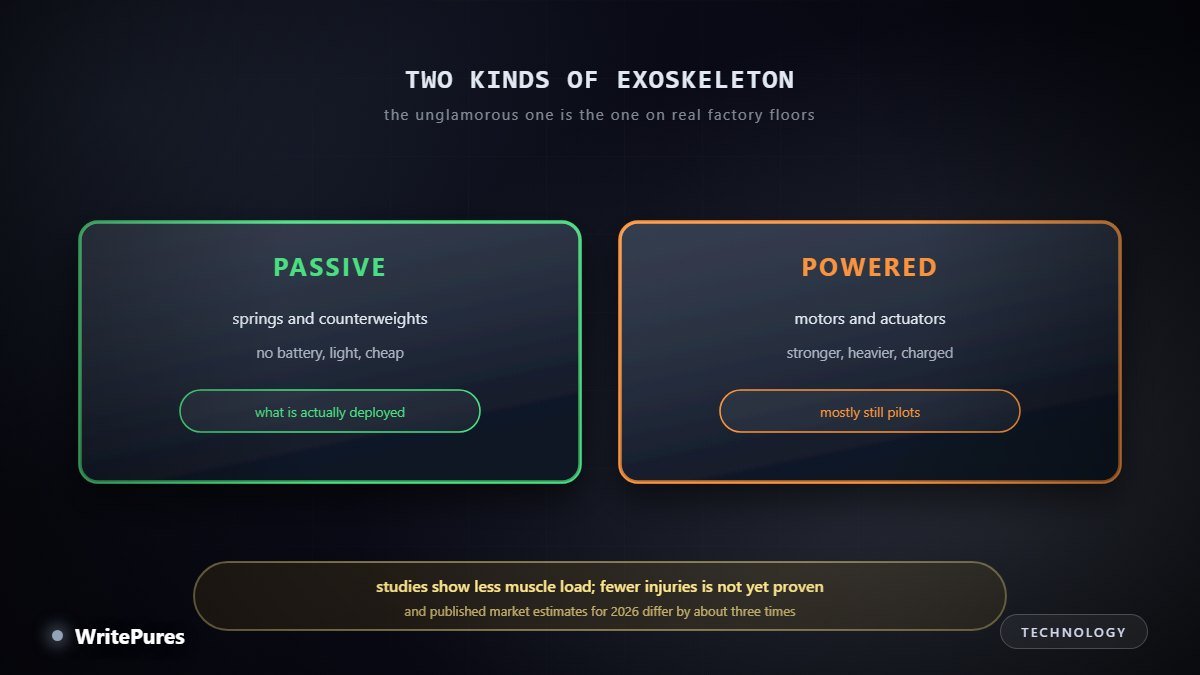
Passive exoskeletons contain no motors. Springs, gas struts or counterweights store energy when the wearer bends and return it when they straighten, shifting load from one part of the body to another — typically from shoulders and lower back into the hips or legs.
They are light, need no charging, require almost no maintenance, cannot fail electrically, and cost a fraction of the alternative. They also cannot add strength. They only redistribute what the wearer already has.
Powered exoskeletons use motors and actuators to contribute force the wearer is not generating. They can do far more, and they are heavier, considerably more expensive, dependent on batteries, and require servicing.
In actual workplace deployments, passive designs dominate — and that is a reasonable engineering outcome rather than a failure of ambition.
Where They Are Genuinely Being Used
Not the applications that generate headlines.
- Overhead assembly. The clearest case. Holding arms above shoulder height for hours is punishing, and a passive shoulder support addresses exactly that posture.
- Warehouse and logistics work, where repeated lifting from low positions is constant.
- Construction, for sustained awkward postures.
- Medical rehabilitation — a separate, more established field, where powered devices help people relearn walking under clinical supervision.
The common thread in industry is repetition, not weight. These are not devices for lifting something enormous once. They are for a posture held four hundred times a shift, where the cumulative load is what damages people.
The Evidence, Stated Carefully
This is where coverage tends to overclaim, so it is worth separating two different findings.
What is measured: published studies consistently show meaningful reductions in muscle activity during supported tasks, with the size of the effect varying considerably between devices and between tasks. The devices demonstrably reduce load on the body in the moment.
What is not yet established: that reduced load translates into fewer injuries over months and years. That requires long-term workplace studies which largely have not been completed. It is a reasonable expectation — less cumulative strain ought to mean less cumulative damage — but expectation is not evidence, and anyone selling these on an injury-reduction promise is ahead of the data.
There is also a secondary question the research raises: redistributing load moves it somewhere else. A shoulder support transfers force into the hips or lower back, and whether that trade is beneficial depends on the person and the task.
Why the Market Numbers Disagree
Published estimates for this sector in 2026 range from roughly a billion dollars to over three billion. That is not one source being wrong; it is reports counting different things.
Some cover industrial devices only. Others include medical rehabilitation, which is larger and more mature. Some count device sales alone, others add service and support. Growth projections to the 2030s diverge further still.
The practical lesson is to treat any single figure quoted without its scope as close to meaningless — and that applies well beyond this industry.
What Would Signal Real Adoption
- Long-term injury data from employers who deployed years ago. This is the number that settles the question.
- Safety certification as standard equipment rather than as a trial, which changes procurement from experiment to purchase.
- Workers choosing to wear them when not required. Comfort and dignity decide this more than specifications — a device that looks awkward or draws comment gets left in the locker.
- Insurers taking an interest. If workplace insurance begins pricing them in, the economics stop depending on anyone's goodwill.
For a country with substantial manufacturing, textile and logistics employment, the relevant version of this question is not whether powered suits arrive but whether cheap passive supports become ordinary protective equipment — the same path taken by hearing protection and safety boots. That is a plausible trajectory, and it is a far less exciting story than the one usually told.
Key Takeaways
- Passive, motorless designs dominate real workplace deployment.
- They redistribute load rather than adding strength.
- Overhead and repetitive work are the clearest genuine applications.
- Reduced muscle load is measured; reduced injuries is not yet proven.
- 2026 market estimates differ roughly threefold because they count different things.
Written by the WritePures newsroom. Spotted something that needs updating? Tell our editors.




0 Comments
Join the conversation
Replying toNo comments yet. Be the first to share your thoughts.