

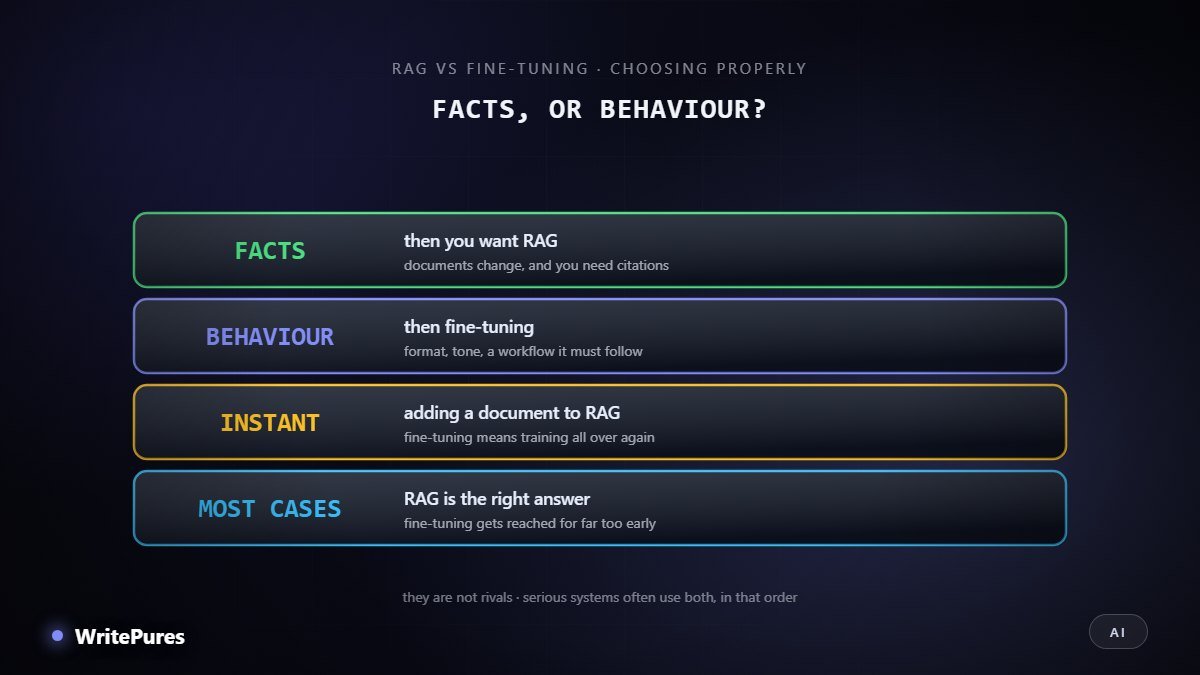
Teams reach for fine-tuning far too early. It sounds like the serious option — you are training a model, after all — and for the most common goal, making an AI answer questions about your own material, it is usually the wrong tool and an expensive detour.
What each one actually does
RAG leaves the model untouched. When a question arrives, you search your own documents for relevant passages, paste them into the prompt, and ask the model to answer from them. The model supplies the language; your files supply the facts.
Fine-tuning changes the model. You train it further on examples, adjusting its weights so it behaves differently — adopting a format, a tone, a way of approaching a task.
The distinction worth holding: RAG changes what the model is looking at. Fine-tuning changes how the model acts.
Side by side
| RAG | Fine-tuning | |
|---|---|---|
| Good for | Facts, documents, anything that changes | Format, tone, workflow, vocabulary |
| Adding information | Instant — index the file | Retrain |
| Correcting an error | Edit the document | Retrain |
| Citations | Yes, it knows the source | No |
| Setup cost | Low | Significant |
| Per-request cost | Higher — context is bigger | Lower — instructions are baked in |
| Debugging | You can see what it retrieved | Largely opaque |
The test that decides it
Ask yourself one question: if the answer changes next month, what has to happen?
If the answer is "someone updates a document" — that is RAG. Prices, policies, contracts, product specifications, staff lists, anything with a version.
If the answer is "nothing, because this is about how the model should behave" — that is fine-tuning. Always reply in this JSON shape. Always use our product names. Always follow this triage order.
Why fine-tuning disappoints on facts
Training a model on your documents does not install a lookup table. It adjusts statistical tendencies, so the model becomes more likely to produce text that sounds like your material — including when it is inventing.
Worse, you lose the thing that makes an AI answer trustworthy: you cannot ask a fine-tuned model which document an answer came from, because it does not know. For any use where someone has to verify the answer — legal, medical, financial, compliance — that alone settles it.
The cost nobody budgets for
The build cost of fine-tuning is visible and usually planned. The maintenance cost is neither.
Every meaningful change to your material means assembling training data and running the process again. Teams that fine-tune on documents typically discover this at the first significant update, then rebuild as RAG having spent weeks learning it the hard way.
RAG's maintenance is adding a file to a folder.
Where to start
Build RAG first, always. It is quicker, it is debuggable, and it answers the question most people actually have. Our nine-chapter RAG tutorial takes you through it end to end, running locally with nothing leaving your machine.
Then, if the remaining problem is behaviour — the answers are correct but badly formatted, or inconsistent in tone — consider fine-tuning on top. In that order you will know exactly what you are fixing, which is not true if you start the other way round.
For the underlying mechanics, our explainers on how generative AI works and how agents work cover why models behave this way in the first place.
Written by the WritePures newsroom. Spotted something that needs updating? Tell our editors.
Part of our guide to local AI models, which covers the whole subject from the beginning.




0 Comments
Join the conversation
Replying toNo comments yet. Be the first to share your thoughts.