
AI
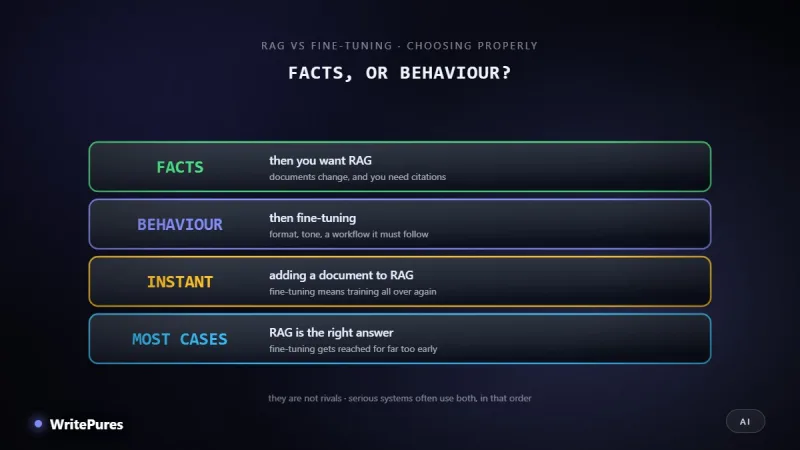
RAG vs Fine-Tuning: Which Do You Actually Need?
A clear comparison of retrieval-augmented generation and fine-tuning: what each is genuinely for, what they cost, and the test that tells you which you need.
A clear comparison of retrieval-augmented generation and fine-tuning: what each is genuinely for, what they cost, and the test that tells you which you need.

Fine-tuning teaches a model how to behave. It does not reliably teach it facts. Confusing the two wastes weeks and produces a confident, wrong model.
Most disappointing AI output is a prompting problem, not a model problem. Here are the practical patterns that make results consistent enough to rely on.

The race for open-source AI supremacy in 2026 pits China’s ultra-efficient DeepSeek-V3 against Meta’s battle-tested Llama 3.3 across reasoning, coding, and deployment cost.

DeepSeek-R1 has disrupted the global artificial intelligence landscape by proving that open-weights reasoning models can match proprietary frontier benchmarks while slashing training expenditures by over ninety percent.

SAN FRANCISCO — Advances in 4-bit GGUF quantization and unified Apple Silicon memory have made it remarkably easy to run local LLMs in 2026, giving developers zero-latency, 100% private coding and reasoning assistants without monthly API bills.
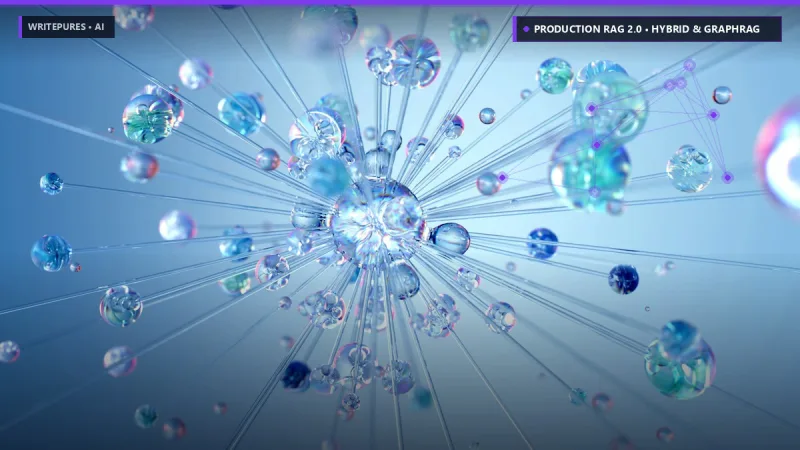
A practical engineering guide to building production-grade Retrieval-Augmented Generation (RAG 2.0) pipelines in 2026 using Contextual Retrieval, Hybrid BM25 + Dense Vector Search, Cross-Encoder Reranking, and GraphRAG.
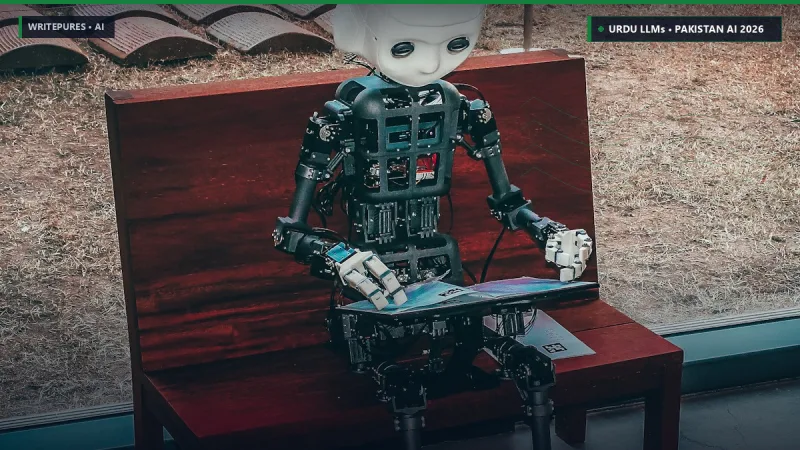
While global AI models excelled primarily in English, a new wave of Pakistani researchers and startups are training parameter-efficient Urdu and regional LLMs to revolutionize agriculture, healthcare, and citizen services.

ISLAMABAD — The Higher Education Commission (HEC) has launched a flagship national HEC AI fellowship across 50 public and private universities in Pakistan, providing research stipends, cloud GPU credits and industry residencies to 5,000 graduate and final-year undergraduate scholars.
Software development is shifting from single-turn chat assistants to autonomous multi-agent systems capable of decomposing complex features, running test suites, and fixing edge cases independently.
Bigger is not always better. Small Language Models running directly on consumer hardware are delivering sub-second latency, zero cloud costs, and rock-solid privacy for everyday applications.

The scaling laws of AI have evolved. Explore how test-time inference compute, native audio-video multimodality, and verifiable reward chains are powering late-2026 frontier models.