
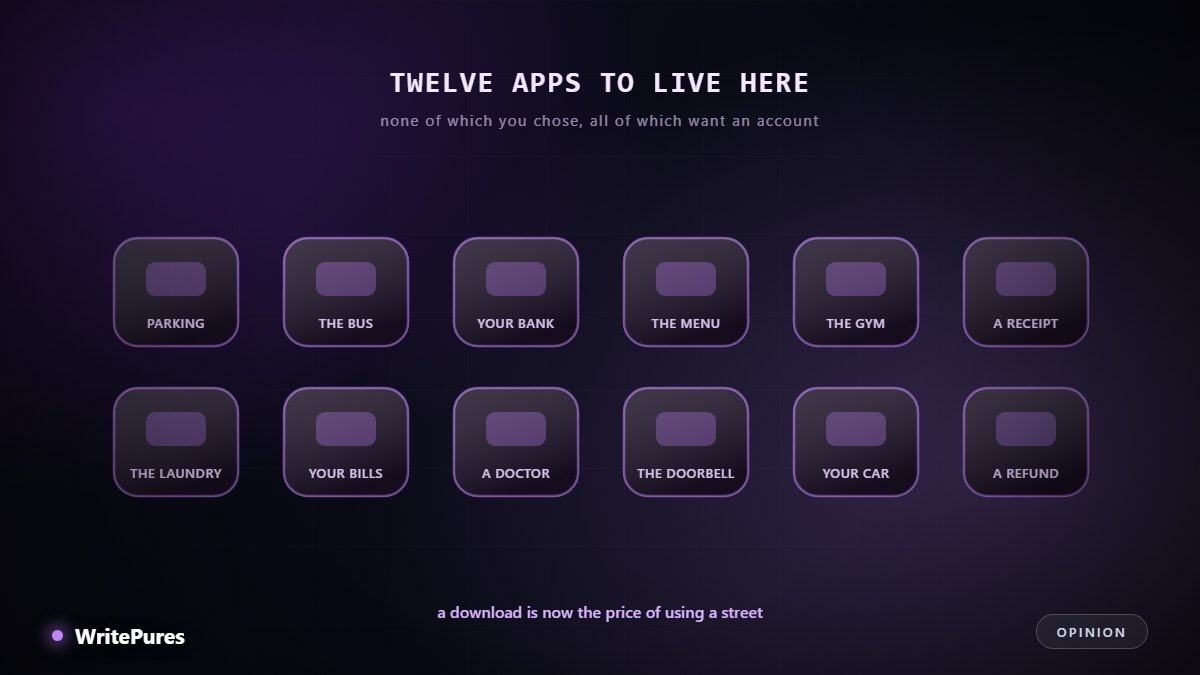
You arrive at a car park and the meter is gone. In its place is a sign with a QR code and an app name. You have a two-minute errand, no storage left on your phone, and a mobile signal that is doing nothing useful. This is now a normal way to fail at parking a car.
The Shift Nobody Announced
Over roughly a decade, a long list of ordinary transactions stopped being things you simply do and became things you install software to do. Paying for parking. Reading a restaurant menu. Topping up a travel card. Booking a gym slot. Receiving a receipt. Opening a door.
Each individual change was defensible. Collectively they add up to something nobody agreed to: a dozen accounts, a dozen sets of permissions, a dozen notification streams, and a phone that is now a prerequisite for participating in public life.
Why Businesses Keep Choosing It
It is worth being accurate about the incentives, because they are not mysterious.
- Push notifications. A direct, free channel to a customer's attention. Nothing on the web matches it, and this is frequently the single biggest reason.
- Data. Apps can collect substantially more than a browser permits — location in the background, device identifiers, usage patterns.
- An icon on the home screen. Permanent, free advertising in the most valuable space a person owns.
- Switching costs. Having installed and configured something, you are less likely to leave.
- Occasionally, real need. Sustained background work, deep hardware access, heavy performance demands. This is a short list, and most app-only services are not on it.
Notice that four of those five benefit the business and are neutral or negative for the customer. That is not a conspiracy; it is just what happens when one party makes the decision and the other absorbs the cost.
What It Actually Costs the Customer
Storage, data and battery
Every app occupies space, updates itself over your connection, and runs background activity you did not ask for. On a cheaper phone with limited storage, a handful of these is the difference between a device that works and one that does not — something we covered in why phones slow down.
Exclusion that follows income and age
App-only access quietly filters people out. Older devices cannot run current versions. Metered or expensive data makes a 90 MB download a real decision. Permission requests that are reasonable to a developer are alarming to someone who has been warned about scams. Visitors from abroad hit regional app store restrictions. The people most affected are disproportionately older and poorer — the same people least able to go elsewhere.
An account for everything
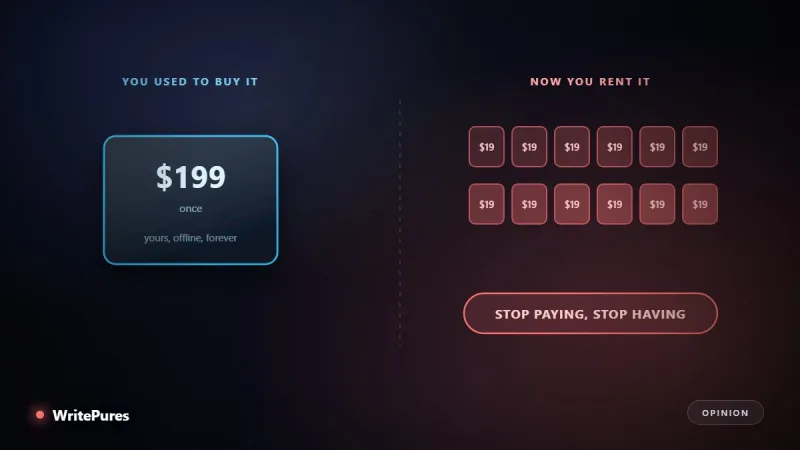
Most of these apps want registration before the task, which means an email address, a password and a marketing relationship in exchange for parking a car for twenty minutes. That is a disproportionate trade, and it accumulates — the same pattern we described in how subscriptions replaced ownership.
Fragility
A paper ticket does not require a signal. An app in an underground car park frequently does, and fails there. Adding a dependency on connectivity, a login session and a third-party server to a transaction that used to need a coin is not obviously progress.
The Honest Test
There is a single question that separates a reasonable app from a toll:
Can a first-time user complete the task in a browser, without installing anything and without creating an account?
If yes, the app is a genuine convenience for regular users and everybody else is still served. If no, the business has shifted its costs onto its customers and called it modernisation. The web can handle payments, camera, location, offline use and saved credentials perfectly well; the reason it is not used is rarely technical. Part of why it feels otherwise is that web software has grown heavier for no corresponding benefit, which we examined in why software feels slower than it should.
What Good Practice Looks Like
- A complete web version, maintained equally. Not a brochure that pushes the download.
- Guest checkout for one-off tasks. Accounts for people who return, not as a gate.
- The app as an upgrade for frequent users, never as the only door.
- A non-digital fallback that still works — a card reader, a phone number, a person.
- Permissions requested when needed, with the reason stated, not all at launch.
None of this is difficult or expensive. It is simply the version that treats the customer's phone, data allowance and attention as theirs rather than as company property.
Key Takeaways
- App-only access shifts cost from the business to the customer.
- Notifications and data, not technical need, drive most of these decisions.
- Exclusion falls hardest on older and lower-income users.
- The test: can a stranger finish the task in a browser, with no install and no account?
- Offer the app as an upgrade, never as the only door.
Written by the WritePures newsroom. Spotted something that needs updating? Tell our editors.

0 Comments
Join the conversation
Replying toNo comments yet. Be the first to share your thoughts.