

The case for Pakistan owning its messaging layer does not depend on the state agreeing to build it. Governments move slowly, budgets shift with administrations, and a programme announced today may not ship this decade. Meanwhile the dependency deepens every month. If the public sector will not move, the software industry can — and would be building a better business than it realises.
Waiting Is Also a Decision
We argued separately that Pakistan should build verified identity and open messaging rails rather than a WhatsApp clone. That case stands. But it assumes a state willing to fund infrastructure across political cycles, and that assumption may not hold.
The cost of waiting is not neutral. Every year more of the country's commerce is conducted inside an account the merchant does not control, more customer relationships are held by a company with no presence here, and the local capability to build this never develops. The businesses losing accounts are losing them now, as our reporting on hijacked WhatsApp Business accounts documented.
Industry does not need permission to start.
Industry's Hand Is Different, Not Weaker
A private effort lacks the state's mandate, captive demand and legal authority. It has three advantages that matter more for this particular problem.
- It can pick a narrow wedge. A government programme is pushed toward serving everyone. A company can serve wholesalers in Karachi first and nobody objects.
- It is funded by customers, not committees. Revenue arriving in month one disciplines the product in a way grant funding never does, and it survives a change of minister.
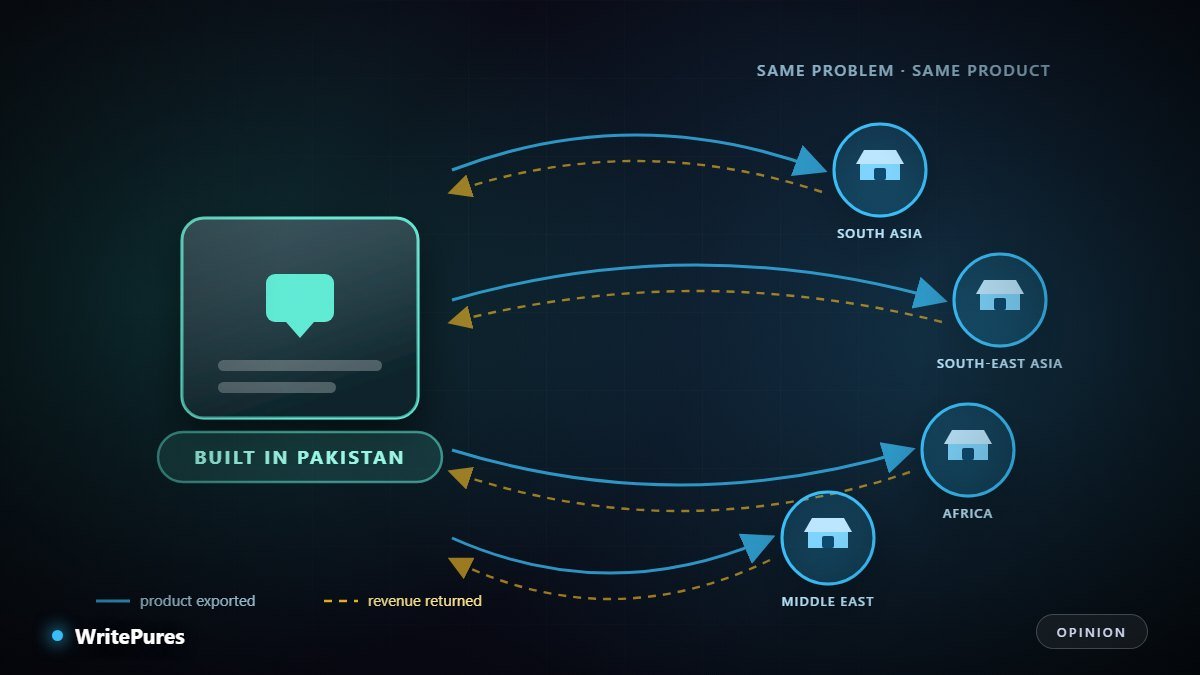
- It can sell abroad. This is the decisive one. The domestic market alone cannot fund the engineering required; export can, and the state has no comparable route.
Three Things Worth Building — None of Them a Chat App
Any plan that begins "we will build a Pakistani WhatsApp" should be stopped at the whiteboard. Messaging has powerful network effects: an app is worthless until the people you message are on it, so a new one starts at zero value regardless of quality. That is a fight with no path to victory.
The money, and the leverage, sit elsewhere.
1. The abstraction layer — the strongest opening move
Instead of replacing the incumbent, make it one of several interchangeable pipes. Sell businesses a single integration that delivers to WhatsApp, SMS, RCS, email and the business's own app, choosing a channel per message and falling back when one fails.
This is commercially attractive immediately — it reduces cost and improves delivery — and it is strategically decisive, because a business wired this way is no longer dependent on any single platform. You have removed the lock-in without ever fighting the network effect. It is also the easiest thing to sell, because it does not ask the customer to change anything their customers see.
2. Verified identity with a recovery guarantee
Sell precisely what the incumbent refuses to provide: a verified business identity, and a published recovery commitment with a human being attached and a time limit measured in hours. The entire grievance from hijacked merchants is that there was nobody to appeal to. A company that answers the phone is differentiated on the only axis those customers care about.
This requires real operational investment — identity verification, a support function, fraud handling — which is exactly why it is defensible. It cannot be copied by shipping a feature.
3. The customer relationship, owned by the merchant
Catalogue, orders, payments through Raast, delivery tracking and a customer list the merchant can export and keep. Our guide to Raast merchant payments covers the rail this can settle on. The pitch is ownership: today a merchant's entire customer base lives inside someone else's account, and losing it is one fraudulent SIM away.
Why Export Is the Strategy, Not an Afterthought
A tool for Pakistani SMEs is a modest business. The same tool across every market with the same conditions is a large one — and that difference is what makes the engineering affordable.
The conditions are not unique to Pakistan. Across much of South Asia, South-East Asia, Africa and the Middle East you find the same pattern: commerce conducted over one foreign messaging platform, cash on delivery, informal catalogues, SIM-swap fraud, thin consumer protection and no local recourse. A product built for a wholesaler in Karachi needs far less adaptation for Lagos, Dhaka or Jakarta than it would for Frankfurt.
| Build for | What transfers | What must be localised |
|---|---|---|
| Similar emerging markets | Core product, channel logic, fraud patterns, support model | Language, payment rail, local identity checks, tax rules |
| Mature Western markets | Comparatively little — buyer expectations and compliance differ | Almost everything, including the sales motion |
This is also a better export than contract development. Selling hours exports labour; selling a product exports intellectual property, earns recurring foreign revenue, and is not capped by headcount. Pakistani founders are already proving the enterprise sales motion works from here — our piece on B2B SaaS founders winning GCC clients covers how.
A realistic sequence
- Prove it domestically with paying customers and public reference stories. Nobody abroad buys unproven software from an unfamiliar market.
- Pick one adjacent market and commit properly — language, local payment rail, a partner who knows the buyers. One market done well beats five announced.
- Sell through local partners at first. Distribution, not product, is the constraint in an unfamiliar market.
- Price for the market, not in converted rupees. Our guide to SaaS pricing covers why anchoring on value rather than cost matters more here than anywhere.
- Use the support that exists. PSEB and the technology zone programmes offer market-access and compliance help — we have written about these schemes. Treat them as removing a specific blocker, not as validation.
Funding It Without Waiting for Venture Capital
This does not need a large round to begin, and chasing one first is a common way to lose a year.
- Start with the revenue wedge. The gateway product earns from month one and funds the harder parts.
- Form a consortium. Several established software houses sharing the cost of the identity and audit layer, competing on products above it, is cheaper for each than going alone — and more credible to a regulator.
- Sign anchor customers. Banks, telcos and large retailers feel impersonation fraud most acutely and can pay properly.
- Treat it as an export business from day one, because that is the story that makes it fundable if you do later raise. Bootstrapping versus raising shapes which outcomes stay available.
Trust Has to Be the Product
A private company asking merchants to move their customer relationships onto its platform faces exactly the trust problem a government would. The answer is the same, and it is not marketing:
- Open-source the core and publish independent security audits, including unresolved findings.
- Guarantee portability in the contract. Being able to leave is the main thing the incumbent does not offer; make it your selling point rather than something you quietly discourage.
- Publish your recovery record — median time to restore a hijacked identity, updated quarterly. Nobody else in this market does, and it is unfalsifiable proof.
- Commit to no exceptional access. If you build a way in for yourself, it is available to whoever finds it.
What Would Make This Fail
Worth stating plainly, because each is a common ending:
- Building a consumer chat app anyway, because it is the exciting version.
- Announcing a platform before selling a tool, and spending the runway on the announcement.
- Entering five markets at once and doing none of them properly.
- Treating security as a feature to add later, after the first breach makes the product unsellable.
- Losing the engineers who can build it, because remote work pays multiples. Equity and interesting problems are the only competitive answers.
Key Takeaways
- Waiting for the state has a cost that compounds; industry can start without permission.
- Never build a consumer chat app — network effects make it unwinnable.
- The abstraction layer is the best opening move: it sells immediately and removes lock-in structurally.
- Sell continuity — verified identity, human recovery, portable customer lists — not messaging.
- Design for export from day one; the domestic market alone cannot fund the engineering.
Building something in this space? Tell our editors — we are documenting what Pakistani companies are shipping.
Written by the WritePures newsroom. Spotted something that needs updating? Tell our editors.
0 Comments
Join the conversation
Replying toNo comments yet. Be the first to share your thoughts.