
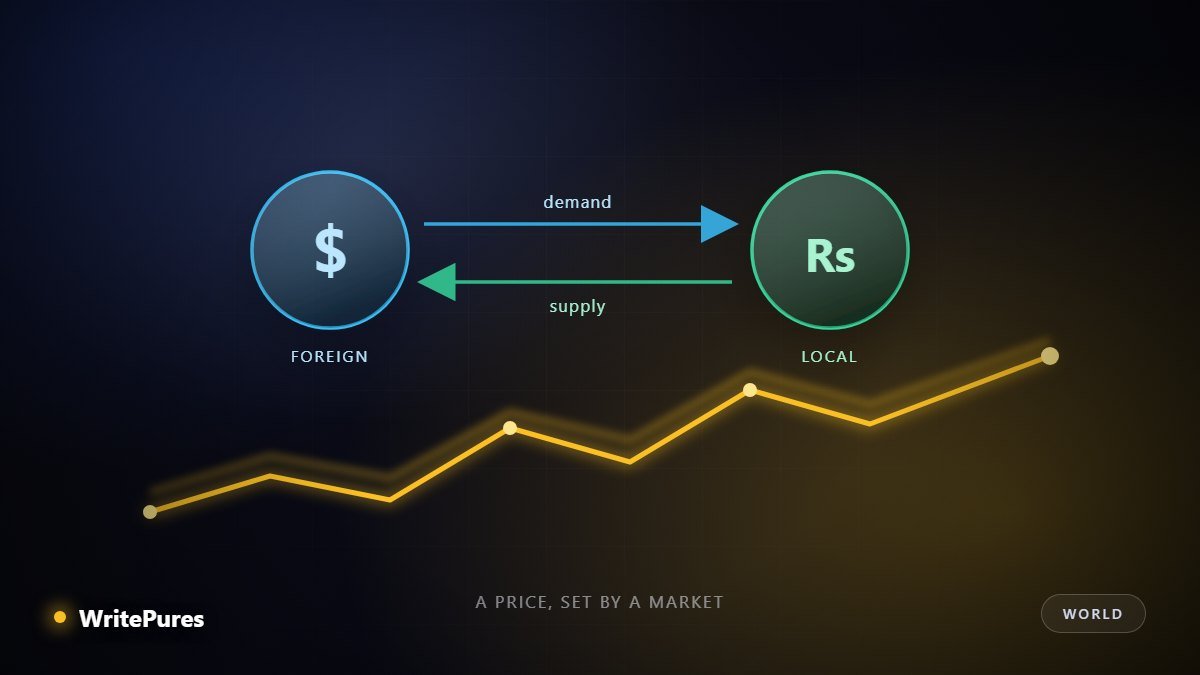
An exchange rate looks like an official number handed down by an authority. It is not. It is a price, set the same way the price of wheat or steel is set — by what people are willing to pay. Once you see it that way, almost everything else about it follows.
It Is a Price, Not a Pronouncement
When you exchange one currency for another you are buying something. The rate is simply what sellers are charging that day.
So the question "why did the rupee weaken?" becomes a more tractable one: why did more people want to sell it than buy it? The usual answers:
- Trade. Importers must buy foreign currency to pay foreign suppliers; exporters bring foreign currency back in. A country importing more than it exports has more people selling the local currency than buying it.
- Investment flows. Foreign money entering a country has to be converted in, and leaving money has to be converted out.
- Interest rates. Higher rates attract money seeking a better return, raising demand for the currency.
- Inflation differences. A currency losing purchasing power faster than another tends to weaken against it over time.
- Expectations. The reflexive one. If people believe a currency will fall, they sell now — and the selling causes the fall.
Remittances matter enormously for several economies, including Pakistan's: workers abroad converting earnings home is a large, steady source of demand for the local currency.
Why Your Rate Is Never the Headline Rate
The number quoted in news reports is the interbank rate — what large institutions pay when trading in very large volumes. You will never get it.
| Layer | What it adds |
|---|---|
| Interbank rate | The reference price |
| Provider margin | A spread added to the rate — usually the largest cost |
| Stated fee | Sometimes zero, which is why the margin exists |
| Card network conversion | Applied when you spend abroad in another currency |
The practical rule when comparing providers: ignore the advertised fee and compare how much arrives at the other end. "Zero commission" frequently means the cost has been moved into the rate, where it is harder to see. One particular trap when travelling is being offered payment in your home currency at a foreign terminal — that conversion is almost always worse than letting your own bank do it.
Fixed, Floating and In Between
Countries choose how much to let the market decide.
- Floating — the market sets it. Volatile, but it absorbs shocks automatically and cannot be "run out of".
- Pegged — the central bank commits to a rate and defends it by buying and selling its own currency. Stable and predictable, but it requires reserves, and defending a rate the market disagrees with eventually becomes unaffordable.
- Managed — mostly market-set, with intervention to smooth sharp moves. The most common arrangement in practice.
Where an official rate diverges from what people will actually pay, a parallel market tends to appear. The gap between the two is a useful signal of how much pressure the official rate is under.
What It Means for You
Strip away the macroeconomics and a moving rate has concrete effects:
- If you earn in foreign currency — freelancers, exporters, remittance recipients — local weakening increases your income in local terms. Our guide to freelancing from Pakistan covers how to price for this.
- If you buy imported goods — phones, cars, fuel, machinery — prices rise, usually faster than they fall when the rate recovers.
- If you hold savings in a weakening currency, purchasing power erodes even if the balance is unchanged.
- If you are pricing a product for export, price in the customer's currency and accept you are carrying the risk, or price in a stable currency and be clear about it.
Key Takeaways
- An exchange rate is a price set by supply and demand, not an official decree.
- The headline rate is the interbank rate; your rate includes a margin you should compare directly.
- A weaker currency helps exporters and hurts importers at the same time.
- Pegs work only while reserves and credibility hold.
- Expectations are self-reinforcing — belief in a fall helps cause it.
Written by the WritePures newsroom. Spotted something that needs updating? Tell our editors.


0 Comments
Join the conversation
Replying toNo comments yet. Be the first to share your thoughts.