
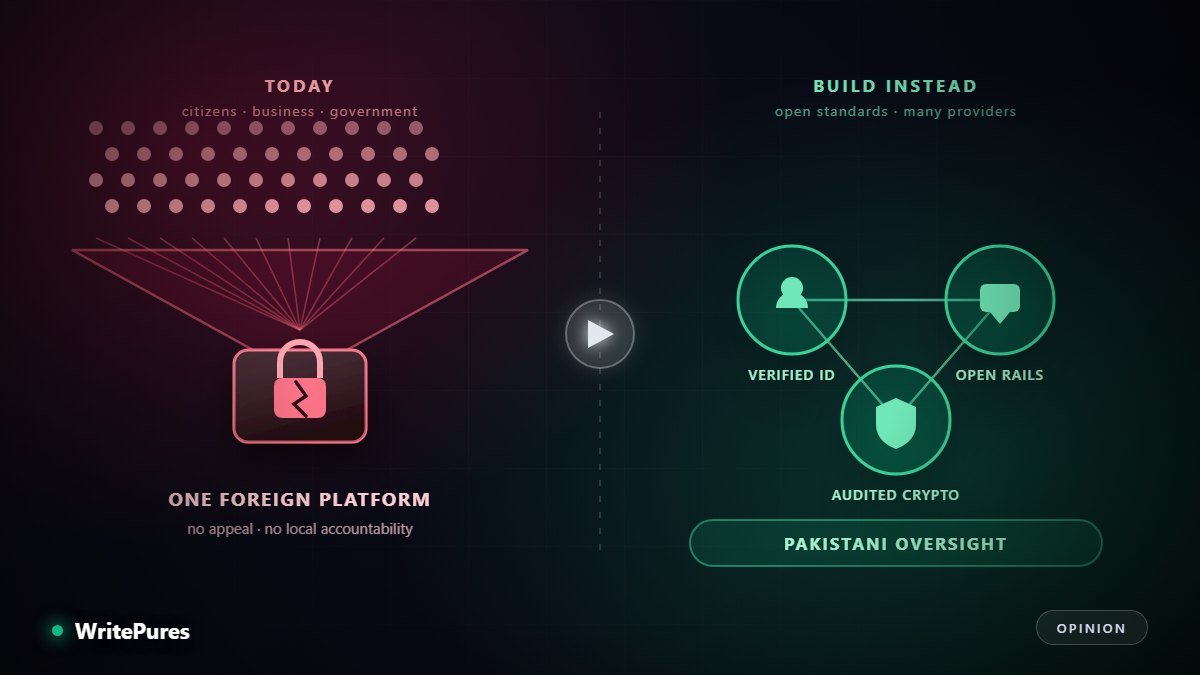
When a Pakistani retailer loses the WhatsApp number printed on their shopfront, the business stops. There is no office to visit, no case officer, no regulator with jurisdiction — only a form and a wait. That is not a customer service complaint. It is a description of critical national infrastructure operated by a company that answers to nobody here.
Get the Diagnosis Right First
Any serious proposal has to begin by naming the failure precisely, because the wrong diagnosis leads to expensive, useless projects.
WhatsApp's message encryption is not the weak point. It uses the Signal protocol, among the most heavily reviewed cryptography deployed anywhere. A national programme that set out to "build something more secure" by writing new encryption would spend public money reproducing solved work, and a fresh implementation would almost certainly be weaker than what it replaced. Cryptography is one of the few fields where novelty is a defect.
What actually fails for Pakistani users sits above the encryption layer:
- Account takeover, usually enabled by fraudulent SIM re-issuance rather than any flaw in the app.
- Recovery that punishes the victim — a waiting period that locks out the rightful owner while the attacker is already inside.
- Automated bans that treat a hijacked business as a spammer for messages the thief sent.
- No human appeal and no local jurisdiction. A business with a hijacked bank account can walk into a branch. A business with a hijacked number has a form.
We documented this pattern in detail in our investigation into WhatsApp Business hijackings. The lesson for policy is narrow and important: the gap is identity, recovery, accountability and jurisdiction — not ciphers.
Why Dependency Is a Strategic Problem
Set the security question aside and the concentration risk alone justifies action.
A single foreign company's product decisions now govern how a large share of Pakistani commerce communicates. It can change its terms, alter its business pricing, ban a number automatically, or withdraw a feature, and no Pakistani institution has standing to object. Small traders who have never heard of platform risk are exposed to it completely, with their entire customer relationship resting inside an account they do not ultimately control.
There is an economic dimension too. Payments, logistics and customer service are being built on top of a foreign messaging layer by thousands of local businesses. The value of that activity accrues to the platform, and the capability to build such a layer is never developed here. Every year of deferral makes the dependency deeper and the local skill base thinner.
And there is a direct harm the state should care about regardless of economics: fraudsters routinely impersonate banks, tax authorities and government departments over the same channels, and citizens have no reliable way to tell an official message from a fake one.
The Honest Difficulties
Most calls for a "national app" ignore the reasons previous attempts failed. A proposal that does not confront these is not worth funding.
| Obstacle | Why it kills projects |
|---|---|
| Network effects | A messenger is worthless until the people you message join. New apps start at zero value regardless of quality. |
| Trust deficit | If citizens suspect state monitoring, they will not adopt — and an unadopted platform is money burned. |
| Security is specialist work | Secure messaging is genuinely hard. A rushed local build will be less safe than what it replaces. |
| Funding across cycles | Infrastructure needs a decade of consistent funding; projects tied to one administration rarely get it. |
| Talent retention | Engineers capable of this work can earn multiples abroad. Public salary scales alone will not hold them. |
The honest conclusion from that table is that a state-built consumer chat app competing with WhatsApp would fail, and failing expensively would set the argument back a decade. The opportunity lies elsewhere.
Build Rails, Not an App
Pakistan already has the proof that this works. Raast did not try to replace every bank's application; it provided instant payment rails that banks and fintechs connect to. The state supplied the standard and the trust layer, and the market supplied the products. That is the model to repeat.
Applied to messaging, it means a programme in three sequenced phases.
Phase 1 — Verified government-to-citizen messaging
Start where demand is captive and the harm is measurable. Departments, NADRA, FBR, utilities and hospitals all need to reach citizens, and fraudsters currently impersonate them freely. A verified official channel, with cryptographically verifiable sender identity, delivers immediate value, requires nobody to abandon an existing app, and builds the identity and delivery layer everything later depends on.
Phase 2 — Verified business sender identity and open rails
Extend verified identity to registered businesses, so a customer can tell a real shop from an impersonator, and define an open interoperability standard any licensed provider may implement. Several competing applications on one set of rails beats a single official app, because it preserves choice and removes the single point of failure that is the whole problem.
Phase 3 — Sector-specific secure communication
Health records, legal correspondence, procurement and inter-agency communication have confidentiality and retention requirements no consumer app meets. These are also the cases where sovereignty genuinely matters, and where a domestic obligation can create the anchor demand local industry needs.
Non-Negotiable Engineering and Legal Requirements
These are not aspirations. Each one is a condition for the thing working at all.
- Use proven protocols. The Signal protocol and the IETF's Messaging Layer Security standard exist, are open, and are reviewed by the global cryptographic community. Adopt, do not invent.
- Open source, published threat model, independent audit. Nobody should be asked to trust a closed national messenger. Publish the code, commission external audits, pay for a bug bounty, and publish the findings including the uncomfortable ones.
- No exceptional access. A lawful-intercept backdoor is a vulnerability available to anyone who finds it, and its existence guarantees the platform will not be trusted or adopted. This is the requirement most likely to be challenged internally and the one least safe to concede.
- Data minimisation in statute. Metadata — who contacted whom, when, how often — is frequently more revealing than content. Limit collection by law, not by policy that can change quietly.
- Independent oversight. The body supervising access must not be the body operating the platform.
- Mandated interoperability and data portability. Users must be able to leave. A sovereign walled garden reproduces the original problem with a different owner.
Fix the Layer That Is Actually Breaking
One recommendation needs no new platform at all, could begin immediately, and would prevent more harm than anything else on this list.
Most account hijackings described to us began with a fraudulently re-issued SIM. That is not a failure of a messaging app; it is a failure of identity verification at the point of SIM issuance, and it sits squarely with mobile operators and the regulator. Tightening re-issuance, requiring stronger verification for replacements, imposing a mandatory cooling-off window before a re-issued SIM can receive verification codes, and giving subscribers a way to check and dispute SIMs registered against their identity would close the route most attacks actually use.
It is unglamorous, it launches no app, and it would protect more businesses this year than any platform could by 2030.
What Industry Should Do Without Waiting
- Stop making one platform the only route to your customers. Collect email and a second channel. This is the single most effective thing any business can do, and it needs no permission.
- Build on open standards so that products remain portable if a platform's terms change.
- Contribute to shared infrastructure — audits, libraries, documentation — rather than each firm solving identity verification privately.
- Invest in security skills. The constraint on any sovereign programme will be people. Our coverage of curriculum reform at Pakistani universities and the developer skills landscape is directly relevant to whether this is buildable at all.
How to Judge Whether It Is Working
Measure outcomes, not activity. Downloads and registered users are the metrics that let a failing programme look successful for three years.
- Reduction in reported impersonation fraud using official sender identities.
- Median time for a business to recover a hijacked verified identity — counted in hours, not weeks.
- Number of independent providers live on the rails, which measures whether it is genuinely open.
- Results of published external security audits, including unresolved findings.
- Share of government-to-citizen communication sent through verified channels.
Key Takeaways
- The gap is identity, recovery and accountability — not encryption. Aiming at the wrong layer wastes the budget.
- A state-built consumer chat app will fail on network effects; build rails many providers connect to, as Raast did.
- Start with verified government-to-citizen messaging, where demand is captive and impersonation is a real harm.
- Open source, no exceptional access, statutory data minimisation and independent oversight are conditions for adoption, not optional extras.
- Tightening SIM re-issuance would prevent more harm this year than any platform could by 2030.
WritePures welcomes responses from PTA, PSEB, operators and industry. Write to our editors — we will publish considered replies.
Written by the WritePures newsroom. Spotted something that needs updating? Tell our editors.

0 Comments
Join the conversation
Replying toNo comments yet. Be the first to share your thoughts.