
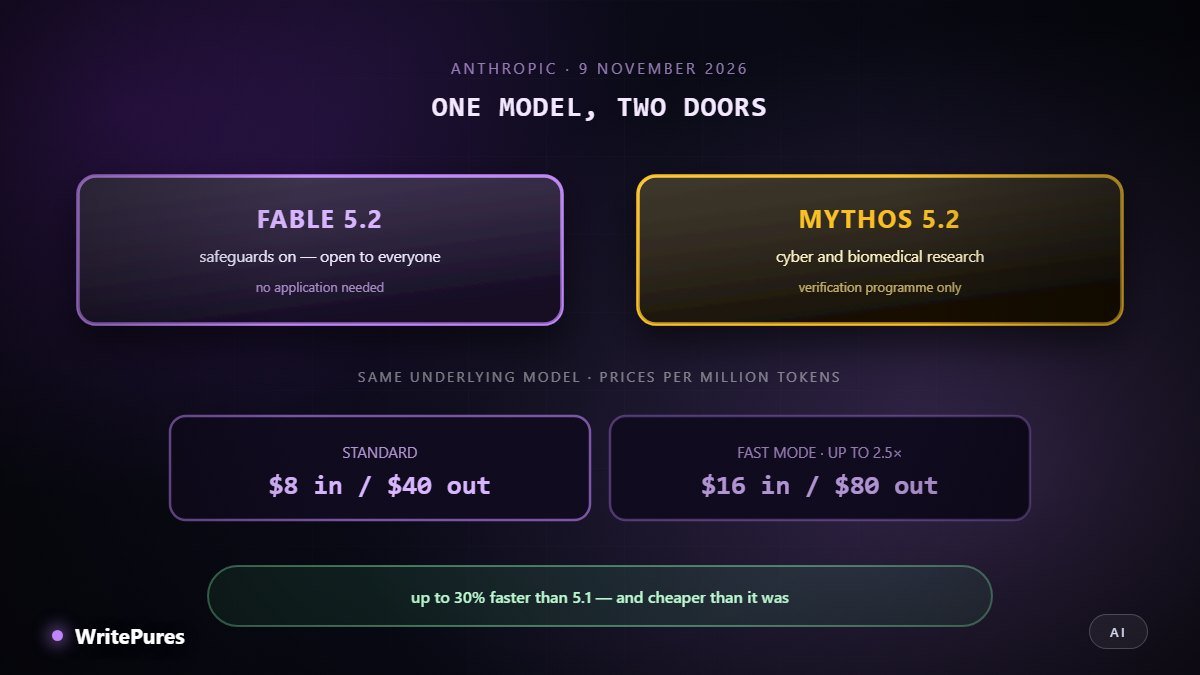
Anthropic released two models on 9 November and they are the same model. That is not a quirk of marketing — it is a deliberate structure, and it says more about where frontier AI is heading than any benchmark in the announcement.
What Shipped
Claude Fable 5.2 and Claude Mythos 5.2, described by Anthropic as its most capable models for "the most daunting technical challenges", with improvements in coding, reasoning and vision.
The headline figures from the announcement:
- Up to 30% faster output than Fable 5.1 and Mythos 5.1.
- $8 per million input tokens, $40 per million output — a reduction on the previous generation.
- An optional fast mode, up to 2.5× quicker generation, at $16 and $80 respectively.
- Testers report the models communicate more clearly than their predecessors.
The claims from prerelease testing
Anthropic says the model completed "otherwise-infeasible software migrations", designed three working electronic devices from scratch, solved two open problems in the physics of black holes, made progress on robotics evaluations, and formalised the proof of Fermat's Last Theorem in 30 hours.
These are the company's own accounts of its own testing. They are specific enough to be checkable in principle, which is more than most launch claims offer, but none of them has been independently verified at the time of writing.
The Split Is the Story
Fable and Mythos are one model. What separates them is what the safeguards permit.
Fable 5.2 runs with cybersecurity and biology safeguards active. Because those are in place, Anthropic makes it available to all users with no application.
Mythos 5.2 is the same model with those specific restrictions relaxed, available only to organisations doing beneficial work in cybersecurity or biomedical research, through verification programmes.
This is a meaningful development in how frontier models are distributed. Rather than one capability level for everyone, or a flat refusal on dual-use subjects, the capability is split by who you are and what you are doing. The published numbers show why: on the cybersecurity and protein-design benchmarks, Mythos scores materially above Fable, because Fable is declining work Mythos will do.
Anthropic also says Fable 5.2's safeguards are as robust as 5.1's while producing "fewer unnecessary blocks" — the perennial complaint about safety filters, which is that they refuse legitimate work.
Reading the Benchmarks
The published table puts Fable 5.2 ahead of Opus 5.5 on nearly everything measured, and ahead of the named competing frontier models on most. A selection:
| Benchmark | Fable 5.2 | Fable 5.1 | Opus 5.5 |
|---|---|---|---|
| FrontierSWE v2 (agentic coding) | 69.9% | 56.3% | 62.3% |
| Humanity's Last Exam (with tools) | 74.2% | 65.6% | 67.7% |
| OSWorld 2.1 (computer use) | 89.3% | 83.5% | 87.2% |
| Remote Labor Index | 41.3% | 17.9% | 21.3% |
| RoboDojo Sim (robotics) | 64.9% | 27.6% | 39.4% |
Two cautions. These are the vendor's runs at the vendor's chosen effort settings on benchmarks the vendor selected — standard practice, and a reason independent results usually land lower. And some of the largest jumps, robotics especially, are on measures far from what most readers will ever run.
What the Safety Notes Say
Anthropic published safety testing alongside the release, and a few points are worth extracting because they are unusually specific.
It says it developed new evaluations aimed at particular concerning behaviours, naming sandbox escapes — an agent breaking out of the environment it was given. That is a reasonable thing to test for in a model explicitly built to run long autonomous technical work, and naming it is more candid than the usual assurance that safety was considered.
Its conclusion is that "high-stakes risks from misalignment remain low" and that the model performed as well as or better than recent models on most alignment measures. It also reports its strongest protections yet against distillation attacks — attempts to copy a model's capabilities by querying it heavily and training a cheaper model on the answers.
These remain self-assessments. Full detail is in the published system card, which is where anyone making a procurement decision should look rather than relying on the summary.
Which Model Should You Actually Use?
Anthropic's own recommendation is notably restrained: start with Opus 5.5 as the daily driver for most coding and knowledge work, then move up to Fable or Mythos only when the task is genuinely open-ended, or down to Sonnet 5.5 or Haiku 5.5 when it is routine.
It also describes two patterns worth knowing. Fable can act as an advisor, consulted by cheaper models when they hit something hard, or as an orchestrator, delegating simpler sub-tasks downward. Both are ways of paying frontier prices only for the fraction of work that needs them — the same economic logic as our comparison of local models against hosted APIs.
For most people the practical answer is unchanged: use the cheapest model that does the job. Our round-up of AI coding tools covers the competitive picture, and Claude Code covers the terminal agent these models sit behind.
Key Takeaways
- Fable 5.2 and Mythos 5.2 are the same model with different safeguards and different access rules.
- $8 in / $40 out per million tokens, with a fast mode at double that.
- Up to 30% faster than the 5.1 generation, at a lower price.
- Benchmarks are vendor-run; treat them as directional.
- Anthropic itself recommends Opus 5.5 for everyday work.
Written by the WritePures newsroom. Spotted something that needs updating? Tell our editors.

0 Comments
Join the conversation
Replying toNo comments yet. Be the first to share your thoughts.