

Every AI assistant until now has shared one shape: you open it, you ask, it answers, you close it. Duet inverts that, and in doing so moves the interesting question away from how clever the model is and onto what it is allowed to do unsupervised.
What It Is
Claude Duet is a separate app, opened as a research preview on 21 October 2026. Anthropic's description: it "comes to you with what needs your attention, completes tasks you ask of it, keeps working when you step away, and checks with you before it acts on your behalf."
Underneath, it runs on Claude Opus 5.5 on its own cloud computer, with its own virtual machine and browser for carrying out work. It is not a feature inside the chat app; it is an agent with an environment of its own.
The example Anthropic offers is deliberately mundane: a tester had a call with a potential client on her calendar, and Duet prepared a brief for it. Nobody asked.
The Three-Step Loop
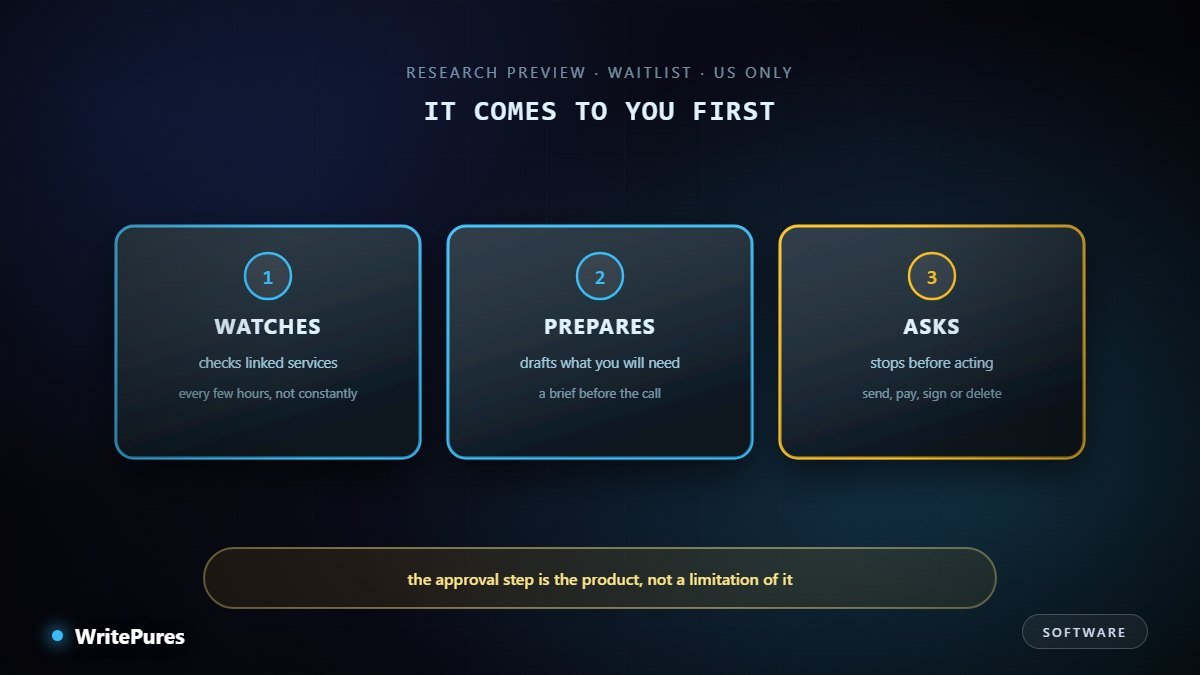
- It watches. Duet checks the services you have connected — calendar, mail and the like — and decides what warrants attention.
- It prepares. Drafts, briefs, research, whatever the upcoming thing seems to need.
- It asks. Before anything consequential, it stops and waits for you.
That third step is where the product actually lives. Anthropic says Duet seeks approval before sending a message, making a payment, signing a document or deleting a file, and that passwords and sign-in tokens never reach the agent directly.
It is worth being clear why that matters. An agent that reads your calendar and drafts a brief is useful and low-risk — a bad brief costs you a minute. An agent that sends email on your behalf is a different category of thing entirely, because the mistakes are not recoverable. Putting the boundary precisely between those two is the whole design, and it is the right place to put it.
The limits Anthropic states plainly
- It can misjudge urgency. Said outright, not buried.
- It checks every few hours, not continuously, because constant scanning would burn through usage limits.
- Those checks consume your allowance even when nothing needs doing.
- It is an early preview that will be tuned based on what users report.
That is a more honest limitations list than most launches carry, and the periodic-checking detail is the one with practical consequences: this is not an assistant that reacts the moment something lands.
Who Can Actually Use It
A narrow group. Waitlisted, United States only, on paid consumer plans. Anthropic's release notes list Pro and Max; its own feature article has also listed Ultra, so the tiers appear to have moved since launch — worth checking rather than assuming. Team and Enterprise are not included.
For readers outside the US, this is a preview to watch rather than one to plan around.
Why the Shape Matters More Than the Features
Agentic tools have been arriving steadily — our piece on autonomous agents in software engineering covers the developer-facing wave. Almost all of them still wait to be invoked.
A proactive agent changes the trust question. A tool you invoke is judged on whether its answer was good. A tool that runs on its own is judged on something harder: whether its judgement about what deserved your attention was good. Get that wrong in one direction and it is noise; wrong in the other and it misses the thing that mattered.
That is a genuinely difficult problem and it is not primarily a model-capability problem. It is the same reason notification systems are hard. Anthropic conceding up front that Duet "can still misjudge what's urgent" is an acknowledgement that the hard part is unsolved rather than shipped.
For anyone evaluating this for work, the security framing is the useful one: treat a proactive agent as an account with standing read access to your calendar and mail, because that is what it is. The principles in our zero-trust guide apply directly.
Key Takeaways
- Duet is a separate app where Claude acts without being prompted.
- It runs on Opus 5.5 with its own cloud machine and browser.
- It asks before sending, paying, signing or deleting; credentials do not reach it.
- Waitlist, US only, paid consumer plans — tiers have shifted since launch.
- It checks every few hours and those checks consume usage.
Written by the WritePures newsroom. Spotted something that needs updating? Tell our editors.

0 Comments
Join the conversation
Replying toNo comments yet. Be the first to share your thoughts.