
A disclosure before anything else: this article is about the company that makes the AI assistant used to help draft it. Readers should weigh that. What follows is restricted to figures as filed and reported, with the risks set out as plainly as the opportunity — which is the right way to write about any listing, and particularly this one.
The Terms as Filed
From the amended S-1 of 10 November 2026 and reporting on it:
| Item | Detail |
|---|---|
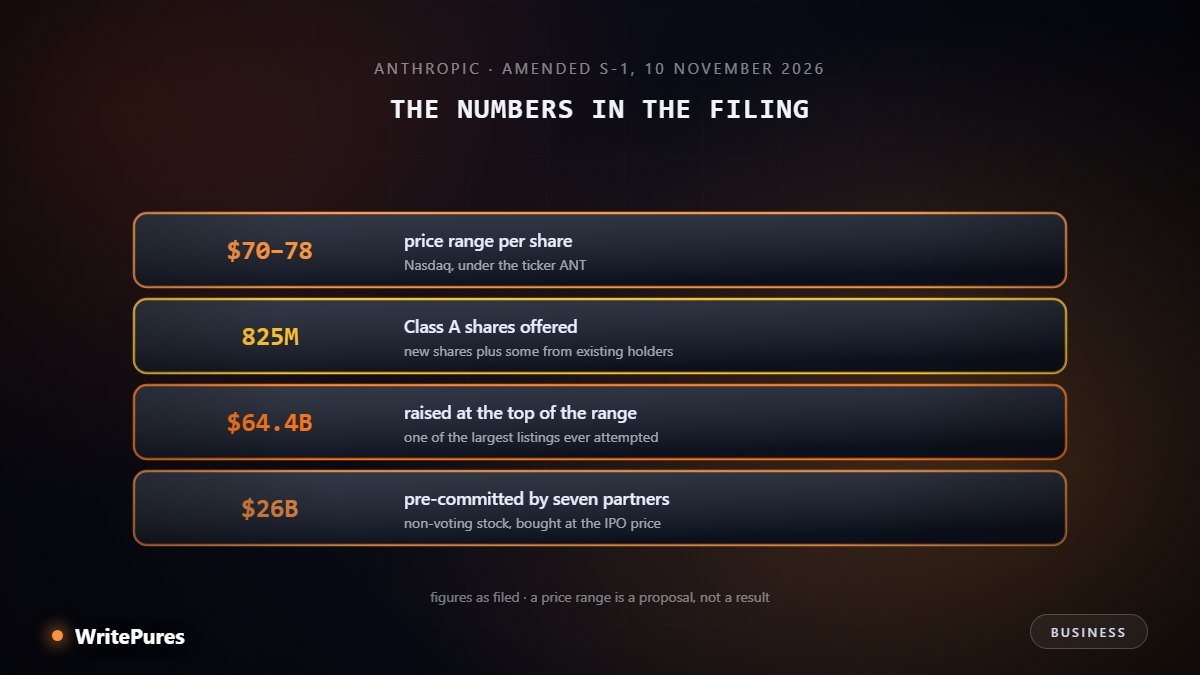
| Price range | $70 – $78 per share |
| Shares offered | 825 million Class A |
| Exchange and ticker | Nasdaq, "ANT" |
| Maximum proceeds | Up to $64.4 billion |
| Pre-committed | $26 billion of non-voting stock across seven strategic partners, including Google and Nvidia |
| Valuation (fully diluted) | Up to about $1.4 trillion |
| Expected listing | Reported as possibly the week of 16 November — unconfirmed |
Two points of care with those numbers. A price range is a proposal; the final price is set the night before trading and can land outside it in either direction. And the valuation figure depends on the method — about $1.4 trillion fully diluted, or roughly $916 billion to $1.02 trillion on shares outstanding after the offering. Headlines rarely say which they are using.
The Pre-Commitment Is the Unusual Part
Seven strategic partners, reported to include Google and Nvidia, have committed to buy $26 billion of non-voting stock at the IPO price. That is a substantial share of the raise spoken for before a single public investor participates.
This cuts two ways and both are worth stating. It signals confidence from parties who know the business well, and it reduces the quantity that has to find buyers in a difficult market. It also means a large block of the company is held by firms that are simultaneously its suppliers, customers and competitors — Nvidia sells the chips, Google sells cloud capacity and competes directly with its own models. Those relationships are disclosed in the filing and are worth reading rather than assuming.
The Market It Is Walking Into
The timing is awkward and the filing does not hide it. In the week before the price range was set, the Nasdaq fell 5.5%, and roughly $2.5 trillion of market value was lost in a single session. The proximate causes reported were investor concern about tighter AI regulation and closer scrutiny of data-centre construction following the US midterms.
Nvidia — a partner in this offering — closed down more than 4% on the Monday after its board disclosed an independent investigation, a story we cover in Jensen Huang's resignation. The wider sell-off is covered in the November AI stock sell-off.
Large listings into falling markets are not unprecedented, and some have done well. But a company choosing to proceed rather than wait tells you something about its own timing calculation, and that is a legitimate thing for a buyer to weigh.
Risks Worth Reading Before the Hype
- Valuation against revenue. The implied multiple is extremely high by any historical standard. That is a bet on growth continuing at a rate that has very few precedents.
- Competition with deeper pockets. Its principal rivals are among the best-capitalised companies on earth and can sustain losses in this market indefinitely.
- Compute dependency. Training frontier models requires hardware and data-centre capacity controlled by a small number of suppliers, two of whom are also investors here.
- Regulation. AI rules are being written now, in several jurisdictions, in ways that cannot be priced with confidence.
- Lock-up expiry. Early shareholders are typically restricted from selling for a period after listing. What happens when that ends is a known source of pressure.
- Voting structure. Class A shares and non-voting stock are not the whole capital structure. Check what control public shareholders actually get.
If You Are in Pakistan
Three practical points. You will not get shares at the offer price — allocations go to institutions and to the underwriters' clients, and ordinary investors buy after trading opens at whatever the market sets. Buying US-listed shares requires a broker that accepts Pakistani clients, and remitting funds abroad for investment is governed by State Bank rules that are worth checking before you commit to anything.
And a warning that matters more than the rest: any offer of guaranteed pre-IPO Anthropic shares is a fraud. High-profile listings reliably attract exactly this scam, usually through WhatsApp and Telegram groups. Our guide to AI-era scams covers the pattern, which is urgency plus an offer you were not looking for.
Nothing here is investment advice, and we are not licensed to give any.
Key Takeaways
- The amended S-1 proposes $70–78 per share for 825 million Class A shares, ticker ANT on Nasdaq.
- Up to $64.4 billion raised; up to roughly $1.4 trillion valuation on a fully diluted basis.
- $26 billion is pre-committed by seven strategic partners including Google and Nvidia.
- A filed price range is a proposal; final price and date are set later.
- It lists into a sharp sector sell-off, with regulation the stated investor concern.
- Retail investors buy after opening, not at the offer price — and pre-IPO offers are scams.
Written by the WritePures newsroom. Spotted something that needs updating? Tell our editors.

0 Comments
Join the conversation
Replying toNo comments yet. Be the first to share your thoughts.