
The scams have not changed. Investment fraud, fake bosses, romance cons and distress calls are all decades old. What changed is that the warning signs people were taught to look for — the clumsy English, the odd phrasing, the voice that did not sound quite right — have been engineered away. In 2026 the question is no longer whether a message looks convincing. It is whether you verified it.
What the Numbers Show
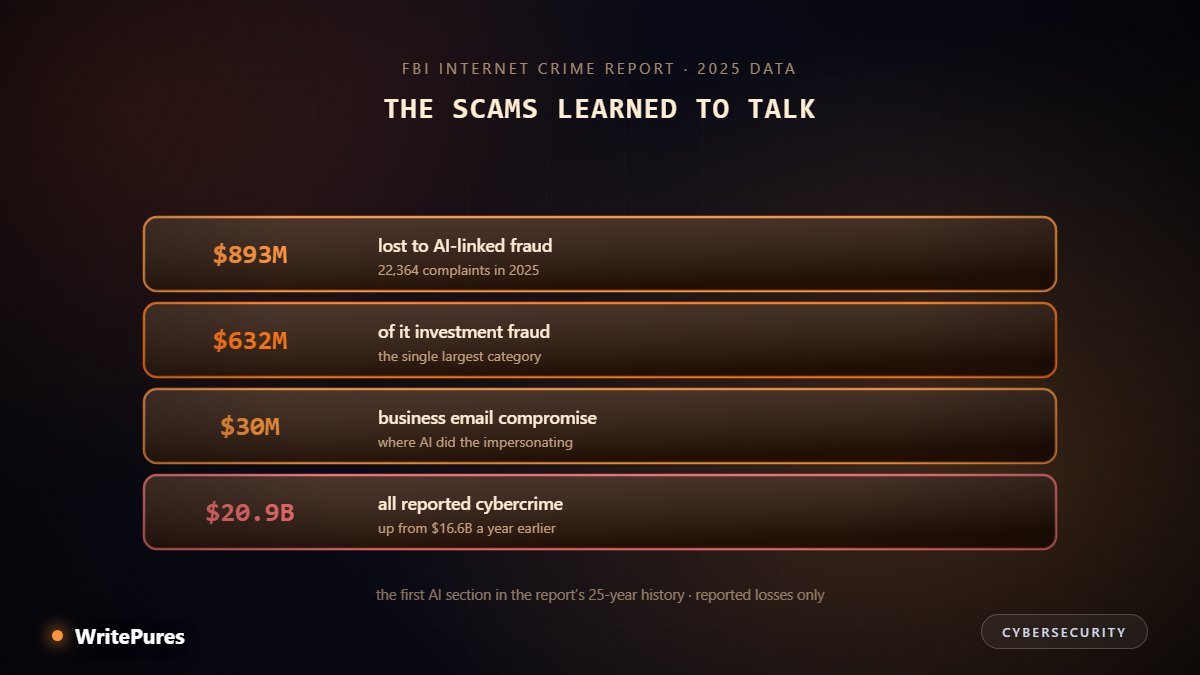
The FBI's Internet Crime Complaint Center published its 2025 report in April 2026, and for the first time in the report's 25-year history it included a dedicated section on artificial intelligence.
| Measure | 2025 figure |
|---|---|
| Total complaints received | 1,008,597 |
| Total reported losses | $20.9 billion (from $16.6bn in 2024) |
| Complaints referencing AI | 22,364 |
| Losses linked to AI | ~$893 million |
| AI-linked investment fraud | ~$632 million |
| AI-assisted business email compromise | ~$30 million |
Two caveats that matter. These are reported losses only, and fraud is heavily under-reported — embarrassment keeps a great many victims silent. And the AI tag depends on someone recognising and noting that AI was involved, which is precisely what a convincing deepfake prevents. Read $893 million as a floor, not a measurement.
The figures are also US-only. They are useful because the US publishes this data consistently, not because the problem is American.
The Five Attacks Worth Knowing
1. Voice cloning
Current tools need only a few seconds of someone's voice, which is trivially available from a voice note, a reel, or a voicemail greeting. Two variants dominate: the distress call, where a cloned relative needs money urgently, and the executive call, where a cloned senior manager authorises a transfer.
In November 2026, federal prosecutors in Manhattan unsealed an indictment alleging that a group used AI-cloned executive voices to take more than $129 million from companies including hospitals and banks. Those are allegations that have not been tested in court, but the scale indicates where this has gone.
2. Deepfake video
Synthetic faces now appear on video calls and in investment advertising, frequently using the likeness of a recognisable public figure to promote a scheme they have nothing to do with. The investment fraud category being the largest share of AI-linked losses is not a coincidence.
3. Phishing that reads correctly
The single most widely taught defence — look for bad spelling and grammar — is now worthless. Messages arrive in fluent Urdu or English, correctly reference your employer, your bank and recent events, and carry no tells at all. Our guides on defending networks against AI phishing and protecting a business from it cover the organisational response.
4. Fake recruiters and job scams
Particularly aggressive against young jobseekers. An approach arrives on LinkedIn or WhatsApp with a plausible offer, sometimes followed by a video interview with synthetic faces. The payload is either an advance fee for "processing" or "training", or enough personal data to open accounts in your name. A real employer does not ask you to pay to be hired.
5. Account takeover
Still the workhorse, and in Pakistan WhatsApp is the main target — a hijacked account is then used to scam everyone in the victim's contacts, with the stolen trust doing the work. If this happens to you, our WhatsApp account recovery guide walks through it.
Where Pakistan Stands
The National Cyber Crime Investigation Agency's published figures are worth reading carefully, because the totals circulating in the press do not reconcile cleanly and some cover different periods.
On a National Assembly document reported in 2026, the agency received roughly 523,749 cybercrime complaints between 2023 and 2026 and secured about 199 convictions — a conviction rate near 0.04%. Separately, reporting puts complaints at 148,204 in 2026 against 104,490 in 2025, with financial fraud the largest category in both years, rising from 49,982 to 71,051. Other published totals for parts of 2026 conflict with these, which is why each is given here with its source and period rather than combined.
Enforcement activity is real — one October 2026 report describes 1,129 arrests and Rs105.3 million recovered in a single month — but the conviction figure is the one to sit with. The practical implication for an individual is blunt: recovery is the exception. Prevention is not the cheaper option, it is effectively the only one.
Defences That Actually Work
Ranked by how much protection they deliver per unit of effort.
- Agree a family safe word. A short phrase any genuine emergency call must include. It costs one conversation and defeats voice cloning outright, because the attacker cannot know it.
- Call back on a number you already have. Never the one in the message or the one the caller gives. This single habit defeats most impersonation.
- Use a second channel for money. Request by phone, verify by message or in person. Always, regardless of who it appears to be from.
- Turn on two-factor authentication, and prefer an authenticator app over SMS, which is vulnerable to SIM swapping.
- Use a password manager. Reused passwords are how one breach becomes ten.
- Treat urgency as the signal. Every scam here depends on you acting before you check. Legitimate organisations tolerate a pause; fraudsters cannot.
- Reduce your public voice and video. Public accounts full of voice notes and clips are training data. This matters most for people whose names carry financial authority.
If You Run a Business
- Require out-of-band confirmation for every payment change. Most BEC losses would be prevented by this one rule, applied without exceptions for senior staff.
- Remove the exception for the boss. Fraud works by exploiting the fact that nobody challenges the CEO. The policy has to cover everyone or it protects no one.
- Train on verification, not detection. Teaching staff to spot fakes is training for a test they will eventually fail.
- Limit what any one account can do. The principles in zero trust security for small business apply directly.
- Rehearse the response. Who freezes the account, who calls the bank, who preserves evidence — decided in advance, not during.
If It Has Already Happened
- Contact your bank or wallet provider immediately and ask for a freeze. Hours matter.
- Change passwords on every affected account and enable two-factor authentication.
- Report to the NCCIA through its official channels, with screenshots, numbers, transaction IDs and timestamps preserved.
- Warn your contacts, especially if a messaging account was taken over.
- Ignore anyone offering to recover your money for a fee. Recovery scams specifically target people who have already been defrauded, because that list is valuable.
Key Takeaways
- The crimes are old; AI removed the tells people were taught to look for.
- The FBI logged ~$893m in AI-linked losses in 2025 across 22,364 complaints — a floor, not a total.
- Investment fraud is the largest AI-linked category at roughly $632 million.
- A few seconds of audio is enough to clone a voice convincingly.
- In Pakistan, complaints run into the hundreds of thousands while convictions number in the hundreds.
- Verification beats detection. A safe word and a call-back habit defeat most of this.
Written by the WritePures newsroom. Spotted something that needs updating? Tell our editors.

0 Comments
Join the conversation
Replying toNo comments yet. Be the first to share your thoughts.