

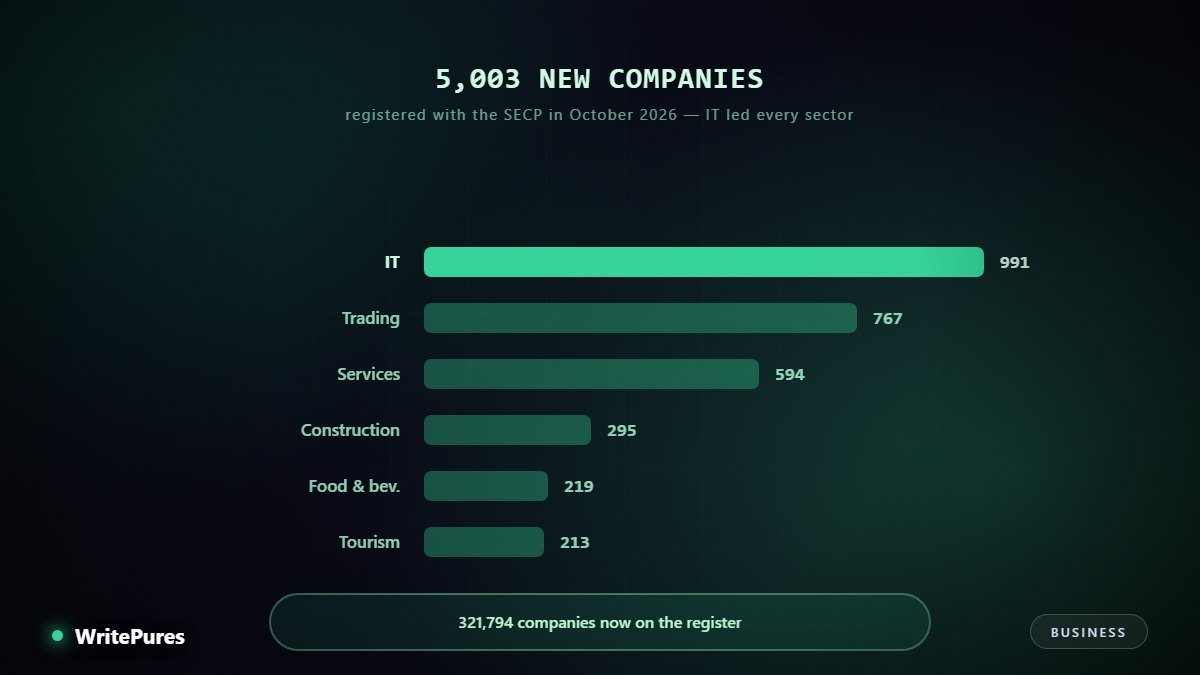
Pakistan added 5,003 new companies to its corporate register in October, and for another month the largest single share of them were technology firms. The headline is encouraging. The breakdown underneath it is the more interesting read.
The Numbers
Figures reported on 5 November 2026 from the Securities and Exchange Commission of Pakistan:
| Sector | New companies in October |
|---|---|
| Information technology | 991 |
| Trading | 767 |
| Services | 594 |
| Construction | 295 |
| Food and beverages | 219 |
| Tourism | 213 |
| Real estate | 170 |
Total registrations for the month were 5,003, taking the national register to 321,794 companies. IT accounted for just under a fifth of everything registered.
What the Figure Does and Does Not Tell You
It is worth being precise about what is being counted, because registration figures are routinely quoted as though they measured output.
What it measures: how many people chose to formally constitute a company in a given sector in a given month. In a country where incorporation is cheap and largely online, that is a reasonable proxy for where ambition is pointing.
What it does not measure: revenue, employment, exports, or survival. A registered company may be a forty-person software house or a single freelancer formalising to open a business bank account and access a more favourable tax treatment. A good number will never trade at all. None of that is unique to Pakistan — it is true of company registers everywhere — but it does mean the figure should not be read as growth.
The useful way to use it is as a directional signal across months, alongside figures that do measure activity: export receipts, headcount and tax filings. Set against reported IT and IT-enabled services exports of $4.6 billion in FY2025-26, the registration count shows a wide base forming beneath a sector whose actual earnings are concentrated in relatively few firms. Our look at the roadmap to $5 billion covers that gap.
The Foreign Investment Detail
173 foreign investors took part in newly incorporated companies during the month. The distribution is the striking part:
- China — 129
- Germany — 6
- United States — 5
- United Kingdom — 3
- Eight other countries — two each
- Elsewhere — 14
Five were foreign corporate entities; the rest were individuals. Roughly three quarters of foreign participation came from a single country, which makes this a measure of one bilateral relationship rather than of broad international appetite. Diversifying that is precisely what trade missions such as the recent Pakistani delegation to Oslo are intended to address.
The participation figure worth watching
Women made up 13 per cent of shareholders and directors in the new companies. One month is far too small a sample to call a trend, but it is a number worth following, and a more meaningful indicator of how the sector is maturing than the registration total.
How This Compares With the Rest of the Register
IT, trading and services together accounted for 2,352 of the 5,003 registrations — roughly 47 per cent between three sectors. That concentration is itself informative. Trading and services are the default categories for small general businesses, so IT outpacing both is not simply a case of technology appearing alongside the usual suspects; it is leading them.
The sectors below the top three tell a quieter story about where the domestic economy is putting its money: construction at 295, food and beverages at 219, tourism at 213 and real estate at 170. Those are physical, capital-intensive, domestically oriented businesses, and collectively they are smaller than IT alone. For an economy that has historically formed companies around property and trade, that is a genuine shift in composition, even if the absolute numbers remain modest.
Why So Many People Are Incorporating
Several things push in the same direction at once. Formal registration is often required to invoice international clients, open a business account, or receive payments through regulated channels. Registered firms can access Pakistan Software Export Board schemes and sector tax treatment. And a large freelancing population — which crossed $1 billion in export earnings in FY2025-26 — reaches a point where formalising is simply easier than not, something our freelancing guide covers, along with the options for taking international payments.
No year-on-year comparison was published alongside these figures, so whether October represents acceleration or a steady rate is not established by this release alone.
Key Takeaways
- 5,003 companies registered in October 2026; 991 of them in IT, the leading sector.
- The national register now holds 321,794 companies.
- Registration measures formation, not revenue, employment or survival.
- 129 of 173 foreign investors were Chinese — a concentrated, not broad, picture.
- Women accounted for 13 per cent of shareholders and directors.
Written by the WritePures newsroom. Spotted something that needs updating? Tell our editors.




0 Comments
Join the conversation
Replying toNo comments yet. Be the first to share your thoughts.