

A pitch deck has one job: earn a conversation. It will not persuade anyone to invest on its own, and trying to make it do that is what produces the dense, unreadable decks that get closed on slide three.
The Ten Slides, in Order
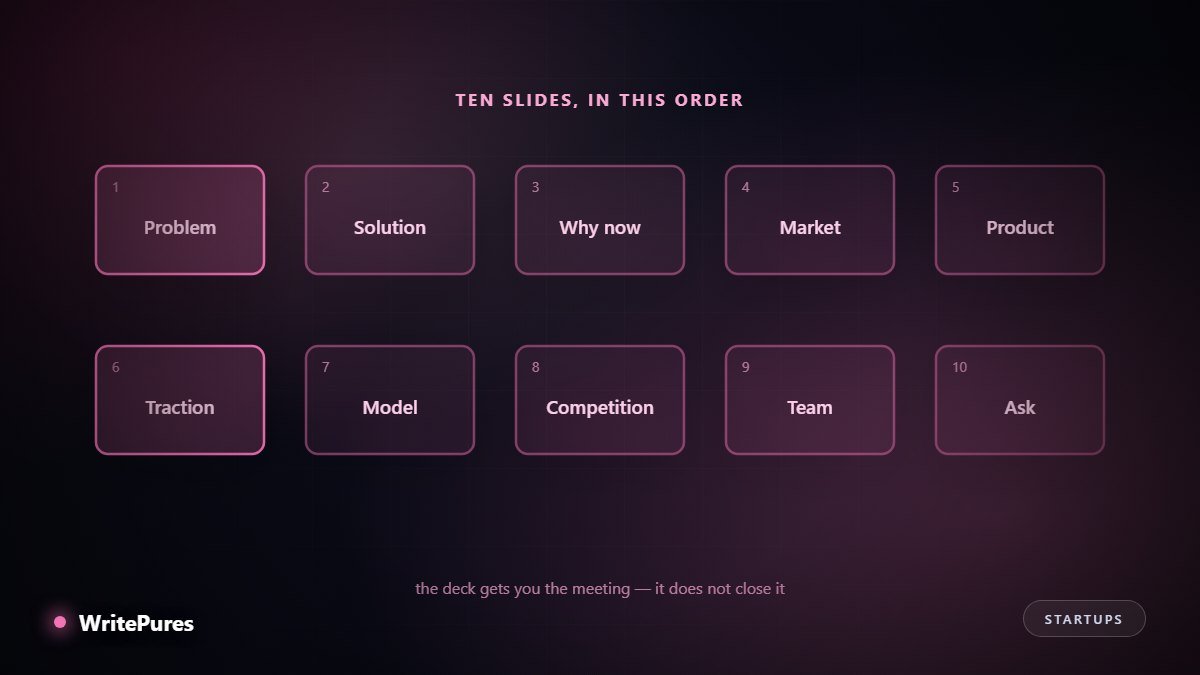
The order matters because it mirrors how a reader forms a judgement. Each slide should answer one question and move on.
- Problem. Who suffers what, specifically. Name the person and the cost. Generic problems produce generic interest.
- Solution. What you built, in plain language. One sentence someone could repeat accurately to a colleague.
- Why now. What changed recently that makes this possible or necessary. A good idea that was equally possible five years ago invites the question of why nobody did it.
- Market. Who buys, how many there are, and what they already spend. Build it from the bottom up.
- Product. Show it. A screenshot beats three bullet points describing a screenshot.
- Traction. Evidence that someone wants this. The slide most read and most often weakest.
- Business model. How money arrives, what a customer is worth, what one costs to acquire.
- Competition. Who else solves this, including the status quo, and why you win for a specific customer.
- Team. Why you specifically. Relevant history, not a list of logos.
- The ask. How much, for what milestones, over what period.
The two that decide everything
Problem and traction. If the problem does not land, nothing after it matters — the reader is evaluating a solution to something they do not believe in. If traction is absent or vague, the deck becomes a request to fund a hypothesis.
Spend disproportionate effort on these two and accept that the others can be merely clear.
Writing Each Slide
- One idea per slide. If it needs two, it is two slides.
- The headline carries the message. Write it as a full sentence stating the point — "Clinics lose six hours a week reconciling paper records" — not a label like "The Problem". A reader skimming only headlines should still get the argument.
- Show, do not assert. "Customers love it" is worth nothing; a retention curve is worth a meeting.
- Make numbers legible. Few, large, labelled, with the time period stated.
- It must work without you. Most decks are read before any meeting. If a slide needs narration, rewrite it.
Traction Without Much Traction
Early companies often have little to show, and the instinct is to inflate. That is the one genuinely damaging choice, because experienced readers recognise dressed-up metrics immediately and the credibility loss is unrecoverable.
Honest alternatives, roughly strongest first:
- Paying customers, however few — and our guide to pricing a SaaS product covers setting a number you can defend when asked.
- Signed letters of intent or a paid pilot with a named organisation.
- Usage data from a prototype, with the denominator shown.
- Results from a manual concierge version proving people want the outcome.
- A waiting list with a conversion rate — the number alone means little.
Label the stage accurately. "Six paying pilots, three months in, 100% renewed" is more persuasive than a large but meaningless total.
Mistakes That End the Review Early
- Top-down market sizing. "A $50bn market, we need 1%" signals you have not thought about who buys. Build from customers and price.
- A competition slide with no competitors. Claiming none says you have not looked, or the market does not exist. The status quo is always a competitor.
- Five-year projections at seed. They invite scrutiny of indefensible assumptions and suggest false confidence.
- Dense text. Decks are skimmed in minutes. Paragraphs do not get read.
- No clear ask. If the reader cannot tell what you want, the default answer is nothing.
- Hiding the weakness. Every company has one. Naming it and explaining your plan reads as competence; concealing it reads as naivety once found.
Before raising at all, it is worth being clear on whether you should — our guides to validating the idea and bootstrapping versus venture capital cover that decision, which shapes what outcomes stay open to you.
Key Takeaways
- The deck earns a meeting; it does not close an investment.
- Ten to twelve slides, one idea each, detail in an appendix.
- Problem and traction carry the deck — everything else need only be clear.
- Write headlines as sentences that state the point.
- Honest small numbers beat inflated ones; the credibility loss is unrecoverable.
Written by the WritePures newsroom. Spotted something that needs updating? Tell our editors.


0 Comments
Join the conversation
Replying toNo comments yet. Be the first to share your thoughts.