

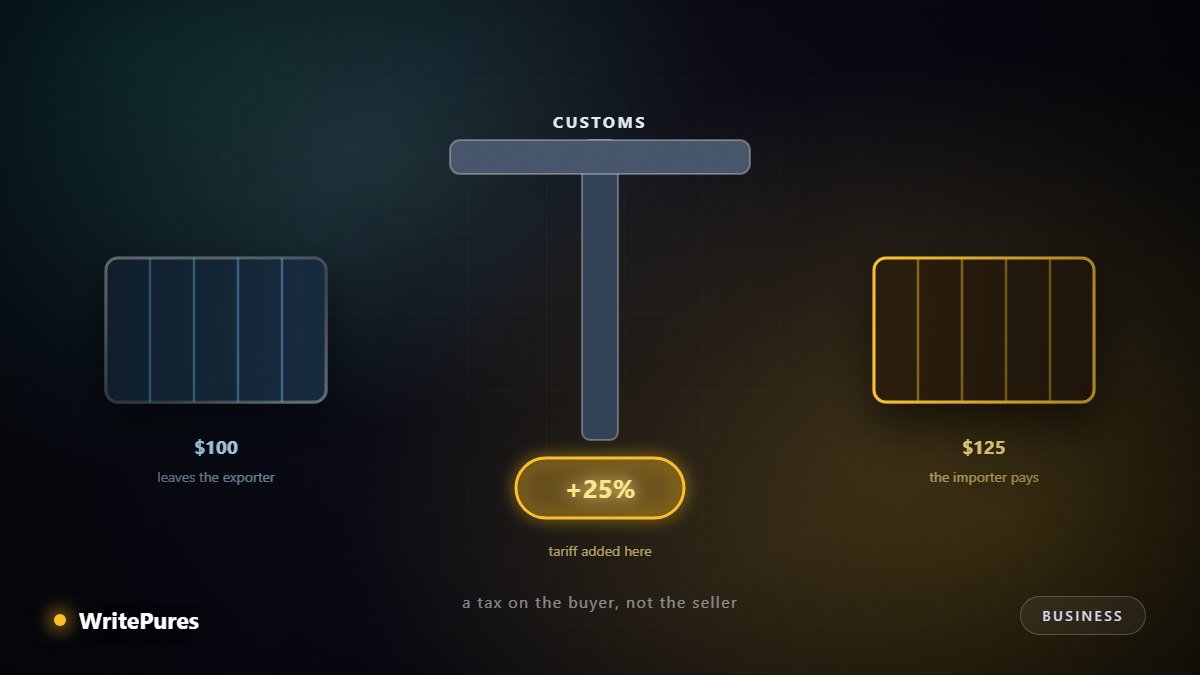
Tariffs return to the headlines regularly, almost always described as something one country imposes on another. The customs paperwork tells a plainer story: the tax is collected from the importer, in the importing country, at the border.
The Mechanics
A tariff is a tax on imported goods. When a shipment arrives, the importer declares what it is and what it is worth, and pays duty before the goods are released.
Three details determine the amount:
- Classification. Every product has a code under an internationally standardised system, and the code sets the rate. Disputes about classification are common and consequential — a small reclassification can change the rate substantially.
- Customs value. Usually the transaction price, with rules on what else to include.
- Origin. Where the goods are deemed to have been made, which is not simply where they were shipped from. Rules of origin decide whether a preferential rate applies, and they are where most of the complexity lives.
So a tariff of twenty-five per cent on a hundred-dollar shipment means the importer pays twenty-five dollars to their own government. Nothing is collected from the exporter.
Who Bears the Cost
Who pays is settled; who bears it is the real question, and the answer is usually "shared, unevenly".
| Response | When it happens | Who absorbs it |
|---|---|---|
| Importer raises prices | Few substitutes; customers have little choice | Domestic consumers |
| Importer absorbs it | Competitive market; cannot raise prices | Importer's margin |
| Exporter cuts price | Exporter is dependent on this market | Exporter's margin |
| Trade shifts elsewhere | Alternative suppliers exist | The original exporter, in lost volume |
The empirical work on recent tariff episodes generally finds a substantial share reaching domestic buyers rather than being absorbed abroad. The practical implication is uncomfortable but important: a tariff is largely a tax on your own consumers and import-using businesses, levied in exchange for protection of a specific domestic industry.
The part that is often forgotten
Many imports are not finished goods — they are inputs. A tariff on steel raises costs for every domestic manufacturer that uses steel, and those firms typically employ far more people than the industry being protected. Protection for one sector is a cost increase for the sectors downstream of it.
Why They Are Imposed Anyway
- Protection. Shielding a domestic industry, preserving jobs in it at a higher price paid by everyone else.
- Revenue. Historically a principal source of government income, and still meaningful where other tax collection is weak.
- Leverage. A bargaining instrument, or retaliation. Increasingly the dominant motive, and the one least related to economics.
- Anti-dumping measures. Duties against goods sold below cost, which are a distinct legal mechanism with their own evidentiary process.
What Exporters Should Do
For a Pakistani exporter watching a destination market raise duties, the sequence that matters:
- Confirm coverage. Check your exact product classification. Measures are usually narrower than the headline implies.
- Check your contract. The agreed delivery terms decide who is responsible for duty. Find out before the shipment lands, not after.
- Model the pass-through. How much can you absorb, how much can your buyer, and what does each scenario do to volume?
- Review origin rules. Where processing happens can change the applicable rate, legitimately.
- Diversify markets. The slowest option and the only permanent one. Our piece on winning enterprise clients in the GCC covers how firms here have approached new markets.
Services are generally not subject to tariffs in the way goods are, which is one structural reason software and IT exports are less exposed to this kind of disruption.
Key Takeaways
- A tariff is paid by the importer to their own government at the border.
- The economic cost is shared, and a substantial share typically reaches domestic buyers.
- Tariffs on inputs raise costs for every domestic industry downstream.
- Classification and rules of origin decide the actual rate — check both.
- Market diversification is the only response that reduces exposure permanently.
Written by the WritePures newsroom. Spotted something that needs updating? Tell our editors.

0 Comments
Join the conversation
Replying toNo comments yet. Be the first to share your thoughts.