
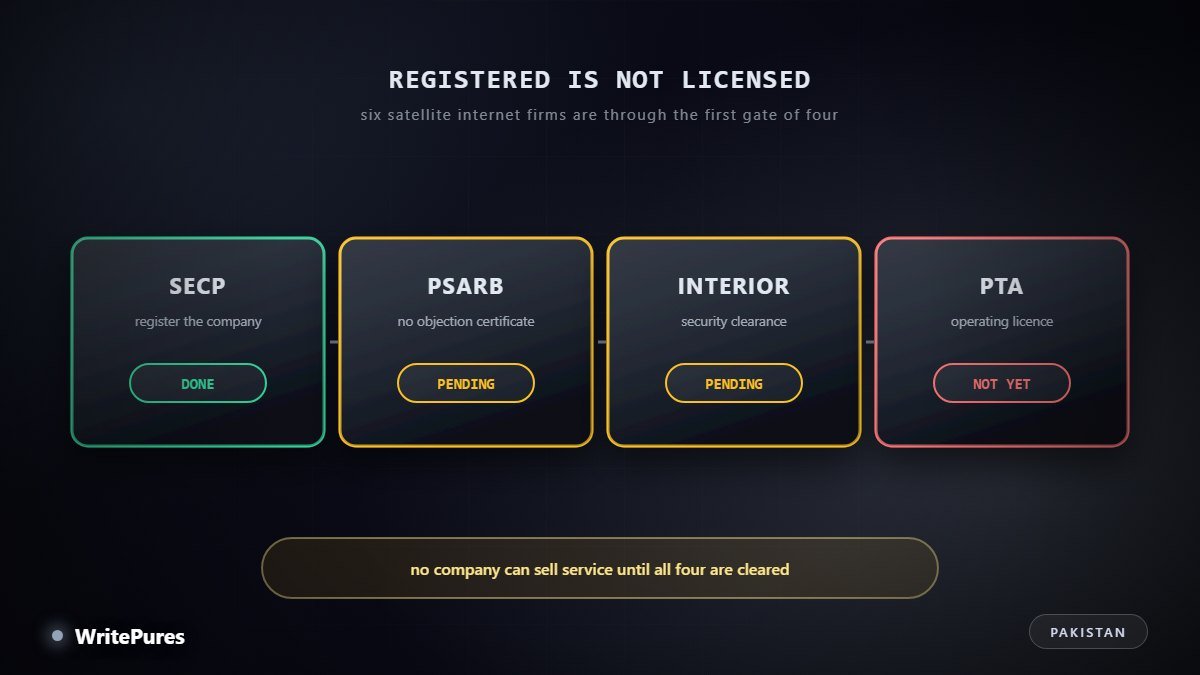
Six companies registering to provide satellite internet in Pakistan reads like a breakthrough. It is more accurately the first of four steps, and the three that follow are the slow ones.
The Four Gates
Getting from interest to a working satellite internet service in Pakistan requires clearing four separate authorities, in order.
- SECP registration. Establish a legal company in Pakistan. Six firms have now done this. The SECP has stated plainly that registration does not permit satellite internet services.
- PSARB no objection certificate. The Pakistan Space Activities Regulatory Board must clear the space-segment side of the operation.
- Security clearance. The Ministry of Interior conducts security checks.
- PTA licence. Only once security checks are complete does the telecom regulator issue an operating licence.
Every one of the six is at stage one. Security approvals for Starlink, Galaxy Space and SpaceCell Pakistan are reported as pending.
A note on the company names
Reports do not agree on who the six are. Starlink appears everywhere. Beyond that, different outlets name Galaxy Space, SpaceCell Pakistan, Spacesail, Ether One, Flynautics and SpaceP in varying combinations.
That inconsistency is worth stating rather than hiding — it suggests the lists are being assembled from different briefings rather than from a single authoritative record. The SECP's own records are the place to settle it. What every account agrees on is the count and the status: six registered, none licensed.
Why Clearance Takes So Long
Satellite internet is regulated as a security matter almost everywhere, and the reason is structural rather than political.
A conventional internet service provider operates infrastructure inside the country: cables, exchanges, equipment that can be inspected, and a corporate presence subject to local law. Traffic can be monitored, filtered or interrupted by domestic mechanisms. A satellite constellation bypasses all of that. A terminal connects upward to a spacecraft and the traffic lands wherever the operator's ground stations are.
That raises questions every government works through before granting access: where traffic egresses, whether lawful interception is possible, whether service can be suspended in an emergency, and who controls the terminals. None of those have quick answers, and the negotiation is usually about gateway placement and routing rather than about whether the service is desirable.
Pakistan's position is not unusual here. What is notable is the number of companies now queuing for the same approvals, which suggests the market is considered worth the wait.
Why It Matters More Here Than in Most Markets
Pakistan has substantial areas where terrestrial connectivity is poor or absent — mountainous north, parts of Balochistan, rural Sindh — and laying fibre to them is uneconomic at any realistic subscriber price.
Satellite is the only technology that reaches those places without a civil engineering programme. That makes it genuinely significant for education, health services and small business in regions currently excluded, and it is a different proposition from satellite internet in a country where it mainly serves as a backup for people who already have broadband.
The economics remain the open question. Satellite service is typically priced well above local terrestrial broadband, and the areas that need it most are the least able to pay. Our Starlink in Pakistan guide covers the pricing and performance picture, and satellite-to-cellular connectivity covers the alternative route of connecting ordinary phones directly.
Six Applicants Is the Interesting Part
Most coverage has focused on Starlink, understandably. The more informative detail is that five other companies have gone through the expense of establishing Pakistani entities for a market where nobody has yet been licensed.
Companies do not register in a jurisdiction speculatively at this cost. Doing so signals a judgement that approval is likely enough to be worth preparing for, and that the market is large enough to justify moving before competitors. For a country whose connectivity debates usually centre on a single foreign provider, having several credible applicants is materially better — it is the difference between negotiating with a monopolist and running a market.
It also raises a question worth tracking. If clearance proves slow and expensive, smaller applicants may not survive the wait, and a process designed to admit six could end up admitting one. That outcome would be a regulatory choice rather than a market one.
What to Watch
- A PSARB NOC being issued to anyone. That is the first real movement past registration.
- Cabinet approval of the PTA fixed satellite framework, reported as near earlier in 2026.
- Whether competition survives the process. Six applicants is healthy; if clearance costs favour the largest, it will not stay six.
- Pricing signals. Approval without affordable pricing changes little for the regions that need it.
Meanwhile the terrestrial build-out continues regardless, through subsea cable expansion and fibre to the home — and for most urban users that remains the thing that will actually change their connection.
Key Takeaways
- Six companies registered with the SECP; registration is not authorisation.
- PSARB clearance, Interior security checks and a PTA licence all still required.
- Reports disagree on which six — treat published name lists cautiously.
- Starlink's PSARB registration remains incomplete.
- No launch date has been announced; treat availability as unscheduled.
Written by the WritePures newsroom. Spotted something that needs updating? Tell our editors.
0 Comments
Join the conversation
Replying toNo comments yet. Be the first to share your thoughts.