

Connected devices have been spreading through Pakistani agriculture, utilities and logistics with very little regulatory attention. A draft framework from the telecom regulator would change that — and the proposed fees suggest an attempt to formalise the sector rather than to tax it.
What the Draft Proposes
The Pakistan Telecommunication Authority has circulated draft Internet of Things and Low Power Wide Area Networks (IoT-LPWAN) Licensing Regulations 2026, introducing mandatory licensing and registration for operators in this space.
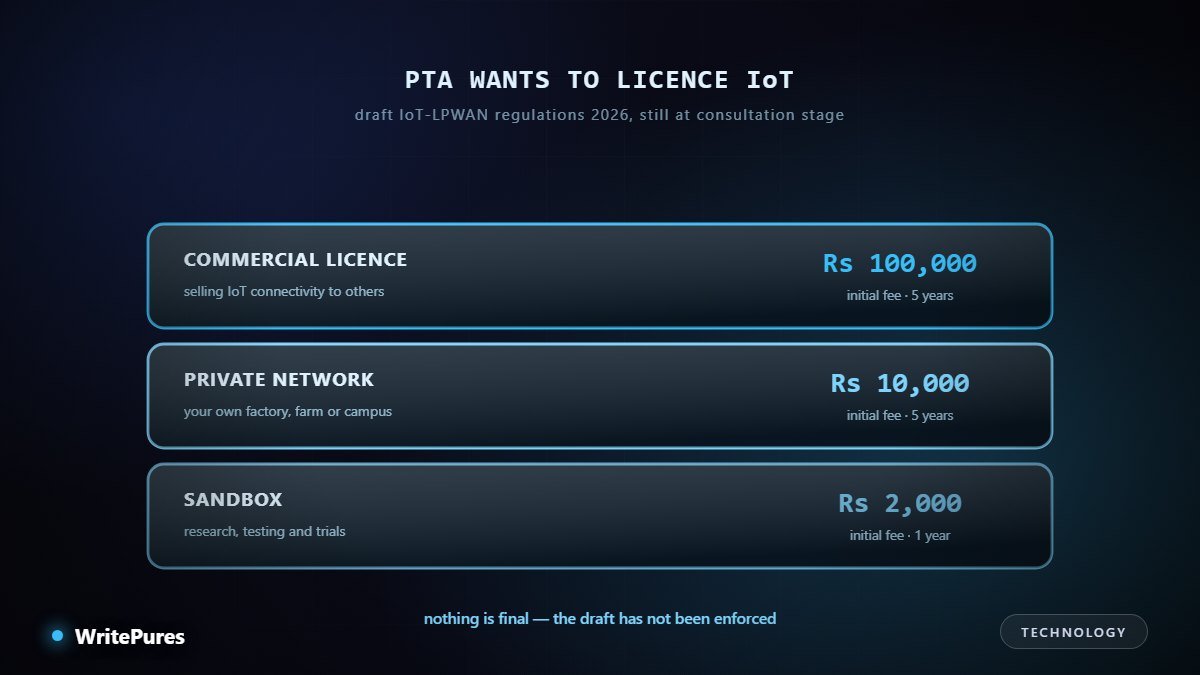
| Category | Who it covers | Initial fee | Term |
|---|---|---|---|
| Commercial licence | Selling IoT connectivity to third parties | Rs 100,000 | 5 years |
| Private network | Your own factory, farm, campus or project site | Rs 10,000 (+ Rs 5,000 processing) | 5 years |
| Platform / application provider | IoT platforms and applications | Rs 10,000 (+ Rs 5,000 processing) | 5 years |
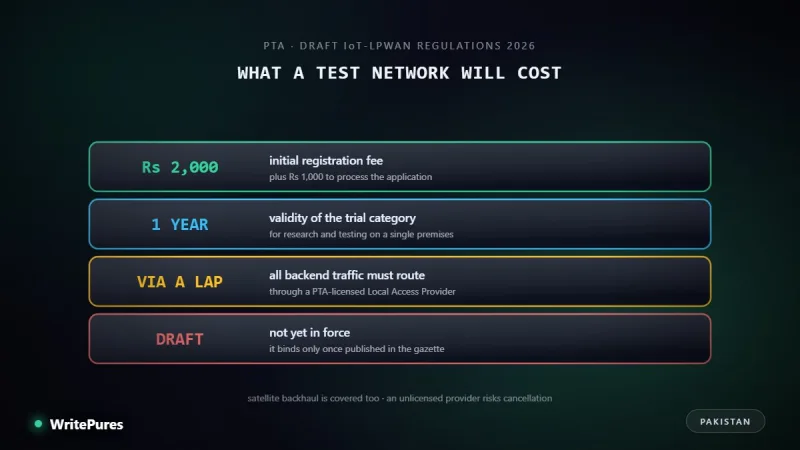
| Regulatory sandbox | Research, development, testing, trials | Rs 2,000 (+ Rs 1,000 processing) | 1 year |
The draft also proposes exemptions for certain categories of IoT activity, though the reporting does not specify which. It is at consultation stage and has not been enforced.
Reading the Fee Structure
The numbers are the most informative part. Rs 100,000 over five years is not a meaningful revenue measure for a regulator, and it is not a barrier to a serious commercial operator. That suggests the intent is visibility rather than extraction — the regulator wants to know who is running networks, not to make a market from licensing them.
The tiering reinforces that reading. A factory running sensors across its own site pays a tenth of the commercial rate, and a university or startup testing something pays Rs 2,000 for a year. Separating "I am selling connectivity" from "I am using connectivity on my own premises" is the right distinction, and getting it wrong is how regulation accidentally kills experimentation.
The sandbox tier in particular is a sensible inclusion. A one-year, cheap, explicitly experimental category gives researchers and early-stage companies a lawful route that does not involve either a commercial licence or operating informally.
Why LPWAN Sits in a Gap
Low power wide area networks exist for devices that send very little data, very occasionally, over long distances, on batteries meant to last years. Water meters. Soil moisture sensors. Container trackers. Streetlight controllers.
Two characteristics make them awkward to regulate. They frequently run on unlicensed or shared spectrum, so no spectrum assignment creates a natural registration point. And they can be deployed by an ordinary company without involving a telecom operator at all — a logistics firm can build a national tracking network without ever appearing in a regulator's records.
That is the gap this draft closes. Whether that is good depends on execution: visibility helps with interference management and security standards, and hurts if registration becomes slow or discretionary.
Why Now
IoT has been deployed in Pakistan for years without a dedicated framework — smart meters, fleet trackers, agricultural sensors and building systems have gone in under general telecom rules or under nothing in particular.
Two pressures tend to force regulators to act. The first is interference: as more devices share the same unlicensed bands, networks begin degrading each other, and nobody can resolve it without knowing who is operating what. The second is security. Connected devices are a well-established weak point in any national network, frequently shipped with default credentials and rarely patched, and a regulator with no register has no way to reach the operators when a flaw emerges.
A licensing framework is the precondition for addressing either. It does not solve them by itself, and a register that exists without enforcement capacity achieves little — but you cannot set device security standards for networks you cannot identify.
Who Should Be Paying Attention
- Agritech companies running sensor networks across farms — likely the private network or platform category.
- Utilities and metering firms, which operate at exactly the scale this is aimed at.
- Logistics and fleet tracking operators.
- Industrial automation vendors deploying on client sites, where whether that counts as private or commercial is a question worth raising during consultation.
- Universities and research groups, for whom the sandbox tier is the relevant provision.
The boundary between "private network" and "commercial service" is the ambiguity most likely to cause disputes later — a vendor who installs and operates a network on a customer's site could plausibly be argued into either box. That is precisely the sort of definitional question consultation exists to settle.
What to Do Now
Consultation is the only stage at which fee levels, definitions and exemptions are still movable. Anyone who would be captured by these rules has far more influence now than after enactment, and the reporting does not state a closing date — so check with PTA directly rather than assuming there is time.
This also arrives alongside other regulatory activity in Pakistani telecoms, including satellite internet licensing and the 5G spectrum rollout. The connected thread is a regulator formalising several categories of network at once.
Key Takeaways
- Draft IoT-LPWAN regulations would make licensing and registration mandatory.
- Rs 100,000 commercial licence, Rs 10,000 private network, Rs 2,000 sandbox.
- Fee levels suggest the goal is visibility, not revenue.
- Consumers using smart devices are not the target.
- Still at consultation — definitions and fees can change, so input now.
Written by the WritePures newsroom. Spotted something that needs updating? Tell our editors.
0 Comments
Join the conversation
Replying toNo comments yet. Be the first to share your thoughts.