
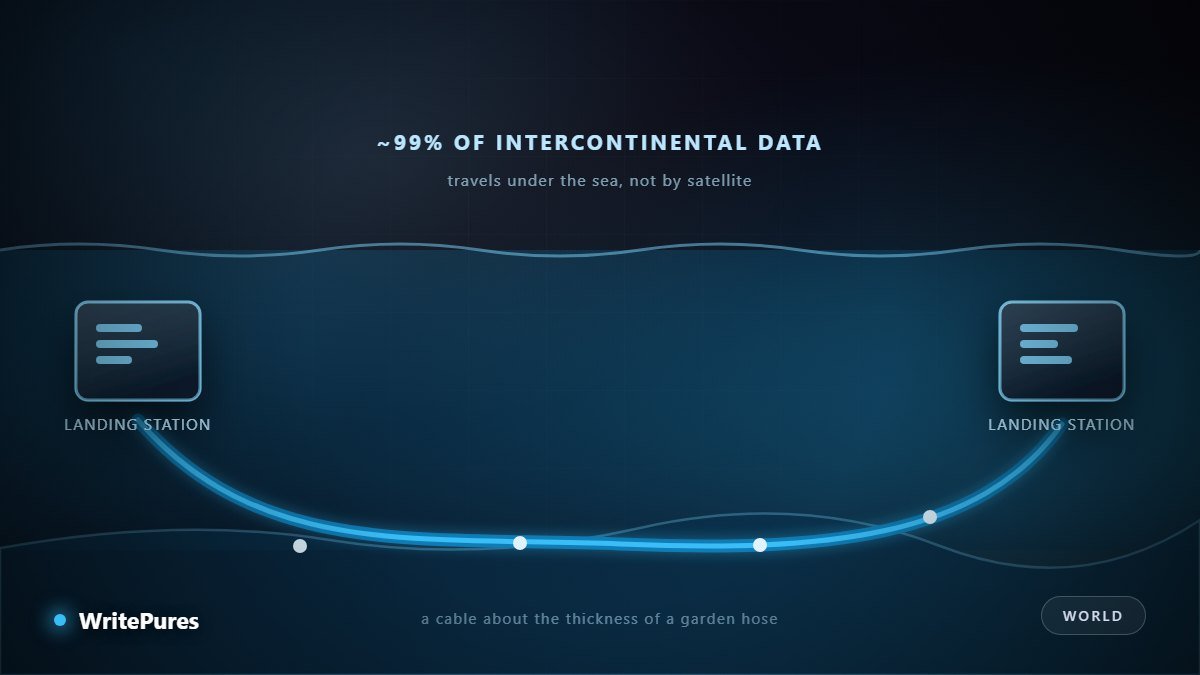
When you load a page hosted on another continent, the request almost certainly travels through a cable lying on the seabed. Not a satellite — a physical strand of glass on the ocean floor, one of a few hundred carrying effectively all intercontinental traffic.
Why the Sea and Not the Sky
The assumption that international internet traffic goes via satellite is among the most common misconceptions about how the internet works. Overwhelmingly, it does not.
Two properties decide it. Capacity: a single modern cable carries an enormous volume of traffic, far beyond what satellite constellations provide, and adding capacity means lighting more wavelengths on glass already laid. Latency: light in fibre takes a direct path along the seabed, while a satellite signal must travel up and back down. For anything interactive — a call, a trade, a game — that difference is noticeable.
Satellites remain essential where cable cannot go: ships, aircraft, disaster zones, sparsely populated regions. They extend the network's edges rather than forming its spine.
What Is Actually Down There
Strip a deep-water cable and you find surprisingly little carrying the data:
- Optical fibres — a small number of hair-thin glass strands at the centre, each carrying many separate wavelengths of light simultaneously.
- A copper conductor — not for data, but to deliver electrical power along the cable.
- Steel armouring and waterproofing — nearly all of the bulk, and all of the weight.
That power matters. Light weakens over distance, so repeaters sit every several tens of kilometres along the route, amplifying the signal. They are powered from shore through the copper conductor, which is why a cable is an electrical system as well as an optical one, and why it must hold up for decades on the seabed without maintenance.
Depth changes the design. In the deep ocean, where nothing much disturbs it, a cable can be comparatively light. On the continental shelf — where trawlers drag nets and ships drop anchor — it is heavily armoured and frequently ploughed into the seabed.
Landing Stations and Chokepoints
A cable comes ashore at a landing station, an unremarkable building where the submarine cable meets terrestrial networks and the repeater power system terminates. These buildings are among the more significant pieces of national infrastructure in most countries, and are rarely identified as such.
Routes concentrate. Geography, politics and the cost of laying cable push traffic through a limited number of corridors, so comparatively narrow stretches of sea carry a disproportionate share of intercontinental capacity. Countries served by only one or two cables are considerably more exposed than those with many diverse routes — which is why cable diversity is a genuine national resilience question and not merely a telecoms procurement one.
Breaks, and Why You Usually Do Not Notice
Cables are damaged regularly — most often by fishing gear and ship anchors, sometimes by undersea landslides or earthquakes. Deliberate damage attracts the most attention and accounts for a small share of incidents.
The network is built to absorb this. Traffic reroutes automatically over alternative paths, so a break in a well-connected region passes unnoticed by users.
The exception is a region with few routes. Then the remaining cables congest, latency rises, and services degrade in ways that feel like a general internet problem. Repair is slow by nature:
- Locate the fault electrically from shore.
- Dispatch a cable repair ship — a small global fleet, sometimes a long way away.
- Grapple the cable from the seabed and raise it.
- Splice in a replacement section and test it.
- Lower it back and, in shallow water, rebury it.
Weeks is normal. Weather, permits and ship availability can extend it considerably.
Who Pays, and Why That Changed
Submarine cables were traditionally funded by consortia of telecom operators, each taking a share of capacity. That model still exists, but the largest content and cloud companies now commission cables directly, because the traffic moving between their own data centres justifies owning the route rather than leasing it.
The effect is more capacity built faster — and a shift in who controls the physical layer of the internet from telecom operators toward a handful of technology firms. For countries evaluating their own connectivity, that is the strategic development worth tracking. Our piece on how global supply chains work covers the same concentration dynamic in physical goods.
Key Takeaways
- Nearly all intercontinental traffic travels by seabed cable, not satellite.
- Most of a cable's bulk is armour and a power conductor; the data rides on hair-thin glass.
- Repeaters powered from shore keep the signal alive across an ocean.
- Breaks are routine and usually invisible — unless a region has few alternative routes.
- Ownership has shifted from telecom consortia toward large technology companies.
Written by the WritePures newsroom. Spotted something that needs updating? Tell our editors.

0 Comments
Join the conversation
Replying toNo comments yet. Be the first to share your thoughts.