

Most students study the way they were taught to by nobody in particular — read the chapter, highlight the important parts, read it again before the exam. It feels productive, and that feeling is the problem. The methods with genuine evidence behind them share one uncomfortable property: they feel harder while you do them.
Why the Popular Methods Fail
Re-reading and highlighting are the two most common study habits and among the least effective. The reason is a trick your brain plays on you called fluency.
The second time you read something, it goes down easily. Nothing surprises you. Your brain interprets that ease as evidence you know the material — but what you have actually built is recognition, the ability to identify the content when it is in front of you. An exam asks for recall, which is producing it when it is not.
Highlighting makes this worse by feeling like work while requiring almost no thought. Deciding a sentence is important is a shallow judgement; it does not force you to engage with what the sentence means.
The Four That Work
1. Retrieval practice — test yourself
The single highest-value change: close the book and try to produce the answer from memory. Flashcards, practice questions, writing out everything you remember on a blank page, explaining a topic aloud.
The act of retrieving strengthens the memory far more than reviewing it does. This is why practice exams are so effective, and it is why the method feels unpleasant — struggling to recall something is the sensation of learning happening.
Do this even before you feel ready. Failing to recall and then checking the answer teaches more than reading the answer first.
2. Spaced repetition — review at increasing intervals
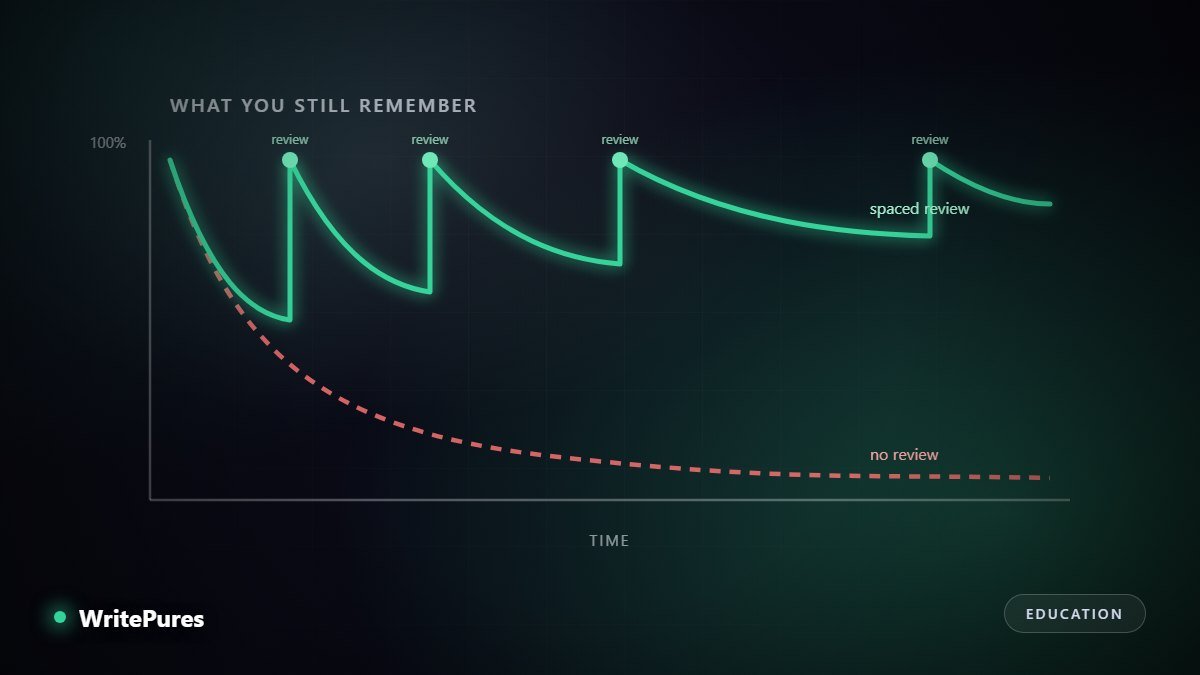
Memory decays steeply at first and then levels off. Each time you review, the decay becomes shallower and the memory lasts longer, which is exactly what the chart at the top of this article shows.
So instead of one long session, review the same material at widening gaps — a day later, then three days, then a week, then a fortnight. Total time spent is the same or less; what you retain is substantially greater. Flashcard applications automate the scheduling, but a simple calendar works.
The corollary matters: cramming is not useless, it is temporary. It can get you through a test tomorrow and will be largely gone in a fortnight, which is why crammed material has to be relearned entirely next year.
3. Interleaving — mix problem types
Doing twenty problems of the same type in a row feels efficient, and performance during the session looks excellent. But after the first few, you are no longer deciding which method applies — you already know. You are practising execution while skipping the harder skill.
Mixing types forces you to identify the problem before solving it, which is what an exam actually requires. Expect to perform worse during practice and better in the exam. That gap is the entire point, and it is why most people abandon the method.
4. Elaboration — explain why
Ask "why is this true?" and "how does this connect to that?" rather than restating the fact. Explain the topic aloud as if teaching someone, in plain language and without notes. The moment you stumble is the precise location of a gap — which is more useful information than any highlighted page.
A Week That Uses All Four
| When | What | Method |
|---|---|---|
| After a lecture | Close everything, write what you remember, then check | Retrieval |
| Next day | Make questions from your notes and answer them | Retrieval + spacing |
| Day three | Mixed problems from several topics | Interleaving |
| End of week | Explain the week's topics aloud, unaided | Elaboration |
| Two weeks on | Revisit the weakest topics only | Spacing |
Practical Points That Matter
- Sleep is part of studying. Memory consolidation happens during sleep; a late night before an exam trades a known benefit for a few extra hours of poor-quality review.
- Put the phone in another room. Having it face-down on the desk still costs attention, because resisting it is itself effortful.
- Study in similar conditions to the exam — quiet, timed, without notes — so the retrieval you practise matches the retrieval you need.
- Track topics, not hours. Hours measure endurance; topics you can explain unaided measure learning.
- Expect it to feel worse. These methods lower how well you perform while practising and raise how much you retain. Judging a method by how smooth it feels will always lead you back to highlighting.
If you are tracking results across a semester, our GPA and CGPA calculator shows how a term's grades move your cumulative average, and free online courses with certificates covers where to practise these methods outside a syllabus.
Key Takeaways
- Re-reading builds recognition; exams require recall. Fluency is a false signal.
- Retrieval practice is the highest-value change you can make.
- Spacing reviews at widening intervals beats one long session for the same total time.
- Interleaving feels worse during practice and performs better in the exam.
- If a method feels easy and smooth, it is probably not working.
Written by the WritePures newsroom. Spotted something that needs updating? Tell our editors.



0 Comments
Join the conversation
Replying toNo comments yet. Be the first to share your thoughts.